- Music → Anne-Sophie Mutter – Meditation (1984)

Anne-Sophie Mutter – Meditation (1984)
1CD | EAC Rip | FLAC(image) + CUE + LOG | 00:49:34 | Cover&Booklet Scans | 241 MB
Genre: Classical, Violin | Label: EMI Classics
More info:
http://www.amazon.com/Anne-Sophie-Mutter-Herbert-von-Karajan/dp/B00064OHQ8
Tracklist:
01. Vivaldi, Antonio / Concerto No. 3 in F, The Four Seasons, Autumn - Allegro [00:04:52]
02. Vivaldi, Antonio / Concerto No. 3 in F, The Four Seasons, Autumn - Adagio [00:02:46]
03. Vivaldi, Antonio / Concerto No. 3 in F, The Four Seasons, Autumn - Allegro [00:03:17]
04. Mozart, Wolfgang Amadeus / Violin Concerto No. 4 in D - Allegro [00:09:24]
05. Mozart, Wolfgang Amadeus / Violin Concerto No. 4 in D - Andante cantabile [00:07:33]
06. Mozart, Wolfgang Amadeus / Violin Concerto No. 4 in D - Rondeau [00:07:18]
07. Massenet, Jules / Meditation from 'Thans' [00:06:42]
08. De Sarasate, Pablo / Zigeunerweisen, Op. 20 [00:07:38]Hotfile:
Download: (Links are interchangeable)
http://hotfile.com/dl/52848243/1a40527/Mutter_m3ditati0n.part1.rar.html
http://hotfile.com/dl/52848248/51e4744/Mutter_m3ditati0n.part2.rar.html
http://hotfile.com/dl/52848250/b0b508e/Mutter_m3ditati0n.part3.rar.html
Fileserve:
http://www.fileserve.com/file/CFuVBvu/Mutter_m3ditati0n.part1.rar
http://www.fileserve.com/file/wdM2Jj7/Mutter_m3ditati0n.part2.rar
http://www.fileserve.com/file/xdRdBFP/Mutter_m3ditati0n.part3.rar
Sharingmatrix:
http://www.sharingmatrix.com/file/11181275/Mutter_m3ditati0n.part1.rar
http://www.sharingmatrix.com/file/11181297/Mutter_m3ditati0n.part2.rar
http://www.sharingmatrix.com/file/11181277/Mutter_m3ditati0n.part3.rar
Friday, October 8, 2010
Anne-Sophie Mutter

Berg's Lulu
Alban Berg: Lulu (Opera in 3 Acts-Original Unfinished Version)


ALBAN BERG (1885-1935)
LULU (Opera in 3 Acts-Original Unfinished Version)
Libretto Alban Berg after Franz Wedekind tragedies Erdergeist & Büchese der Pandora
Cast:
Anneleise Rothenberger
Toni Blakenheim
Gerhard Unger
Kristin Meyer
Erwin Wohlfahrt
Kim Borg
Benno Kusche
Philarmonic Staatsorchester Hamburg
Leopold Ludwig
Disc: 1
1. Prologue
2. Scene One: Darf Ich Eintreten? - Mein Sohn!?Gnadige Frau...Frau Medizinalrat/Sie Bekommen Mich Noch Lange Night/Wie Ist Dir?
3. Scene One: Machen Sie Auf!/Auf Einmal Springt Er Auf/Noch Nicht Wieder Zur Besinnung Gekommen?/Kannst Du Die Wahrheit Sagen?/Ich Mochte Tauschen Mit Dir.../Canon/Wollen Sie Mir Zuhaken
4. Scene Two: Eva! - Befehlen?/Ich Finde, Du Siehst Heute Reizend Aus
5. Scene Two: Den Hab' Ich Mir Auch Ganz Anders Vorgestellt
6. Scene Two: Was Tut Denn Ihr Vater Da?/Wenn Ich Ihr Mann Ware
7. Scene Two: Du Hast Eine Halbe Million Geheiratet
8. Scene Two: Ich Darf Mich Jetzt Hier Nicht Sehen Lassen
9. Scene Two: (Verwandlungsmusik)
10. Scene Three: Seit Ich Fur Buhne Arbeite/Noch Etwas, Bitte
11. Scene Three: Uber Die Liesse Sich.../Ich Hatte Bei Herrn Dr. Schon Das Vergnugen/Sie Hatte Einen Ohnmachtsanfall/Das Hattest Du Dir Besser Erspart
12. Scene Three: Wie Kannst Du Die Szene Gegen Mich Ausspielen/Mein Alter! Meine Welt!/Sehr Geehrtes Fraulein...
Disc: 2
1. Scene One: Sie Glauben Nicht, Wie Ich Mich Darauf Freue/Konntest Du Dich Fur Heute Nachmittag Nicht Freimachen?
2. Scene One: Gott Sei Dank.../Er Hat Sie Namlich Ursprunglich Heiraten Wollen/Hast Du Oben Abgeschlossen?
3. Scene One: Die Matinee Wird...
4. Scene One: Sein Vater! - In Paris Ist.../Wo Ist Denn Der Hin?/Du Kreatur...
5. Scene One: Wenn Sich Die Menschen.../Nieder, Morderin! In Die Knie!/Du Kannst Mich Nicht Dem Bericht Ausliefern!
6. Scene One: Verwandlung (Filmmusik)
7. Scene Two: Er Lasst Auf Sich Warten...
8. Scene Two: Sie Wolten Der Verruckten Rakete.../Mit Wem Habe Ich...Sie?
9. Scene Two: Hu, Kleine Lulu/O Freiheit! Herr Gott Im Himmel!
10. Scene Two: Wenn Deine Beiden Grossen Kinderaugen Nicht Waren/Durch Dieses Kleid Empfinde Ich Deinen Wuchs
11. Variationsmusik
12. Schlussmusik
13. Nein! Morder! Polizei!
NO MIRRORS, DO NOT REUPLOAD TO POST ON OTHER SITES, MY OWN RP OF MY OWN CD, THANKS!!
http://rapidshare.com/files/376544876/AlBeLu.part1.rar
http://rapidshare.com/files/376545064/AlBeLu.part2.rar
http://rapidshare.com/files/376544785/AlBeLu.part3.rar
http://rapidshare.com/files/376544770/AlBeLu.part4.rar
http://rapidshare.com/files/376544918/AlBeLu.part5.rar
Bach & Schumann: WOW!

Johann Sebastian Bach: 6 Sonatas for Violin Solo with Piano Accompaniment by Schumann (1996)
2CD | EAC Rip | FLAC(tracks) + CUE + LOG | 53:28 + 65:30 | No Scans | 530 MB
Genre: Classical | Label: MD&G Records
This CD presents the rarely recorded version of Johann Sebastian Bach's complete solo violin works with piano accompaniment by Robert Schumann. Schumann's piano accompaniment adds a conversational element to the music that I would have sworn I would never have associated with these works. It is a musical conversation across centuries between two great German masters. You should not be worried about Schumann taking over control from Bach - Schumann's added piano part is only accompaniment as the title indicates. Besides this recording emphasizes the violin in the sound picture and places the piano in the background. The playing is good but it doesn't reach John Holloways's (on ECM) metaphysical heights... well, maybe these musicians don't aim for those heights at all... it is more of a human interpretation.
Performers:
Benjamin Schmid, violin
Lisa Smirnova, piano
More info:
http://www.amazon.com/6-Sonatas-Violin-J-S-Bach/dp/B0000021GP
Tracklist:
CD1:
Sonata for solo violin No. 1 in G minor, BWV 1001
01. I. Adagio (3:52)
02. II. Fuga. Allegro (4:37)
03. III. Siciliano (3:05)
04. IV. Presto (2:12)
Partita for solo violin No. 1 in B minor, BWV 1002
05. I. 1. Allemande ... 2. Double (7:41)
06. II. 1. Courante. ... 2. Double. Presto (4:08)
07. III. 1. Sarabande ... 2. Double (3:54)
08. IV. 1. Tempo di Bourree ... 2. Double (4:09)
Sonata for solo violin No. 2 in A minor, BWV 1003
09. I. Grave (3:34)
10. II. Fuga (6:50)
11. III. Andante (5:21)
12. IV. Allegro (3:35)
CD2:
Partita for solo violin No. 2 in D minor, BWV 1004
01. I. Allemande (4:12)
02. II. Courante (2:31)
03. III. Sarabande (3:57)
04. IV. Gigue (3:34)
05. V. Chaconne (12:13)
Sonata for solo violin No. 3 in C major, BWV 1005
06. I. Adagio (4:34)
07. II. Fuga. Alla breve (9:27)
08. III. Largo (3:24)
09. IV. Allegro assai (3:16)
Partita for solo violin No. 3 in E major, BWV 1006
10. I. Preludio (3:12)
11. II. Loure (4:28)
12. III. Gavotte en Rondeau (2:52)
13. IV. 1. Menuet 1 ... 2. Menuet 2 ... 3. Menuet 1 da capo (4:06)
14. V. Bourree (1:21)
15. VI. Gigue (1:50)
Download: (Links are interchangeable)
Recovery Record 5% Added
Hotfile:
CD1
http://hotfile.com/dl/58726735/727fc8a/Bak_6sonat_shuman_D1.part1.rar.html
http://hotfile.com/dl/58726740/a85f27d/Bak_6sonat_shuman_D1.part2.rar.html
http://hotfile.com/dl/58726741/564ae0b/Bak_6sonat_shuman_D1.part3.rar.html
CD2
http://hotfile.com/dl/58726736/bf90701/Bak_6sonat_shuman_D2.part1.rar.html
http://hotfile.com/dl/58726742/1cdf1b8/Bak_6sonat_shuman_D2.part2.rar.html
http://hotfile.com/dl/58726899/a6162d2/Bak_6sonat_shuman_D2.part3.rar.html
http://hotfile.com/dl/58727059/c27d8e7/Bak_6sonat_shuman_D2.part4.rar.html
Fileserve:
CD1
http://www.fileserve.com/file/xGfBFHa/Bak_6sonat_shuman_D1.part1.rar
http://www.fileserve.com/file/wYqxrJT/Bak_6sonat_shuman_D1.part2.rar
http://www.fileserve.com/file/rrvuUmG/Bak_6sonat_shuman_D1.part3.rar
CD2
http://www.fileserve.com/file/aXXpzeJ/Bak_6sonat_shuman_D2.part1.rar
http://www.fileserve.com/file/WmpKjB9/Bak_6sonat_shuman_D2.part2.rar
http://www.fileserve.com/file/KVfq8hA/Bak_6sonat_shuman_D2.part3.rar
http://www.fileserve.com/file/wX8Edec/Bak_6sonat_shuman_D2.part4.rar
Sharingmatrix:
CD1
http://www.sharingmatrix.com/file/15500001/Bak_6sonat_shuman_D1.part1.rar
http://www.sharingmatrix.com/file/15500005/Bak_6sonat_shuman_D1.part2.rar
http://www.sharingmatrix.com/file/15500007/Bak_6sonat_shuman_D1.part3.rar
CD2
http://www.sharingmatrix.com/file/15500021/Bak_6sonat_shuman_D2.part1.rar
http://www.sharingmatrix.com/file/15500029/Bak_6sonat_shuman_D2.part2.rar
http://www.sharingmatrix.com/file/15500045/Bak_6sonat_shuman_D2.part3.rar
http://www.sharingmatrix.com/file/15500049/Bak_6sonat_shuman_D2.part4.rar
Music → Johann Sebastian Bach: 6 Sonatas for Violin Solo with Piano Accompaniment by Schumann (1996)
Robert Schumann - 4 Symphonies
Music → Robert Schumann - 4 Symphonies - Giuseppe Sinopoli & Staatskapelle Dresden (1996) [FLAC]
![Robert Schumann - 4 Symphonies - Giuseppe Sinopoli & Staatskapelle Dresden (1996) [FLAC]](http://img201.imageshack.us/img201/7183/resizedresizedcover.jpg "Robert Schumann - 4 Symphonies - Giuseppe Sinopoli & Staatskapelle Dresden (1996) [FLAC]")
Robert Schumann - 4 Symphonies - Giuseppe Sinopoli & Staatskapelle Dresden [Japan Ed.]
Classical | FLAC(Tracks) | 2 CDs | Tracks: 17 | 135:33 mins | Scans Included | Total ~627 MB
HF.com + ULD.com | Release: 1996 | Language: Neutral | Recovery: 10%
Track list:
Disc 1:
1. Symphony No. 1 in B flat major ('Spring'), Op. 38: 1. Andante un poco maestoso - Allegro molto vivace
2. Symphony No. 1 in B flat major ('Spring'), Op. 38: 2. Larghetto - attacca:
3. Symphony No. 1 in B flat major ('Spring'), Op. 38: 3. Scherzo. Molto vivace - Trio I/II
4. Symphony No. 1 in B flat major ('Spring'), Op. 38: 4. Allegro animato e grazioso
5. Symphony No. 2 in C major, Op. 61: 1. Sostenuto assai - Allegro, ma non troppo
6. Symphony No. 2 in C major, Op. 61: 2. Scherzo. Allegro vivace
7. Symphony No. 2 in C major, Op. 61: 3. Adagio espressivo
8. Symphony No. 2 in C major, Op. 61: 4. Allegro molto vivace
Total: 71:47
Disc 2:
1. Symphony No. 3 in E flat major ('Rhenish'), Op. 97: 1. Lebhaft
2. Symphony No. 3 in E flat major ('Rhenish'), Op. 97: 2. Scherzo. Sehr mäßig
3. Symphony No. 3 in E flat major ('Rhenish'), Op. 97: 3. Nicht schnell
4. Symphony No. 3 in E flat major ('Rhenish'), Op. 97: 4. Feierlich
5. Symphony No. 3 in E flat major ('Rhenish'), Op. 97: 5. Lebhaft
6. Symphony No. 4 in D minor, Op. 120: 1. Ziemlich langsam - Lebhaft - attacca:
7. Symphony No. 4 in D minor, Op. 120: 2. Romanze. Ziemlich langsam - attacca:
8. Symphony No. 4 in D minor, Op. 120: 3. Scherzo. Lebhaft - Trio - attacca:
9. Symphony No. 4 in D minor, Op. 120: 4. Langsam - Lebhaft - Schneller - Presto
Total: 63:46
Download (Hotfile.com) :
http://hotfile.com/dl/33288526/38e7200/SS2CD.part1.rar.html
http://hotfile.com/dl/33288923/de09a2c/SS2CD.part2.rar.html
http://hotfile.com/dl/33289364/9d49efc/SS2CD.part3.rar.html
http://hotfile.com/dl/33290514/3495e44/SS2CD.part4.rar.html
http://hotfile.com/dl/33290003/cd174fe/SS2CD.part5.rar.html
http://hotfile.com/dl/33290417/a392edf/SS2CD.part6.rar.html
http://hotfile.com/dl/33290537/9bfa9ff/SS2CD.part7.rar.html
Mirror (Uploading.com) :
http://uploading.com/files/3d7cm8ed/SS2CD.part1.rar/
http://uploading.com/files/7cmabdd2/SS2CD.part2.rar/
http://uploading.com/files/a25f5123/SS2CD.part3.rar/
http://uploading.com/files/d4a97mm2/SS2CD.part4.rar/
http://uploading.com/files/369edm24/SS2CD.part5.rar/
http://uploading.com/files/emfmeea6/SS2CD.part6.rar/
http://uploading.com/files/m7d7535e/SS2CD.part7.rar/
Georg Heym's The Morgue
Silently on their soles the wardens slip
Where through the cloth white skulls gleam in the bins.
We dead ones gather for the final trip
Through deserts wide and sea and winter winds.
We are enthroned on high bald catafalques,
We lie with black rags hideously spanned,
The mortar falls. And from the ceiling's balks
A Christ is stretching toward us his large hands.
Gone by is our time. And done the rite.
We are beneath. Look how we now are dead.
In white eyes dwells for us already night,
Not evermore we see a morn rise red.
Step backward from our majesty away,
And do not touch us who can now espy
The land in winter wide, where shadows stay
Whose blackened shoulders hide the evening !sky.
You who like dwarfs are shriveled up and shrunken,
You who are lying wrinkled on our knee,
We grew above you, we like mountains high,
As great as gods, to night's eternity.
With candles are we laughably bedecked,
We whom they once from hollow corners drew
Still grunting, now, see, our chests are flecked
With blue over which at night the deathbird flew.
We kings who, dangling, have been cut from trees
From whirring air, the kingdom of the wings,
And some who glided deep through many reeds;
An animal white, its eyes like round soft rings.
Thrown up by autumn. Foul fruit of the years,
At summer to the holes of gutters swept
The fallow spider of July heat crept.
Do we now rest forgotten in the mute tower?
And shall we as a wave in Lethe flow?
Or tossed round chimneys by the winter shower
Like jackdaws riding on the fire glow?
Shall we be flowers? Shall we turn into birds,
In azure's pride, in wide seas' angry mood?
Or will we wander in the depth of the earths
As moles and mute in the dead !solitude ?
Shall we be dwellers in the locks of dawn,
Or bloom in trees, slumber in fruits at day,
Blue dragon flies over sea anemones
Trembling at midday in a silent bay?
Shall we be like a word by no one heard?
Or smoke that flutters in an evening beam?
A cry by which a joyful man is stirred?
Or a beacon at night? Or a dream? . . .
We unknown beings, poor and without names,
We died in empty cellars - you
Why do you call us with our burnt-out flames,
Why trouble this our happy rendezvous?
See him there out of whose large mouth unhinged
Gray laughter in a mirthful chuckle ran,
And on his chest his long long tongue is crimped,
He laughs at you, that husky pelican.
And he will bite you, for he was a guest
Of fishes many weeks. Smell how he stinks,
Look, in his hair a snail still has its nest
That mockingly at you with feelers winks.
- A little bell -. And we are moving out.
To us on blackened hands will darkness creep,
In loneliness we rest in the vast house,
And countless coffins on high walls are deep.
Will he not come? We have the shrouds all on,
And death shoes too, and all of us are fed.
Where is the Prince, he whol will lead us on,
Whose large flag marches, when we go, ahead?
Where will his loud voice blow for us its tone?
Into what twilight's dusks shall we now fly?
Forsaken stand in solitude alone
Before what empty heavens' scorn and lie?
Eternal stillness. What was life before
Now weathers and decays in blackened gloom.
The wind of death that now leaves our door,
The dark lungs filled with dust from this our tomb,
Heavily breathes outside where rustles rain,
Dull-toned and far, like music in the ear
That darkly listens to the storm at night,
And through the house run calls full-voiced and blear.
And our festering's blue and shining halo
Is kindled over our face, a light.
A rat hops over our naked toe,
Come on, we have enough for you to bite.
Once we set forth begirded as are giants,
Each one was clanking just like a Goliath.
Now we have only mice as satellites,
And all our flesh became lean maggots' path.
We, Icarides, who with their once white wings,
Have blustered once in the blue storm of light,
We could still hear what the great towers sing,
When we rushed headlong into black death's night.
On distant plains of the lost heavenly lands,
On oceans wide where far the billow went,
We proudly flew in the red brand of dusk
With sails so large, which storm and weather bent.
What did we find in beams of heavens' ends?
An empty nothing. Slack are now our feet,
Just like a cent that in his empty hands
A beggar rattles at the edge of streets.
The Lord still waits? The house with us abounds,
The chambers round the caravanseray,
The market of the dead, whose bones did sound
Like comets into the deserts loud away.
Die Morgue
Die Wärter schleichen auf den Sohlen leise,
Wo durch das Tuch es weiß von Schädeln blinkt.
Wir, Tote, sammeln uns zur letzten Reise
Durch Wüsten weit und Meer und Winterwind.
Wir thronen hoch auf kahlen Katafalken,
Mit schwarzen Lappen garstig überdeckt.
Der Mörtel fällt. Und aus der Decke Balken
Auf uns ein Christus große Hände streckt.
Vorbei ist unsre Zeit. Es ist vollbracht.
Wir sind herunter. Seht, wir sind nun tot.
In weißen Augen wohnt uns schon die Nacht,
Wir schauen nimmermehr ein Morgenrot.
Tretet zurück von unserer Majestät.
Befaßt uns nicht, die schon das Land erschaun
Im Winter weit, davor ein Schatten steht,
Des schwarze Schulter ragt im Abendgraun.
Ihr, die ihr eingeschrumpft wie Zwerge seid,
Ihr, die ihr runzelig liegt auf unserm Schoß,
Wir wuchsen über euch wie Berge weit
In ewige Todes-Nacht, wie Götter groß.
Mit Kerzen sind wir lächerlich umsteckt,
Wir, die man früh aus dumpfen Winkeln zog
Noch grunzend, unsre Brust schon blau gefleckt,
Die nachts der Totenvogel überflog.
Wir Könige, die man aus Bäumen schnitt,
Aus wirrer Luft im Vogel-Königreich,
Und mancher, der schon tief durch Röhricht glitt,
Ein weißes Tier, mit Augen rund und weich.
Vom Herbst verworfen. Faule Frucht der Jahre,
Zerronnen sommers in der Gossen Loch,
Wir, denen langsam auf dem kahlen Haare
Der Julihitze weiße Spinne kroch.
Wir, Namenlose, arme Unbekannte,
In leeren Kellern starben wir allein.
Was ruft ihr uns, da unser Licht verbrannte,
Was stört ihr unser frohes Stell-Dich-Ein?
Seht den dort, der ein graues Lachen stimmt
Auf dem zerfallnen Munde fröhlich an,
Der auf die Brust die lange Zunge krümmt,
Er lacht euch aus, der große Pelikan.
Er wird euch beißen. Viele Wochen war
Er Gast bei Fischen. Riecht doch wie er stinkt.
Seht, eine Schnecke wohnt ihm noch im Haar,
Die spöttisch euch mit kleinem Fühler winkt.
- Ein kleines Glöckchen -. Und sie ziehen aus.
Das Dunkel kriecht herein auf schwarzer Hand.
Wir ruhen einsam nun im weiten Haus,
Unzählige Särge tief an hoher Wand.
Ewige Stille. Und des Lebens Rest
Zerwittert und zerfällt in schwarzer Luft.
Des Todes Wind, der unsre Tür verläßt,
Die dunkle Lunge voll vom Staub der Gruft,
Er atmet schwer hinaus, wo Regen rauscht,
Eintönig, fern, Musik in unserm Ohr,
Das dunkel in die Nacht dem Sturme lauscht,
Der ruft im Hause traurig und sonor.
Und der Verwesung blauer Glorienschein
Entzündet sich auf unserm Angesicht.
Ein Ratte hopst auf nacktem Zehenbein,
Komm nur, wir stören deinen Hunger nicht.
Wir zogen aus, gegürtet wie Giganten,
Ein jeder klirrte wie ein Goliath.
Nun haben wir die Mäuse zu Trabanten,
Und unser Fleisch ward dürrer Maden Pfad.
Wir, Ikariden, die mit weißer Schwinge
Im blauen Sturm des Lichtes einst gebraust,
Wir hörten noch der großen Türme Singen,
Da rücklings wir in schwarzen Tod gesaust.
Im fernen Plan verlorner Himmelslande,
Im Meere weit, wo fern die Woge flog,
Wir flogen stolz in Abendrotes Brande
Mit Segeln groß, die Sturm und Wetter bog.
Was fanden wir im Glanz der Himmelsenden?
Ein leeres Nichts. Nun schlappt uns das Gebein,
Wie einen Pfennig in den leeren Händen
Ein Bettler klappern läßt am Straßenrain.
Was wartet noch der Herr? Das Haus ist voll,
Die Kammern rings der Karawanserei,
Der Markt der Toten, der von Knochen scholl,
Wie Zinken laut hinaus zur Wüstenei.
Was kommt er nicht? Wir haben Tücher an
Und Totenschuhe. Und wir sind gespeist.
Wo ist der Fürst, der wandert uns voran,
Des große Fahne vor dem Zuge reist?
Wo wird uns seine laute Stimme wehen?
In welche Dämmerung geht unser Flug?
Verlassen in der Einsamkeit zu stehen
Vor welcher leeren Himmel Hohn und Trug?
Ruhen wir uns aus im stummen Turm, vergessen?
Werden wir Welle einer Lethe sein?
Oder, daß Sturm uns treibt um Winteressen,
Wie Dohlen reitend auf dem Feuerschein?
Werden wir Blumen sein? Werden wir Vögel werden,
Im Stolze des Blauen, im Zorne der Meere weit?
Werden wir wandern in den tiefen Erden,
Maulwürfe stumm in toter Einsamkeit?
Werden wir in den Locken der Frühe wohnen,
Werden wir blühen im Baum, und schlummern in Frucht,
Oder Libellen blau auf den See-Anemonen
Zittern am Mittag in schweigender Wasser Bucht?
Werden wir sein, wie ein Wort von niemand gehöret?
Oder ein Rauch, der flattert im Abendraum?
Oder ein Weinen, das plötzlich Freudige störet?
Oder ein Leuchter zur Nacht? Oder ein Traum?
Oder - wird niemand kommen?
Und werden wir langsam zerfallen,
In dem Gelächter des Monds,
Der hoch über Wolken saust,
Zerbröckeln in Nichts,
- Daß ein Kind kann zerballen
Unsere Größe dereinst
In der dürftigen Faust.
The Expressionism of Georg Heym: A Note and Two Translations
Author(s): Werner VordtriedeSource: Wisconsin Studies in Contemporary Literature, Vol. 4, No. 3, Studies of RecentBritish & Continental Literature (Autumn, 1963), pp. 284-297Published by: University of Wisconsin PressStable URL: http://www.jstor.org/stable/1207280Accessed: 05/10/2010 15:06
Where through the cloth white skulls gleam in the bins.
We dead ones gather for the final trip
Through deserts wide and sea and winter winds.
We are enthroned on high bald catafalques,
We lie with black rags hideously spanned,
The mortar falls. And from the ceiling's balks
A Christ is stretching toward us his large hands.
Gone by is our time. And done the rite.
We are beneath. Look how we now are dead.
In white eyes dwells for us already night,
Not evermore we see a morn rise red.
Step backward from our majesty away,
And do not touch us who can now espy
The land in winter wide, where shadows stay
Whose blackened shoulders hide the evening !sky.
You who like dwarfs are shriveled up and shrunken,
You who are lying wrinkled on our knee,
We grew above you, we like mountains high,
As great as gods, to night's eternity.
With candles are we laughably bedecked,
We whom they once from hollow corners drew
Still grunting, now, see, our chests are flecked
With blue over which at night the deathbird flew.
We kings who, dangling, have been cut from trees
From whirring air, the kingdom of the wings,
And some who glided deep through many reeds;
An animal white, its eyes like round soft rings.
Thrown up by autumn. Foul fruit of the years,
At summer to the holes of gutters swept
The fallow spider of July heat crept.
Do we now rest forgotten in the mute tower?
And shall we as a wave in Lethe flow?
Or tossed round chimneys by the winter shower
Like jackdaws riding on the fire glow?
Shall we be flowers? Shall we turn into birds,
In azure's pride, in wide seas' angry mood?
Or will we wander in the depth of the earths
As moles and mute in the dead !solitude ?
Shall we be dwellers in the locks of dawn,
Or bloom in trees, slumber in fruits at day,
Blue dragon flies over sea anemones
Trembling at midday in a silent bay?
Shall we be like a word by no one heard?
Or smoke that flutters in an evening beam?
A cry by which a joyful man is stirred?
Or a beacon at night? Or a dream? . . .
We unknown beings, poor and without names,
We died in empty cellars - you
Why do you call us with our burnt-out flames,
Why trouble this our happy rendezvous?
See him there out of whose large mouth unhinged
Gray laughter in a mirthful chuckle ran,
And on his chest his long long tongue is crimped,
He laughs at you, that husky pelican.
And he will bite you, for he was a guest
Of fishes many weeks. Smell how he stinks,
Look, in his hair a snail still has its nest
That mockingly at you with feelers winks.
- A little bell -. And we are moving out.
To us on blackened hands will darkness creep,
In loneliness we rest in the vast house,
And countless coffins on high walls are deep.
Will he not come? We have the shrouds all on,
And death shoes too, and all of us are fed.
Where is the Prince, he whol will lead us on,
Whose large flag marches, when we go, ahead?
Where will his loud voice blow for us its tone?
Into what twilight's dusks shall we now fly?
Forsaken stand in solitude alone
Before what empty heavens' scorn and lie?
Eternal stillness. What was life before
Now weathers and decays in blackened gloom.
The wind of death that now leaves our door,
The dark lungs filled with dust from this our tomb,
Heavily breathes outside where rustles rain,
Dull-toned and far, like music in the ear
That darkly listens to the storm at night,
And through the house run calls full-voiced and blear.
And our festering's blue and shining halo
Is kindled over our face, a light.
A rat hops over our naked toe,
Come on, we have enough for you to bite.
Once we set forth begirded as are giants,
Each one was clanking just like a Goliath.
Now we have only mice as satellites,
And all our flesh became lean maggots' path.
We, Icarides, who with their once white wings,
Have blustered once in the blue storm of light,
We could still hear what the great towers sing,
When we rushed headlong into black death's night.
On distant plains of the lost heavenly lands,
On oceans wide where far the billow went,
We proudly flew in the red brand of dusk
With sails so large, which storm and weather bent.
What did we find in beams of heavens' ends?
An empty nothing. Slack are now our feet,
Just like a cent that in his empty hands
A beggar rattles at the edge of streets.
The Lord still waits? The house with us abounds,
The chambers round the caravanseray,
The market of the dead, whose bones did sound
Like comets into the deserts loud away.
Die Morgue
Die Wärter schleichen auf den Sohlen leise,
Wo durch das Tuch es weiß von Schädeln blinkt.
Wir, Tote, sammeln uns zur letzten Reise
Durch Wüsten weit und Meer und Winterwind.
Wir thronen hoch auf kahlen Katafalken,
Mit schwarzen Lappen garstig überdeckt.
Der Mörtel fällt. Und aus der Decke Balken
Auf uns ein Christus große Hände streckt.
Vorbei ist unsre Zeit. Es ist vollbracht.
Wir sind herunter. Seht, wir sind nun tot.
In weißen Augen wohnt uns schon die Nacht,
Wir schauen nimmermehr ein Morgenrot.
Tretet zurück von unserer Majestät.
Befaßt uns nicht, die schon das Land erschaun
Im Winter weit, davor ein Schatten steht,
Des schwarze Schulter ragt im Abendgraun.
Ihr, die ihr eingeschrumpft wie Zwerge seid,
Ihr, die ihr runzelig liegt auf unserm Schoß,
Wir wuchsen über euch wie Berge weit
In ewige Todes-Nacht, wie Götter groß.
Mit Kerzen sind wir lächerlich umsteckt,
Wir, die man früh aus dumpfen Winkeln zog
Noch grunzend, unsre Brust schon blau gefleckt,
Die nachts der Totenvogel überflog.
Wir Könige, die man aus Bäumen schnitt,
Aus wirrer Luft im Vogel-Königreich,
Und mancher, der schon tief durch Röhricht glitt,
Ein weißes Tier, mit Augen rund und weich.
Vom Herbst verworfen. Faule Frucht der Jahre,
Zerronnen sommers in der Gossen Loch,
Wir, denen langsam auf dem kahlen Haare
Der Julihitze weiße Spinne kroch.
Wir, Namenlose, arme Unbekannte,
In leeren Kellern starben wir allein.
Was ruft ihr uns, da unser Licht verbrannte,
Was stört ihr unser frohes Stell-Dich-Ein?
Seht den dort, der ein graues Lachen stimmt
Auf dem zerfallnen Munde fröhlich an,
Der auf die Brust die lange Zunge krümmt,
Er lacht euch aus, der große Pelikan.
Er wird euch beißen. Viele Wochen war
Er Gast bei Fischen. Riecht doch wie er stinkt.
Seht, eine Schnecke wohnt ihm noch im Haar,
Die spöttisch euch mit kleinem Fühler winkt.
- Ein kleines Glöckchen -. Und sie ziehen aus.
Das Dunkel kriecht herein auf schwarzer Hand.
Wir ruhen einsam nun im weiten Haus,
Unzählige Särge tief an hoher Wand.
Ewige Stille. Und des Lebens Rest
Zerwittert und zerfällt in schwarzer Luft.
Des Todes Wind, der unsre Tür verläßt,
Die dunkle Lunge voll vom Staub der Gruft,
Er atmet schwer hinaus, wo Regen rauscht,
Eintönig, fern, Musik in unserm Ohr,
Das dunkel in die Nacht dem Sturme lauscht,
Der ruft im Hause traurig und sonor.
Und der Verwesung blauer Glorienschein
Entzündet sich auf unserm Angesicht.
Ein Ratte hopst auf nacktem Zehenbein,
Komm nur, wir stören deinen Hunger nicht.
Wir zogen aus, gegürtet wie Giganten,
Ein jeder klirrte wie ein Goliath.
Nun haben wir die Mäuse zu Trabanten,
Und unser Fleisch ward dürrer Maden Pfad.
Wir, Ikariden, die mit weißer Schwinge
Im blauen Sturm des Lichtes einst gebraust,
Wir hörten noch der großen Türme Singen,
Da rücklings wir in schwarzen Tod gesaust.
Im fernen Plan verlorner Himmelslande,
Im Meere weit, wo fern die Woge flog,
Wir flogen stolz in Abendrotes Brande
Mit Segeln groß, die Sturm und Wetter bog.
Was fanden wir im Glanz der Himmelsenden?
Ein leeres Nichts. Nun schlappt uns das Gebein,
Wie einen Pfennig in den leeren Händen
Ein Bettler klappern läßt am Straßenrain.
Was wartet noch der Herr? Das Haus ist voll,
Die Kammern rings der Karawanserei,
Der Markt der Toten, der von Knochen scholl,
Wie Zinken laut hinaus zur Wüstenei.
Was kommt er nicht? Wir haben Tücher an
Und Totenschuhe. Und wir sind gespeist.
Wo ist der Fürst, der wandert uns voran,
Des große Fahne vor dem Zuge reist?
Wo wird uns seine laute Stimme wehen?
In welche Dämmerung geht unser Flug?
Verlassen in der Einsamkeit zu stehen
Vor welcher leeren Himmel Hohn und Trug?
Ruhen wir uns aus im stummen Turm, vergessen?
Werden wir Welle einer Lethe sein?
Oder, daß Sturm uns treibt um Winteressen,
Wie Dohlen reitend auf dem Feuerschein?
Werden wir Blumen sein? Werden wir Vögel werden,
Im Stolze des Blauen, im Zorne der Meere weit?
Werden wir wandern in den tiefen Erden,
Maulwürfe stumm in toter Einsamkeit?
Werden wir in den Locken der Frühe wohnen,
Werden wir blühen im Baum, und schlummern in Frucht,
Oder Libellen blau auf den See-Anemonen
Zittern am Mittag in schweigender Wasser Bucht?
Werden wir sein, wie ein Wort von niemand gehöret?
Oder ein Rauch, der flattert im Abendraum?
Oder ein Weinen, das plötzlich Freudige störet?
Oder ein Leuchter zur Nacht? Oder ein Traum?
Oder - wird niemand kommen?
Und werden wir langsam zerfallen,
In dem Gelächter des Monds,
Der hoch über Wolken saust,
Zerbröckeln in Nichts,
- Daß ein Kind kann zerballen
Unsere Größe dereinst
In der dürftigen Faust.
The Expressionism of Georg Heym: A Note and Two Translations
Author(s): Werner VordtriedeSource: Wisconsin Studies in Contemporary Literature, Vol. 4, No. 3, Studies of RecentBritish & Continental Literature (Autumn, 1963), pp. 284-297Published by: University of Wisconsin PressStable URL: http://www.jstor.org/stable/1207280Accessed: 05/10/2010 15:06
Thursday, October 7, 2010
Hans Knappertsbusch conducting Wagner
Prelude (8:47)
Download (mp3)
Act 1 (1:10:01)
Download (mp3)
Act 2 (1:00:04)
Download (mp3)
Act 3 (1:11:01)
Download (mp3)
Act 4 (49:15)
Download (mp3)
And this is Furt...
Act 1 (1:12:28)
Download (mp3)
Act 2 (1:02:17)
Download (mp3)
Act 3 In the first half (1:09:00)
Download (mp3)
Act 3 In the latter half (43:27)
Download (mp3)
Download (mp3)
Act 1 (1:10:01)
Download (mp3)
Act 2 (1:00:04)
Download (mp3)
Act 3 (1:11:01)
Download (mp3)
Act 4 (49:15)
Download (mp3)
And this is Furt...
Act 1 (1:12:28)
Download (mp3)
Act 2 (1:02:17)
Download (mp3)
Act 3 In the first half (1:09:00)
Download (mp3)
Act 3 In the latter half (43:27)
Download (mp3)
Furtwängler conducting Wagner
Prelude (10:58)
Download (mp3)
Act 1 Scene 1 (6:27)
Download (mp3)
Act 1 Scene 2 (10:11)
Download (mp3)
Act 1 Scene 3 (21:44)
Download (mp3)
Act 1 Scene 4 (8:17)
Download (mp3)
Act 1 Scene 5 (27:50)
Download (mp3)
Act 2 Scene 1 (16:26)
Download (mp3)
Act 2 Scene 2 (44:18)
Download (mp3)
Act 2 Scene 3 (25:43)
Download (mp3)
Act 3 Scene 1 (55:44)
Download (mp3)
Act 3 Scene 2 (10:15)
Download (mp3)
Act 3 Scene 3 (16:48)
Download (mp3)
Download (mp3)
Act 1 Scene 1 (6:27)
Download (mp3)
Act 1 Scene 2 (10:11)
Download (mp3)
Act 1 Scene 3 (21:44)
Download (mp3)
Act 1 Scene 4 (8:17)
Download (mp3)
Act 1 Scene 5 (27:50)
Download (mp3)
Act 2 Scene 1 (16:26)
Download (mp3)
Act 2 Scene 2 (44:18)
Download (mp3)
Act 2 Scene 3 (25:43)
Download (mp3)
Act 3 Scene 1 (55:44)
Download (mp3)
Act 3 Scene 2 (10:15)
Download (mp3)
Act 3 Scene 3 (16:48)
Download (mp3)

Wednesday, October 6, 2010
 Download
Tuesday, October 5, 2010
Hölderlin (IV, 246)
"… und darum ist der Güter Gefährlichstes, die Sprache dem Menschen gegeben[*], damit er schaffend, zerstörend, und untergehened, und wiederkehrend zur ewiglebenden, zur Meisterin und Mutter, damit er zeuge, was er sei / geerbt zu haben, gelernt von ihr, ihr Göttlichstes, die allerhaltende Liebe."
- Friedrich Hölderlin, betitelt mit "Im Walde" nach der Großen Stuttgarter Ausgabe, Bd.2.1, S.325; Betitelung, Zuordnung und Genese jedoch sehr umstritten
* "...that is why language, the most dangerous of goods, has been given to man ... so that he may bear witness to what he is...."
* "...y por consiguiente es el más peligroso de los bienes, el lenguaje dado a los hombres..."
- Friedrich Hölderlin, betitelt mit "Im Walde" nach der Großen Stuttgarter Ausgabe, Bd.2.1, S.325; Betitelung, Zuordnung und Genese jedoch sehr umstritten
* "...that is why language, the most dangerous of goods, has been given to man ... so that he may bear witness to what he is...."
* "...y por consiguiente es el más peligroso de los bienes, el lenguaje dado a los hombres..."
Monday, October 4, 2010
Sunday, October 3, 2010
A Surprising Statement
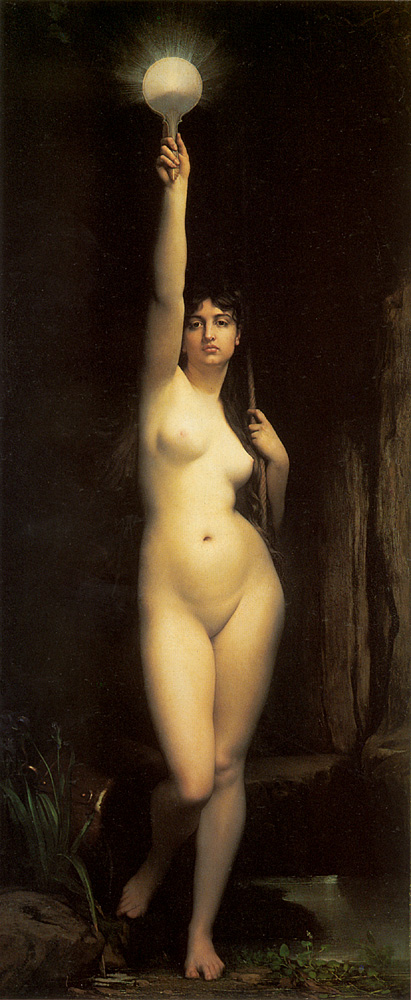
La Verite (1870) by Jules-Joseph Lefebvre (1836-1911)
If this amazing splendor is Truth
Why do we still mistrust her?
Visit: French Anglo Saxon Venus: Lady Godiva by Jules-Joseph Lefebvre
Saturday, October 2, 2010
Movie Review
Feuerreiter (1998)
reviewed by
Steve Rhodes
RIDER OF THE FLAMES
A film review by Steve Rhodes
Copyright 1999 Steve Rhodes
RATING (0 TO ****):  ***
It's almost the turn of the century -- no, not this century. In RIDER OF THE FLAMES (FEUERREITER), it's 1796, and the famous German poet, Friedrich Hölderlin, played with haunting melancholy by Martin Feifel, is madly in love with Susette Gontard (Marianne Denicourt), who shares his passion.
But Hölderlin has a problem. Two actually.
First of all, Susette is a happily married woman who has four delightful young children. She lives with her husband, Jakob (Ulrich Mühe), in their lavish mansion, full of servants. Asking her to give all of this up and run away with him, as he does, is like asking the cow to jump over the proverbial moon.
Second, while Hölderlin, a poor poet who has little success in selling his writings, has the requisite wealthy patron, Baron Isaac von Sinclair (Ulrich Matthes), the Baron is infatuated with Hölderlin and has no desire to share him with Susette.
The story starts in 1802 at Susette's deathbed but quickly flashes back to the first time the poet sees the love of his life. In a movie gorgeously filmed by Egon Werdin, the occasion of their first encounter is pure magic. She is backlit by bright, white fireworks that dazzle against a royal blue background. Throughout the rest of the movie, the male lead's beauty outshines the female's, but not in this scene, in which she looks like something sent from heaven. (Hölderlin, with his long, curly hair and striking beauty, looks like a model for the cover of one of those romance novels known as "bodice rippers.")
Hölderlin arranges to get himself hired as a tutor to his would-be lover's son so that he can be near her. He succeeds but is in agony until he can win her heart. After he does, he comes to even more grief, as he becomes painfully aware that getting her to leave her husband, for whom she has genuine affection, is extremely difficult at best.
Writer Susanne Schneider does a masterful job of naturally weaving in passages of Hölderlin's poetry without it ever sounding stilted or forced. Looking terminally sad, he reads his poetry about Susette ("My soul to song had fallen silent") and reflects on the hopelessness of their love affair. At one point, he covers himself in papers on which he has written poems about her so that he can feel her. "Everything that mankind has ever done is naught compared to a single moment of love," Hölderlin declares, having a terminal case of love for the essentially unobtainable.
As directed by Nina Grosse, the lavish costume drama makes careful choices about what to explain and what to just let happen. The entire story has a war as the backdrop. Exactly who is fighting whom and why is left unexplained.
The war causes Jakob to send his wife and children away with Hölderlin to look after them. This violates a husband's first rule: Do not entrust your wife for safekeeping to someone who looks like Antonio Banderas. The precise results are unpredictable but almost certainly undesirable -- at least for the husband.
The only problem with the film comes from the director's falling in love with her work. At almost two and one quarter hours, the movie sags when a little judicious pruning would have kept the focus. And after a logical conclusion right after Susette's death, the movie continues on with a anticlimactic and overlong epilogue that would have been better handled in a written explanation in the closing credits. These faults are minor, however, and detract little from the success of this picture of tragic romance.
RIDER OF THE FLAMES runs 2:12. The film is in German with English subtitles. It is not rated but would probably be an R for very brief sex, nudity and violence. It would be fine for teenagers.
The film, which was released last month in Germany, will be the opening night film at the 4th annual "Berlin and Beyond Film Festival" at the Castro Theater in San Francisco (January 15-21, 1999).
Email: Steve.Rhodes@InternetReviews.com Web: www.InternetReviews.com
The review above was posted to the rec.arts.movies.reviews newsgroup (de.rec.film.kritiken for German reviews).
The Internet Movie Database accepts no responsibility for the contents of the review and has no editorial control. Unless stated otherwise, the copyright belongs to the author.
Please direct comments/criticisms of the review to relevant newsgroups.
Broken URLs in the reviews are the responsibility of the author.
The formatting of the review is likely to differ from the original due to ASCII to HTML conversion.
Related links: index of all rec.arts.movies.reviews reviews
The Internet Movie Database accepts no responsibility for the contents of the review and has no editorial control. Unless stated otherwise, the copyright belongs to the author.
Please direct comments/criticisms of the review to relevant newsgroups.
Broken URLs in the reviews are the responsibility of the author.
The formatting of the review is likely to differ from the original due to ASCII to HTML conversion.
Johann Christian Friedrich Hölderlin (1770-1843)
[Taken from here]
 Although J. C. F. Hölderlin has, since the beginning of the twentieth century, enjoyed the reputation of being one of Germany’s greatest poets, his recognition as an important philosophical figure is more recent. The revival of an interest in German Idealism, and the philosophical developments from Kant’s critical period to Hegel’s mature thought, have ensured that Hölderlin is given his due for his important philosophical insights. Hölderlin’s life was marked by theological training, together with Hegel and Schelling, followed by a period of simultaneous philosophical and poetic activity. Eventually, Hölderlin concentrated on poetry as a superior form of access to the truth. His theoretical philosophy is marked by an anti-foundationalist rebuttal of Fichte’s first principle. The key idea is that nothing can be said about what grounds the possibility of the subject-object relation, a primordial unity which Hölderlin calls Absolute Being. This central idea was crucial to the development of Schelling’s thought. Hölderlin’s ethical views emphasize an understanding of life as torn between two principles: a hankering after this original unity and freedom’s desire to constantly assert itself. His novel Hyperion illustrates this struggle and how the integration of these two principles is set as a goal for life. The superiority of poetry over philosophy in pointing to the truth is suggested through this novel plus several poems, and this theme was of particular interest for Heidegger’s later thought.
Table of Contents
- Overview
- Life and Philosophical Background
- Unity and Freedom
- The Self and Human Life
- Hölderlin’s Influence
- Conclusion
- References and Further Reading
1. Overview
Johann Christian Friedrich Hölderlin is well known as a key figure of German romantic poetry. This recognition was, however, late to come, and it is chiefly in the first half of the twentieth century that he acquires his status as one of Germany’s greatest poets, and, in particular, became a key figure in Heidegger’s later thought. Hölderlin’s own contribution to philosophy, both in theoretical and literary form, has taken much longer to be acknowledged. It is of great importance, however, both for an understanding of the development of German Idealism and in relation to contemporary philosophical issues. Although Hölderlin left little published material of direct philosophical relevance, his personal acquaintance with Schiller, Novalis, Fichte, Schelling and Hegel ensured the dissemination of his ideas among his immediate contemporaries. In the second half of the twentieth century, two factors have been decisive in the renewed interest in Hölderlin as a philosopher. On the one hand, there has been a striking growth of scholarship in the philosophy that marks the transition from Kant to Hegel, chiefly through philosophers such as Dieter Henrich and Manfred Frank. On the other, a short philosophical text came to light in 1961, which for the first time presented key central tenets of Hölderlin’s thought in a concise form.2. Life and Philosophical Background
Hölderlin was born in 1770 in Swabia in South-Western Germany. He studied theology and was originally destined for a career in the Lutheran church. His studies eventually took him, at the age of eighteen, to the famous Tübingen seminary where he studied with Hegel, as well as with his old school friend Schelling. Hölderlin came to Jena in 1794, after Fichte had taken over the chair of philosophy from Reinhold. During that period, Hölderlin was a staunch supporter of the French Revolution, which was seen by many German intellectuals as a source of hope for the future. Hölderlin found a position as a private tutor and fell passionately in love with his pupils’ mother, Susette Gontard. She was to be the inspiration behind the Diotima of his novel Hyperion. The emotional upheaval caused by the end of the impossible liaison with Susette had a detrimental effect on his health. In 1800, after his disillusionment with philosophy that led him to abandon any plans to find an academic position, he spent a year recovering in Switzerland and decided to devote the rest of his life to writing poetry. In 1802, the news of Susette’s death, however, drove him to near insanity. Treatment enabled him to continue writing at intervals while working as a librarian in Homburg until 1807 when he became insane (though harmless). In 1805, he was one of a group of Jacobin militants, led by his friend Isaac von Sinclair, involved in a conspiracy against the Elector of Württemberg. Hölderlin was accused of high treason, but thereafter was released on grounds of diminished mental capacity. He was taken to Tübingen where he lived until his death in 1843. Some form of poetic output continued in Tübingen, although these later poems are significantly marked by Hölderlin’s mental illness.Hölderlin’s original philosophical thought emerged before his move to Jena: the main poetic work of philosophical interest, Hyperion, was started in Tübingen in 1792, and after the publication of a fragment in Schiller’s review Thalia, the full work was later published in two volumes in Jena. It is, however, in Jena that Hölderlin’s philosophical ideas took their definitive form, partly as a result of its bustling intellectual climate.
The philosophical background to his philosophical ideas can be traced back to Reinhold’s lectures and publications on Kant’s philosophy in the late 1780’s and early 1790’s. Reinhold, who was one of the main expositors of Kantian critical thought of that period, developed a philosophical system essentially aimed at providing Kant’s critical philosophy with a first principle. The need to underpin Kant’s system with such a ground was to prove a fundamental, but contentious, issue for the philosophical developments of the 1790’s in Germany.
Fichte echoed some of the criticisms that were to be addressed in the specifics of Reinhold’s first principle, the principle of consciousness (e.g. in Schulze’s Aenesidemus, see Giovanni and Harris, 2000), but agreed with the need for such a grounding and set out to provide his own first principle instead. The resulting system, the Wissenschaftslehre (Doctrine of science), first published in 1794, was Fichte’s attempt to develop a philosophical doctrine that would respect the spirit, if not the letter, of Kant’s critical philosophy. The first principle of this philosophy expressed a relation of the I to itself: “The I posits its own being unconditionally” (Fichte, 1994). Against any such grounding attempts, the circle of Jena philosophers around Niethammer claimed, in line with earlier criticism of Kant by Jacobi, that such an enterprise was flawed in principle; since any principle requires justification beyond itself, an infinite regress ensues. As a result, philosophy, for Niethammer’s circle, is an unending enterprise that approaches the truth but can never reach it.
This anti-foundationalist line became Hölderlin’s when he rejected Fichte’s philosophy in the mid-1790s, but the philosophical ideas that Hölderlin developed during this period were also motivated by other concerns. To understand these, we must turn to moral philosophy. Kant’s ethics had a profound influence on many writers of the time, and Schiller’s response is particularly important. In 1793, Schiller showed enthusiasm for Kant’s ethics of duty while querying the rigorism which some Kantian statements strongly suggest. Hence, Schiller’s famous joke that it seems Kant prefers the agent who would do his duty with displeasure, to one whose inclinations are in line with the commands of the moral law. Schiller claimed that a harmony of duty and inclination represented the highest ideal of morality, while Kant found inclinations to be worthless. In his letters, “On the Aesthetic Education of Man” (Schiller, 1982), he argues for the moral value of the aesthetic ideal of grace (Anmut). For Schiller, “grace” describes the moral beauty of an agent whose emotions have been educated by reason. Given Schiller’s endorsement of the basic tenets of Kant’s ethics, this notion of the “beautiful soul” is problematic. Indeed, it implies a purported reconciliation between the sublimity that attaches to the dutiful agent who, in his freedom, places the moral law above all inclinations, and the beauty of a harmony of inclinations and duty. Since the moral law, however, requires that the agent act out of duty regardless of what inclines her, this is hardly compatible with an ideal of harmony between duty and inclinations. As a result of the tension between the freedom of the moral agent and this ideal of harmony, the cogency of the proposed moral value of the beautiful soul becomes questionable.
3. Unity and Freedom
Hölderlin, in fact, sees these two aspects of human life, the “all-desiring, all-subjugating dangerous side of man,” i.e. freedom, and the “most beautiful condition he can achieve,” i.e. unity (preface to Hyperion in Thalia, 1794) as representing the essence of the human condition. This accounts for his understanding of human life as man’s “eccentric path”: an unreflective unity constitutes the core of our existence, but we cannot remain within it. Rather, it becomes something we strive towards with our freedom.With this bi-polarity in mind, we can now appreciate Hölderlin’s contribution to the theoretical debate around Fichte’s attempts to find a foundational principle for philosophy. Fichte had proposed to ground philosophy on the pure relation of the I to itself. In Über Urtheil und Seyn (On Judgment and Being), a short manuscript that was only first published in 1961 (Hölderlin, 1972), Hölderlin points out that subjectivity cannot provide the first principle of philosophy since the I is always defined in relation to an object of judgment. This criticism of Fichte’s system may appear unfair as, in the 1797 edition of the Doctrine of Knowledge, he does discuss the fact that there must be a pre-reflective form of self-awareness. However, Fichte does not draw all the consequences from this observation. Hölderlin’s point is that such self-consciousness cannot be accounted for in terms of the I of judgment. The ground for the I’s reflective self-consciousness must, thus, be sought beyond the division between the subject ‘I’ and an object which this presupposes. Such a ground, Hölderlin calls “absolute Being.” This is, moreover, the ground for all judgments in which the subject ‘I’ is distinguished from an object.
An original unity of subject and object in Being is what underpins their separation in judgment. Hölderlin, thus, defines Being as follows: “Where Subject and Object are absolutely, not just partially united…there and not otherwise can we talk of an absolute Being, as is the case in intellectual intuition (ibid., p. 515).” He understands judgment as the original cleavage of object from subject: “Judgment: is in the highest and strictest sense the original sundering of Subject and Object most intimately united in intellectual intuition, the very sundering which first makes Object and Subject possible (ibid., p.516).” Of Being, no further knowledge is possible. It is only known as the original unity that underpins all judgments. It, therefore, functions as a postulated ground rather than as a first principle.
4. The Self and Human Life
In terms of the understanding of the self, there are two types of self-awareness. In one sense, when I reflect upon myself, I am distinct from the object of my awareness. In another, I must understand myself as belonging to an original pre-reflective unity. The first provides the ground for the freedom of the I to raise itself above anything that is given in the empirical world. The second provides the self with an ideal of unity characterised by a belonging to Being. The “eccentric path” of life is, therefore, torn between these two poles of unity and freedom. The latter takes us away from the original unity while being grounded in it. The task of integrating the two poles in one’s life is that of bringing freedom to recognize the greater unity of Being, but this can only be a progressive and never-ending enterprise.The novel Hyperion presents different practical approaches to dealing with the bi-polarity of the “eccentric path.” This novel is a collection of letters, mostly written by the novel’s modern Greek hero, Hyperion, to his German friend, Bellarmin, in which he recounts his adventures, states of mind, and longings. The original unity which Hyperion was, from the outset, keen to recapture, is understood in different ways by Hyperion at different stages of his life. Ultimately, he will realize that none of these is satisfactory, but that they represented ways of approaching that which is the underlying unity, i.e. Being, throughout the course of his life.
These different representations of unity are of ancient Greece (also reflected in childhood), of modern Greece liberated from Turkish rule, and of aesthetic beauty. This trilogy is not random but corresponds to different temporal understandings of the idea of the fundamental unity of Being. It is first grasped as belonging to the past (Childhood/Ancient Greece), then the future (liberated Greece), and finally the present (immediacy of aesthetic beauty). Each way of life is exemplified by a character with whom Hyperion is connected, respectively through a master-pupil relationship (Adamas), friendship (Alabanda) and love (Diotima).
In each case, Hyperion attempts to fully adopt the corresponding way of being only to find its limitations and be confronted with the need to move on. Thus, with Adamas, Hyperion feels compelled to leave his master and seek another way of life because of man’s lack of contentment and constant desire to go beyond his current condition: “We delight in flinging ourselves into the night of the unknown, into the cold strangeness of any other world, and, if we could, we would leave the realm of the sun and rush headlong beyond the comet’s track” (Hölderlin, 1990, p. 10) [“Wir haben unsre Lust daran, uns in die Nacht des Unbekannten, in die kalte Fremde irgend einer andern Welt zu stürzen, und wär’ es möglich, wir verlieβen der Sonne Gebiet und stürmten über des Irrsterns Grenzen hinaus” (Hölderlin, 1999, p.492)]. After leaving home and learning about the world, his encounter with Alabanda is that of a soul-mate who has fought his way to freedom. Together, they plan noble and heroic deeds, but Hyperion’s world crumbles when he realizes the dark side of such purported moral ambition. Alabanda’s friends are ruthless revolutionaries who seek to overthrow the present powers by violent means: “The cold sword is forged from hot metal” (ibid., p.26) [“Aus heiβem Metalle wird das kalte Schwert geschmieden” (ibid., p. 510)]. Through this experience, Hyperion grasps something of the conflictual nature of human life: “If the life of the world consists in an alteration between opening and closing, between going forth and returning, why is it not even so with the heart of man” (ibid., p.29) [“Bestehet ja das Leben der Welt im Wechsel des Entfaltens und Vershlieβens, in Ausflug und in Rückkehr zu sich selbst, warum nicht auch das Herz des Menschen” (ibid., p.514)]? However, it is by encountering beauty in the person and life of Diotima (Book II of Volume I) that Hyperion believes he has found what he is looking for, i.e. the Unity he is after: “I have seen it once, the one thing that my soul sought, and the perfection that we put somewhere far away above the stars, that we put off until the end of time – I have felt it in its living presence” (ibid., p.41) [“Ich habe es Einmal gesehen, das Einzige, das meine Seele suchte, und die Vollendung die wir über die Sterne hinauf entfernen, die wir hinausscheben bis ans Ende der Zeit, die hab’ ich gegenwärtig gefühlt” (ibid., p.529)]. A period of bliss ensues, but Diotima understands that Hyperion is “born for higher things” (ibid., p.72) [“zu höhern Dingen geboren” (ibid., p.566)], that the simple harmony of her life is not for him. He must go out and bring beauty to those places where it is lacking. Having grasped this (Book I of Volume II), Hyperion answers Alabanda’s call to join him in battle to free Greece.
Hyperion’s departure for battle is followed by several letters addressed to Diotima and a couple of her replies. After initial success in the fight against the Turks, Hyperion’s men are delayed by the long siege of Mistra. Nonetheless, as they finally enter the town, they go on a]rampage, pillaging and killing indiscriminately. Rather than face the enemy, Hyperion’s army disperses once its lust for plunder is satisfied. This leads to the death of forty Russian soldiers who stood alone fighting the common foe. Hyperion takes his army’s dishonour to make him unworthy, in his eyes, for Diotima’s love: “I must advise you to give me up, my Diotima” (ibid., p.98) [“ich muβ dir raten, daβ du mich verlässest, meine Diotima” (ibid., p.597)]. In letters to Bellarmin, we discover more details of the battles fought by Hyperion and Alabanda. Their friendship flourished again, but Alabanda’s lust for battle eventually came to an end, thus pointing once more to the limits of his way of life. In a letter from Diotima that arrives later, it emerges that she lost her will to live as her lover did not return, and she finally let herself die. In a development which reflects Hölderlin’s understanding of human life, the effortless harmony of Diotima’s world of beauty, once disturbed by the fire of Hyperion’s free aspiration to noble deeds, could not simply return to its original form. Rather, it became something to aim for, something Diotima thought Hyperion could achieve for her: “You drew my life away from the Earth, but you would also have had power to bind me to the Earth” (ibid., p.122) [“Du entzogst main Leben der Erde, du hättest auch Macht gehabt, mich an die Erde zu fesseln” (ibid., p.626)]. It is, thus, through its very destruction, that Diotima’s way of life ceases to represent that which Hyperion could have sought to take refuge in. Diotima’s words illustrate the whole problem of life as an “eccentric path,” but her death, apparently, only leaves Hyperion confused: “as I am now, I have no names for things and all before me is uncertainty” (ibid., p.126) [“wie ich jetzt bin, hab ich keinen Namen für die Dinge, und es ist mir alles ungewiβ” (ibid., p.632)]. At the end of the novel, however, the beauty of Nature once again fills Hyperion with joy, and this poetic sense of oneness reaches beyond separation and death to Alabanda and Diotima. Somehow, he has made some sense of his experiences. Thus, after all these tragedies, an overall feeling of unity prevails: “You springs of earth! you flowers! and you woods and you eagles and you brotherly light! how old and new is our love!- We are free, we are not narrowly alike in outward semblance; how should the Mode of life not vary? yet we love the ether, all of us, and in the inmost of our inmost selves we are alike” (ibid., p.133) [“Ihr Quellen der Erd! Ihr Blumen! Und ihr Wälder und ihr Adler und du brüderliches Licht! Wie alt und neu ist unsere Liebe! – Frei sind wir, gleichen uns nicht ängstig von auβen; wie sollte nicht wechseln die Weise des Lebens? Wir lieben den Äther doch all und innigst im Innersten gleichen wir uns” (ibid., p.639-640)]. However, the last words of the novel suggest an open ending: “So I thought. More soon” (ibid., p.133) [“So dacht’ ich. Nächstens mehr” (ibid., p.640)]. Thus, after all the ordeals that he has worked through in these letters, Hyperion’s life goes on. This seems to point to new experiences and the possibility of revisiting his interpretation of his life thus far.
The poetic contemplation of our oneness with Nature, which is prominent in the novel’s final letter, points to an understanding which philosophy cannot reach. Hyperion hints at this when he complains about the Germans: “Is not the air that you drink in better than your chatter? Are not the sun’s rays nobler than all of you in your cleverness” (ibid., p.129) [“Ist besser, denn euer Geschwätz, die Luft nicht, die ihr trinkt? Der Sonne Strahlen, sind sie edler nicht, denn all’ ihr Klugen” (ibid., p.635)]? Hölderlin’s life confirms his endorsement of the superiority of poetry. After the Jena period, he finally followed the advice his friend Schiller had given him in 1796 and never returned to philosophical argumentation, rather seeking to show something of the greater unity of Being in poetic form.
In line with his understanding of Being as lying beyond our ken, Hölderlin developed a theory of tonal modulations (Wechseltonlehre) that is illustrated in much of his poetic output. According to this theory, there are three fundamental poetic tones: the naïve, the heroic and the ideal. A tone, however, cannot be expressed in its pure form but only through a tension with its medium, a tension created by the work of art. Thus, the poem becomes what Hölderlin calls an “extended metaphor” of what cannot be said directly (Hölderlin, 1990).
5. Hölderlin’s Influence
Because of his small philosophical output, it is important to indicate in what way Hölderlin’s ideas have influenced his contemporaries and later thinkers. It was Hölderlin whose ideas showed Hegel that he could not continue to work on the applications of philosophy to politics without first addressing certain theoretical issues. In 1801, this led Hegel to move to Jena where he was to write the Phenomenology of Spirit. It could be argued, however, that Hegel’s (1977) view of poetry as belonging to the past and his dismissal of the Romantic movement, show a lack of a grasp of the kind of point Hölderlin was making.Schelling’s early work amounts to a development of Hölderlin’s concept of Being in terms of a notion of a prior identity of thought and object in his Philosophy of Identity (Schelling, 1994). This philosophy apparently makes knowledge of the Absolute (i.e. the absolute ground) impossible, and Schelling wrestles with the possibility of articulating how the Absolute amounts to knowledge of itself in Hegelian fashion. However, his later philosophy clearly distinguishes itself from Hegel’s in that it claims that the ground of the understanding contained in a philosophical system such as Hegel’s is “what is above all understanding” and can, therefore, “never become comprehensible” (ibid., p.162). This endorsement of a claim related to Hölderlin’s about the unknowability of the ultimate ground of conceptual discourse draws to a close the efforts of German Idealism to grasp the whole of reality in conceptual terms. Finally, we must note that Heidegger saw in Hölderlin a prophetic figure, but it was Hölderlin the poet, not the philosopher, whom Heidegger had in mind. In Being and Time, Heidegger first introduces his key idea of the forgetting of the question of Being. His later thought develops this idea which leads to the thought that poetry announces a new clearing of Being. This echoes Hölderlin’s privileging of poetry with respect to conceptual thought. For Heidegger, poetry cannot name the unnameable, but it can keep open the space for it (Heidegger, 1996, 2000). However, Heidegger understands Hölderlin as showing the way to a future clearing of Being. We note that Heidegger’s interpretation is controversial and has been criticised, in particular by Henrich (1992, 1997), for whom Hölderlin is a “recollective” poet. For Henrich, Hölderlin’s work is turned to the past, and to our longings, both for a sense of original unity and for the freedom of the self.
6. Conclusion
Hölderlin’s philosophically relevant output, although very small, is central to a proper understanding of the development of German Idealism from its source in the task of providing a ground for Kant’s critical system to its later attempts to give an all-encompassing philosophical account of reality. Hölderlin’s insights in his theoretical text On Judgment and Being can be seen as relevant to this development. The consequent privileging of poetry over philosophy, of which Hölderlin’s career provides a striking illustration, resonates into the twentieth century in Heidegger’s later thought, but central to Hölderlin’s philosophical contribution is also the practical correlate of his theoretical thought: his novel Hyperion provides a profound insight into his understanding of life’s “eccentric path” as a struggle between the harmony of a lost, original unity and the drive of human beings’ free spirit always to seek the overcoming of any given limits.7. References and Further Reading
- Adorno, T.W. (1992) Parataxis: On Hölderlin’s late poetry, in Adorno, Notes to Literature Vol. 2, transl. S.W.Nicholsen, Columbia University Press, New York, pp. 109-149.
- Ameriks, K. (ed.) (2000) The Cambridge Companion to German Idealism, Cambridge University Press, Cambridge.
- Constantine, D. (1988) Hölderlin, Clarendon Press, Oxford.
- Donelan, J.H. (2002) Hölderlin’s poetic self-consciousness, Philosophy and Literature, 26, 125-142.
- Fichte, J.G. (1994) Introductions to the Wissenschaftslehre and Other Writings (1797-1800), ed. and transl. D. Breazeale, Hackett, Indianapolis/Cambridge.
- Förster, E. (1995) ‘To lend wings to physics once again’: Hölderlin and the ‘Oldest System Program of German Idealism’, European Journal of Philosophy, 3(2), 174-198.
- di Giovanni, G. and Harris, H.S., editors, (2000) From Kant to Hegel: Texts in the Development of Post-Kantian Idealism, Hackett, Indianapolis
- Hegel, G.W.F. (1977) Phenomenology of Spirit, transl. A.V.Miller, Oxford University Press, Oxford.
- Heidegger, M. (2000) Elucidations of Hölderlin’s poetry, transl. K.Hoeller, Humanity Books, New York.
- Heidegger, M. (1996) Holderlin’s Hymn “the Ister”, Indiana University Press, Indianapolis.
- Henrich, D. (1992) Der Grund im Bewuβtsein: Untersuchungen zu Hölderlin’s Denken, 1794-1795, Klett-Cotta, Stuttgart.
- Henrich, D. (1997) The Course of Remembrance and Other Essays on Hölderlin, ed. E. Förster, Stanford University Press, Stanford.
- Hölderlin, F. (1972) Über Urtheil und Seyn (On Judgment and Being), in H.S. Harris: ‘Hegel’s Development: Toward the Sunlight 1770-1801’, Clarendon Press, Oxford.
- Hölderlin, F. (1990) Hyperion and selected poems, ed. Eric L. Santner, Continuum, New York.
- Hölderlin, F. (1999) Sämtliche Gedichte und Hyperion, Insel Verlag, Frankfurt-am-Main.
- Ryan, L. (1960) Hölderlin’s Lehre vom Wechsel der Töne, Klett-Cotta, Stuttgart.
- Schelling, F.W.J. (1994) On the History of Modern Philosophy, transl. A. Bowie, Cambridge University Press, Cambridge.
- Schiller, F. (1982) On the Aesthetic Education of Man in a series of letters, ed. & transl. E.M.Wilkinson & L.A. Willoughby, Clarendon Press, Oxford.
- Waibel, V. (2000) Hölderlin und Fichte: 1794-1800, Paderborn.
Author Information
Christian J. OnofEmail: c.onof@imperial.ac.uk
University of London
United Kingdom
A Biography [in German]
Hölderlin [Taken from here]

Friedrich Hölderlin, Pastell von Franz Karl Hiemer, 1792
Inhaltsverzeichnis |
Leben

Hölderlins Geburtshaus,
Zeichner unbekannt, um 1840
Zeichner unbekannt, um 1840

Hölderlins Elternhaus,
Lauffen am Neckar, Januar 2009
Lauffen am Neckar, Januar 2009
Schul- und Universitätsjahre
Hölderlin wurde 1770 in Lauffen am Neckar als Sohn eines Klosterpflegers und einer Pfarrerstochter geboren. Im Alter von zwei Jahren verlor er seinen Vater; sieben Jahre später starb auch der zweite Mann seiner Mutter. Die Mutter konnte sich nichts anderes vorstellen, als dass ihr ältester Sohn evangelischer Pfarrer würde. Deshalb besuchte Hölderlin die Lateinschule in Nürtingen und dann die evangelischen Klosterschulen (Gymnasien) in Denkendorf (Württemberg) und Maulbronn.Während des Studiums an der Universität Tübingen, als Stipendiat im Tübinger Stift, schloss er mit den zukünftigen Philosophen Hegel und Schelling Freundschaft.
Hauslehrerjahre
Aufgrund der begrenzten Mittel der Familie und seiner Weigerung, eine kirchliche Laufbahn einzuschlagen, war Hölderlin zunächst als Hauslehrer für Kinder wohlhabender Familien tätig. So wurde er 1793/94 Hauslehrer bei Charlotte von Kalb in Waltershausen im Grabfeld. Nach Forschungen unter anderem von Adolf Beck und Ursula Brauer soll er zusammen mit Wilhelmine Kirms, einer Angestellten Charlotte von Kalbs, ein Kind gehabt haben. 1794 besuchte er die Universität Jena, um dort Fichtes Vorlesungen zu hören; er lernte während dieses Aufenthaltes Goethe, Schiller und Fichte kennen. Auch soll er die Bekanntschaft Friedrich von Hardenbergs gemacht haben. Im Mai 1794 lernte Hölderlin in Jena Isaac von Sinclair kennen. Sie bewohnten ab April 1795 ein Gartenhäuschen in Jena. Im Juni 1795 verließ er die Universitätsstadt fluchtartig und kehrte nach Nürtingen zurück.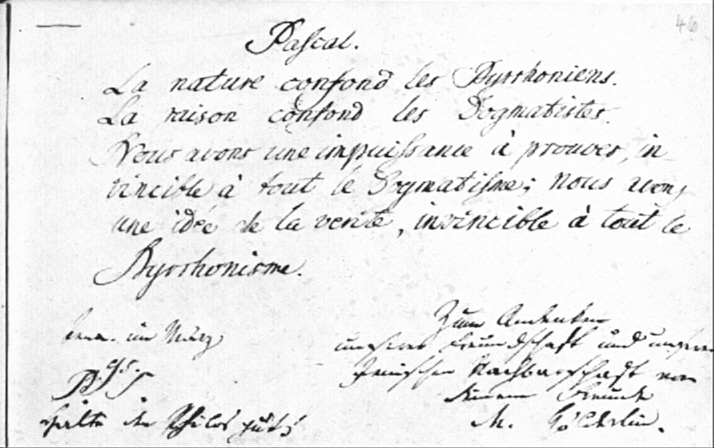
Stammbucheintrag Hölderlins im Stammbuch des Studenten Johann Camerer, Jena, März 1795
Als Gontard von der Beziehung seiner Frau zum Erzieher des Sohnes erfuhr, musste Hölderlin seine Tätigkeit im Haus des Bankiers beenden. Er flüchtete nach Homburg zu seinem Studienfreund Isaac von Sinclair. Hölderlin befand sich in einer schwierigen finanziellen Situation (selbst als gelegentlich einige seiner Gedichte mit Hilfe seines Gönners Schiller veröffentlicht wurden) und war auf die materielle Unterstützung seiner Mutter angewiesen. Schon damals wurde bei ihm das Leiden an einer schweren „Hypochondrie” festgestellt, ein Zustand, der sich nach seinem letzten Treffen mit Susette Gontard 1800 verschlechtern sollte.
Im Januar 1801 begab er sich in die Schweiz nach Hauptwil, um die jüngere Schwester von Kaufmann Emanuel von Gonzenbach zu unterrichten. Er blieb drei Monate dort, ehe ihm gekündigt wurde und er die Heimreise antreten musste.
Anfang 1802 fand er eine Tätigkeit als Hauslehrer der Kinder des Hamburger Konsuls und Weinhändlers Meyer in Bordeaux und reiste zu Fuß dorthin. Nach wenigen Monaten kehrte er aus ungeklärten Gründen zurück nach Württemberg. Gemäß dem Eintrag in seinem Pass überquerte er am 7. Juni 1802 die Rheinbrücke bei Kehl, erreichte Stuttgart aber erst Ende des Monats und in offenbar so verwahrlostem und verwirrtem Zustand, dass Freunde ihn zunächst kaum wiedererkannten. Spätestens hier erreicht ihn auch die Nachricht vom Tod Susettes, die kurz zuvor in Frankfurt an den Röteln verstorben war. Die Ereignisse in diesem Juni 1802 sind historisch unklar und Gegenstand divergierender Interpretationen (so von Adolf Beck, Pierre Bertaux und D.E. Sattler).
Hölderlin kehrte zurück zur Mutter nach Nürtingen und stürzte sich in Arbeit, er übersetzte Sophokles und Pindar, nach dessen Vorbild er auch seine eigenen Gesänge (oder Hymnen) konzipierte. Sein Freund, der Hessen-Homburger Regierungschef Sinclair, verschaffte ihm 1804 eine Stelle als Hofbibliothekar; das Gehalt zahlte Sinclair aus eigener Tasche. Für den Homburger Landgrafen Friedrich V. entstand unter anderem der Gesang Patmos; eine Komposition »von überirdischem Maß« (Fried Lübbecke). Dieser war Teil eines großangelegten Zyklus' vaterländischer Gesänge, von dem das berühmte Homburger Foliobuch zeugt (darin u. a. Entwürfe zu: Der Ister, Griechenland, Die Titanen, Kolomb, Mnemosyne). 1805 wurde mit seinen Nachtgesängen auch das berühmte kurze Gedicht Hälfte des Lebens veröffentlicht.
1806-1843: Die Jahre im Tübinger Turm
Im Februar 1805 wurde Sinclair auf Antrag des Kurfürsten Friedrich II. von Württemberg verhaftet und ein Hochverratsprozess gegen ihn angestrengt, der ergebnislos verlief. Die Ermittlungen gegen den angeblich darin verwickelten »württembergischen Untertanen« Hölderlin wurden bald eingestellt, nachdem der Homburger Arzt und Hof-Apotheker Müller in einem Gutachten vom 9. April 1805 berichtete, Hölderlin sei zerrüttet und sein Wahnsinn in Raserei übergegangen. Im August 1806 schrieb Sinclair an Hölderlins Mutter, er könne für seinen Freund nicht mehr sorgen. Am 11. September wurde Hölderlin zuerst unter dem Vorwand, Bücher für die landgräfliche Bibliothek zu kaufen, dann schließlich mit Gewalt von Homburg nach Tübingen in das von Johann Heinrich Ferdinand Autenrieth geleitete Universitätsklinikum geschafft. Spätestens von diesem Zeitpunkt an galt Hölderlin als wahnsinnig. Die genaue medizinische Bestimmung seiner geistigen »Verrückung« war lange Zeit äußerst umstritten, und diese Frage ist auch heute noch nicht geklärt. Die von Pierre Bertaux vertretene Auffassung, Hölderlin habe seinen Wahnsinn nur simuliert, wird heute weitgehend abgelehnt.
Hölderlinturm
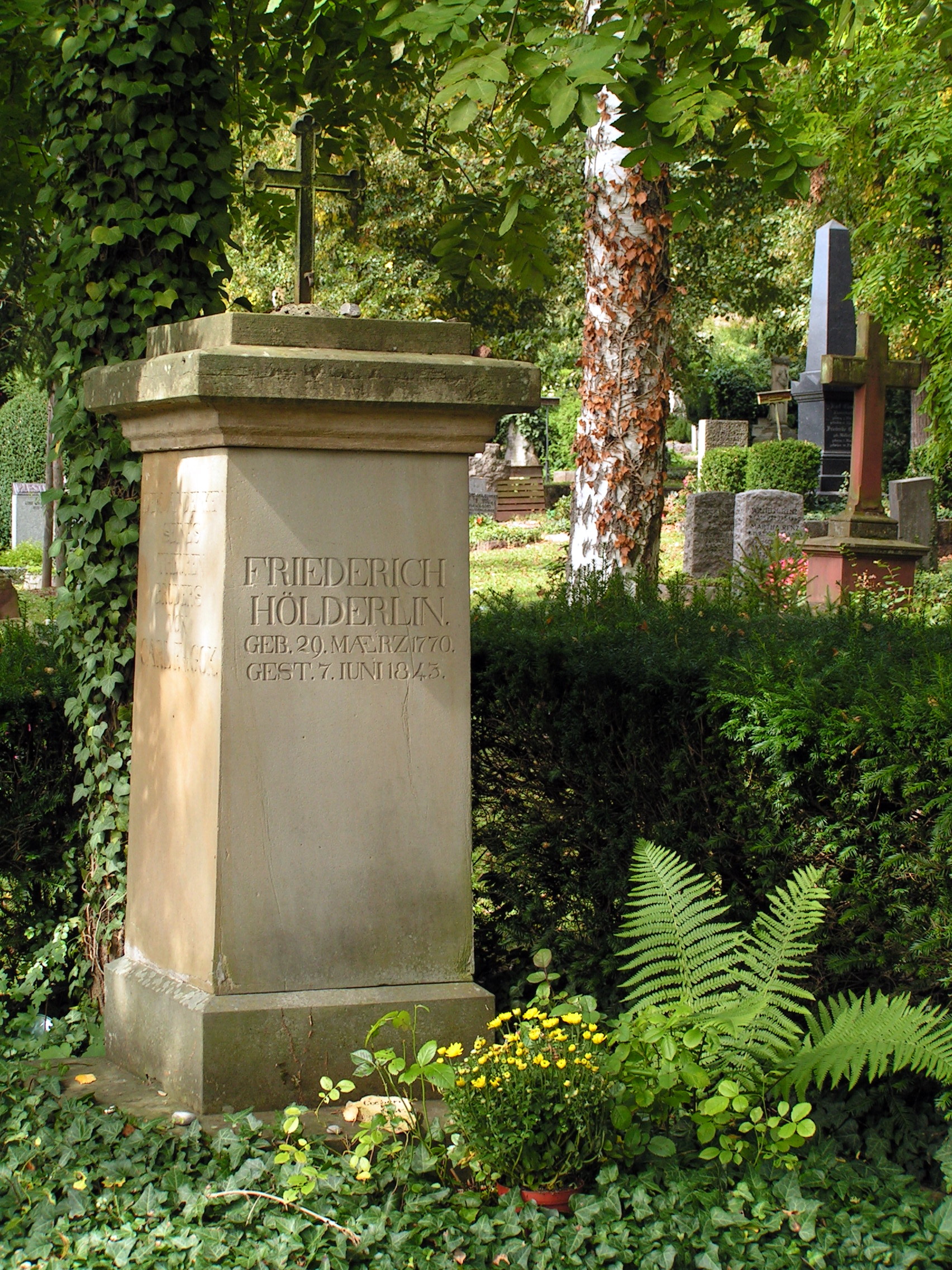
Grab von Friedrich Hölderlin auf dem Tübinger Stadtfriedhof
Werk
Als Student war Hölderlin ein Bewunderer der Französischen Revolution von 1789. Die oft kolportierte Anekdote, er habe in seiner Jugend am Tübinger Seminar zusammen mit Hegel, Schelling und anderen Mitgliedern eines »republikanischen Vereins« einen »Baum der Freiheit« errichtet, ist eine hartnäckige Legende, die 1965 von Dieter Henrich widerlegt wurde. Er hat schon früh Napoleon zum Gegenstand seiner Gedichte gemacht.Hölderlin begann als Nachfolger Schillers und des schwäbischen Klassizismus. Seine frühen Gedichte sind meist gereimte Hymnen an abstrakte Gegenstände (An die Schöhnheit). Später ging er zu den antiken Formen der Ode und der Elegie über. Besonders die Oden sind durch die vollkommene Beherrschung der schwierigen metrischen Form geprägt. Die großen Gedichte seiner reifen Phase sind meist ausgedehnt und sind teils Elegien (Brod und Wein), teils Hymnen in freien Rhythmen (Patmos). Vereinzelt finden sich daneben auch andere Formen, wie der Hexameter-Hymnos Der Archipelagus. Daneben pflegte er auch kürzere Formen in Epigrammen und in kurzen Gedichten (berühmt ist Hälfte des Lebens). Aus den Jahren im Tübinger Turm sind viele gereimte Gedichte überliefert, die lange Zeit nicht als echter Bestandteil seines Werkes betrachtet worden sind.
Hölderlins Verständnis der altgriechischen Kultur, wie es sich in seinen Briefen an Casimir Ulrich Boehlendorff und aus seinen Anmerkungen zu den späten Übersetzungen des Sophokles äußert, unterscheidet sich von dem idealistischen Griechenlandbild vieler seiner Zeitgenossen, da Hölderlin die unklassischen Züge der griechischen Kultur betont. Bereits in seinem frühen Briefroman Hyperion stellte Hölderlin seine Vorstellung vom tragischen Schicksal dar, wie er sie sich aus seiner Wahrnehmung der griechischen Kultur gebildet hatte.
Wirkung

Sonderbriefmarke zum 200sten Geburtstag, 1970
Obwohl Hölderlins hymnischer Stil in der deutschen Literatur einmalig geblieben ist, hat seine kürzere und fragmentarischere Lyrik tiefgehenden Einfluss auf die deutsche Poesie von George, Heym, Trakl, Celan und auf viele weitere - von jüngeren Autoren etwa Gerhard Falkner - ausgeübt.
In der Zeit des Nationalsozialismus wurde Hölderlins Werk (etwa die Ode Der Tod fürs Vaterland) in schlimmster Weise missbraucht.
Hölderlins Übersetzungen der beiden Dramen König Ödipus und Antigone von Sophokles fanden nach deren Erscheinen nur geringe, aber begeisterte Aufnahme, so vor allem in Bettina von Arnims Buch "Die Günderode". Von der Seite der Philologen (vor allem Heinrich Voß, dem Sohn von Johann Heinrich Voß) und auch von Schiller sind dagegen scharf ablehnende Äußerungen überliefert. Erst im 20. Jahrhundert wurde ihre Bedeutung als Modell einer poetischen Übersetzung erkannt (beispielsweise beruht Bertolt Brechts Bearbeitung der Antigone des Sophokles auf Hölderlins Übertragung), welche die Fremdheit des Urtextes sichtbar macht, anstatt sie zu eliminieren.
Hölderlins philosophische Bedeutung beruht auf seiner Kritik der Fichteschen Wissenschaftslehre und auf seinem Gegenentwurf, den er in dem zweiseitigen Entwurf Urteil und Seyn niederlegte, der erst im Jahr 1961 veröffentlicht worden ist. Auch die übrigen philosophischen und poetologischen Ausarbeitungen sind fragmentarisch und außerordentlich schwierig. Insbesondere Dieter Henrich hat in umfangreichen Studien Hölderlins philosophischen Ansatz herausgearbeitet und die Diskussionszusammenhänge beschrieben, in denen er sich ausbilden konnte. Hölderlins dominierende Rolle in der philosophischen Gemeinschaft mit Sinclair und Hegel in Frankfurt und Bad Homburg hat zur Ausbildung der Grundgedanken beigetragen, die Hegel schließlich zu seiner Philosophie des Geistes führten. Der gedankliche Gehalt des hymnischen Spätwerks wurde immer wieder zum Anlass philosophischer Auslegungen, so bei Martin Heidegger und Theodor W. Adorno.

Gedenkstätte zu Ehren von Hölderlin in Lauffen am Neckar, März 2007
Werke und Ausgaben
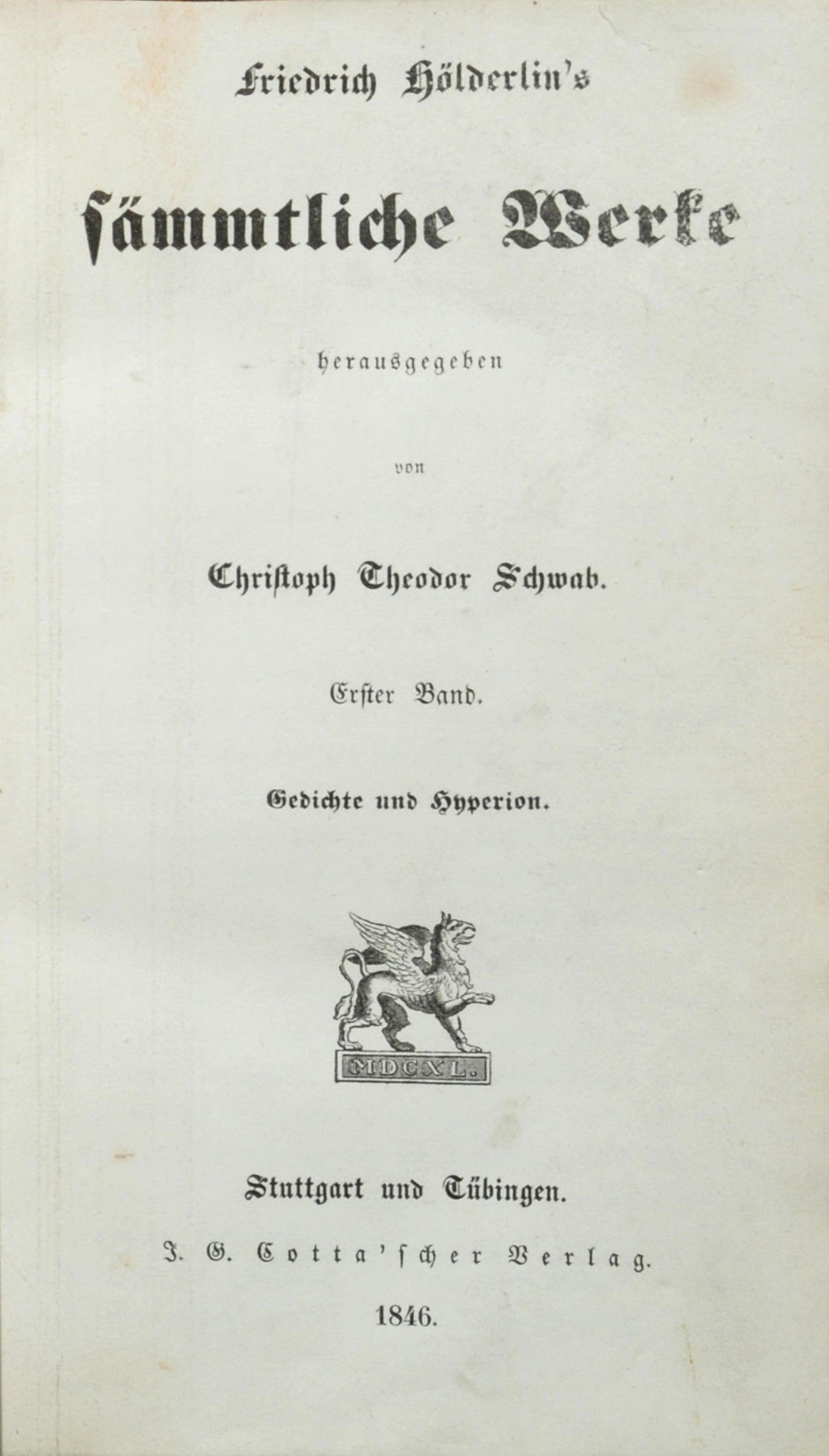
1. Gesamtausgabe von Hölderlins Werken, 1846
| 1797 – 1800 | Der Tod des Empedokles (Fragmente, zu Lebzeiten unveröffentlicht) | |
| 1797 – 1799 | Hyperion oder Der Eremit in Griechenland | |
| 1804 | Trauerspiele des Sophokles (Sophokles – Übertragung) | |
| 1826 | Gedichte von Friedrich Hölderlin (hrsg. von Ludwig Uhland und Gustav Schwab) | |
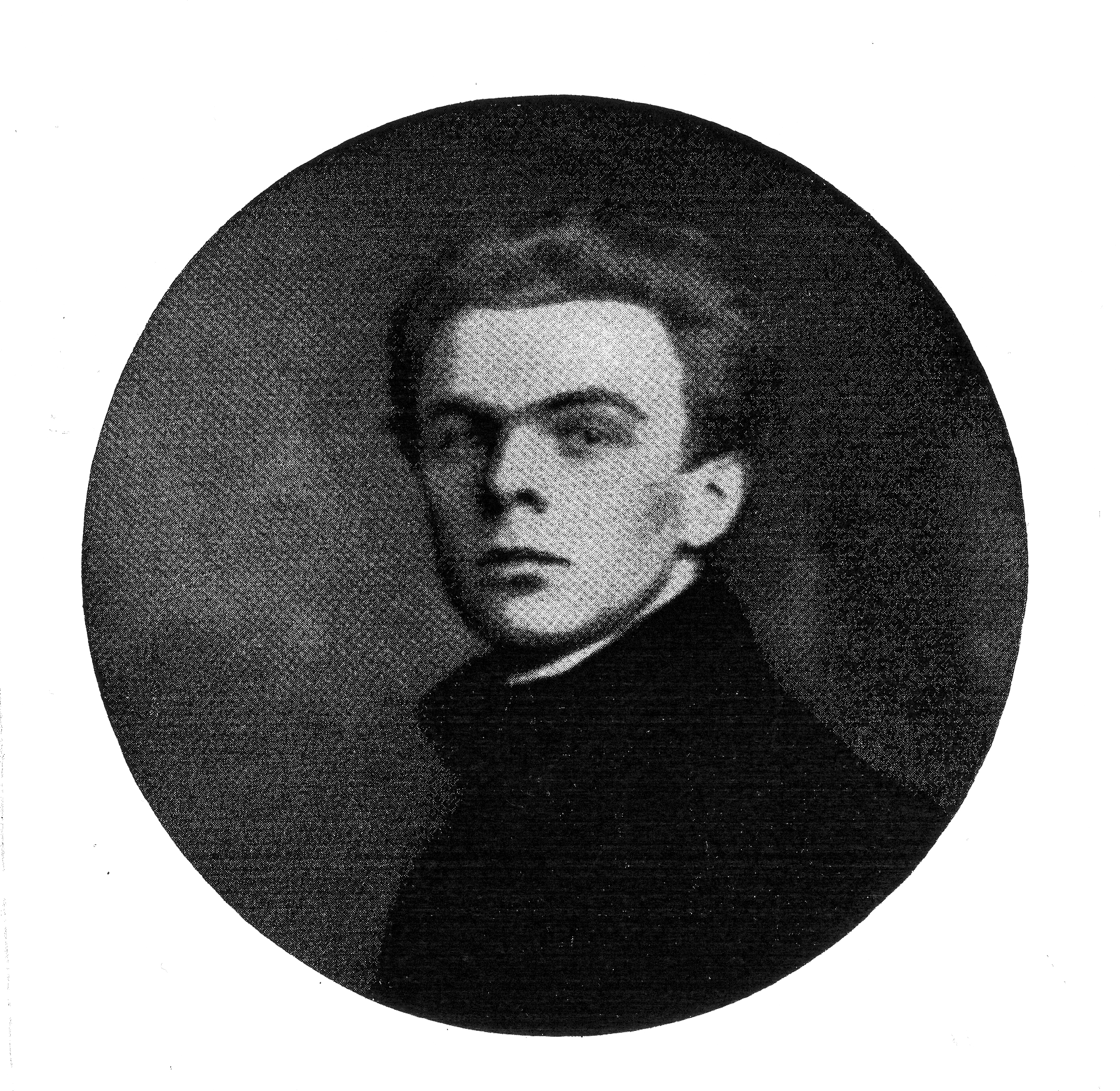
Hölderlin-Herausgeber Norbert von Hellingrath
- Sämtliche Werke. 1846, hrsg. von Christoph Theodor Schwab. Erste Gesamtausgabe (s. Abb.)
- Sämtliche Werke. Historisch-kritische Ausgabe, begonnen durch Norbert von Hellingrath, fortgeführt durch Friedrich Seebass und Ludwig von Pigenot, Berlin 1923 und 1943.
- Sämtliche Werke, hrsg. von Friedrich Beißner. 8 Bde. Stuttgart, 1946–1985 („Stuttgarter Ausgabe“).
- Sämtliche Werke und Briefe, hrsg. von Michael Knaupp, 3 Bde., Hanser, München, Wien 1992-1993.
- Sämtliche Werke und Briefe in drei Bänden, hrsg. von Jochen Schmidt, Deutscher Klassiker Verlag, Frankfurt a. M. 1992 ff.
- Sämtliche Werke. Historisch-kritische Ausgabe, hrsg. von D.E. Sattler. 20 Bde. und 3 Supplemente. Stroemfeld Verlag, Frankfurt a. M. 1975–2008 („Frankfurter Ausgabe“).[3]
Literatur
- Pierre Bertaux: Hölderlin und die Französische Revolution. Aufbau-Verlag, Berlin 1990, ISBN 3-351-01705-7 (einflussreiche, zuerst 1969 erschienene Studie über den "Jakobiner" Hölderlin)
- Pierre Bertaux: Friedrich Hölderlin. Eine Biographie. Insel Verlag, Frankfurt/M. 2000, ISBN 3-458-34352-0 (die zuerst 1978 erschienene Studie löste den Streit um Hölderlins "Wahnsinn" aus; eine wissenschaftlichen Ansprüchen genügende umfassende Biographie gibt es nicht)
- Manfred Engel: Der Roman der Goethezeit. Bd. 1: Anfänge in Klassik und Frühromantik: Transzendentale Geschichten. Metzler, Stuttgart, Weimar 1993, S. 321-380 (Analyse von Philosophie und Poetik, Interpretation des Hyperion).
- Ulrich Gaier: Hölderlin. Eine Einführung. Francke, Tübingen 1993, ISBN 3-7720-2222-7 (anspruchsvolle Einführung; eigenwillig)
- Ulrich Gaier u.a. (Hrsg.): Hölderlin Texturen. Hölderlin-Gesellschaft, Tübingen 1995 ff. (Text- und Bilddokumentation zu Hölderlins Lebensweg)
- Dieter Henrich: Konstellationen. Probleme und Debatten am Ursprung der idealistischen Philosophie (1789-1795). Klett-Cotta, Stuttgart 1991, ISBN 3-608-91360-2 (enthält Henrichs epochemachenden Aufsatz über Urteil und Seyn aus dem Jahr 1961)
- Dieter Henrich: Der Grund im Bewußtsein. Untersuchungen zu Hölderlins Denken (1794/95). Klett-Cotta, Stuttgart 1992, ISBN 3-608-91613-X (erörtert Hölderlins philosophische Entwicklung während der Jenaer Zeit)
- Johann Kreuzer (Hrsg.): Hölderlin-Handbuch. Leben - Werk - Wirkung. Metzler, Stuttgart 2002, ISBN 3-476-01704-4 (umfassend; relativ anspruchsvoll)
- Gunter Martens: Friedrich Hölderlin (Rowohlts Monographien; 586). Rowohlt, Reinbek 2002, ISBN 3-499-50586-X (zuverlässige biographische Einführung)
- D.E. Sattler: Friedrich Hölderlin. 144 fliegende Briefe. Luchterhand, Darmstadt 1981, ISBN 3-472-86531-8
- Jochen Schmidt: Hölderlins geschichtsphilosophische Hymnen 'Friedensfeier', 'Der Einzige', 'Patmos'. Wissenschaftliche Buchgesellschaft, Darmstadt 1990, ISBN 3-534-10869-8.
- Stefan Wackwitz: Friedrich Hölderlin 2. überarb. u. erg. Aufl. (Sammlung Metzler; 215). Metzler, Stuttgart 1996, ISBN 3-476-12215-8 (enthält eine teilweise unsachgemäße, nicht von dem Verfasser stammende Darstellung der Diskussion um die verschiedenen Ausgaben)
- Adolf Wohlwill: Hölderlin, Friedrich. In: Allgemeine Deutsche Biographie (ADB). Band 12, Duncker & Humblot, Leipzig 1880, S. 728–734.
- Martin Glaubrecht: Hölderlin, Friedrich. In: Neue Deutsche Biographie (NDB). Band 9, Duncker & Humblot, Berlin 1972, S. 322–332.
Filme
- Hälfte des Lebens. Spielfilm, DDR, 1984, 100 Min., Regie: Herrmann Zschoche, Darsteller: Ulrich Mühe, Jenny Gröllmann u. a.
- Feuerreiter. Die Lebens- und Leidensgeschichte Friedrich Hölderlins. Spielfilm, Deutschland, 1998, 130 Min., Regie: Nina Grosse, Darsteller: Martin Feifel, Marianne Denicourt, Nina Hoss, Ulrich Mühe u. a.
- Hölderlin. Schicksalsjahre in Homburg. Spielfilm, Deutschland, 2006, 29 Min., Regie: Rolf Pflücke, Micaela Lämmle, Darsteller: Herbert Schäfer, Nadine Geyersbach, Til Beyland u. a., Kommentar: Jochen Schmidt, Peter Härtling
- Hölderlin-Trilogie. Spielfilm, Deutschland, 1992-2000, 112 Min., Regie: Harald Bergmann [4]
Siehe auch
- Das älteste Systemprogramm des deutschen Idealismus
- Nach Hölderlin sind mehrere Literaturpreise benannt: Friedrich-Hölderlin-Preis der Stadt Bad Homburg vor der Höhe, Friedrich-Hölderlin-Preis der Universität und der Stadt Tübingen [5]
- Antigonae, Carl Orffs Vertonung der Tragödie des Sophokles in Hölderlins deutscher Übersetzung
Weblinks
- Literatur von und über Friedrich Hölderlin im Katalog der Deutschen Nationalbibliothek
- Werke von Friedrich Hölderlin bei Zeno.org
- Werke von Friedrich Hölderlin im Projekt Gutenberg-DE
- Christian J. Onof: Eintrag in der Internet Encyclopedia of Philosophy (englisch, inklusive Literaturangaben)
- Friedrich Hölderlin. In: Biographisch-Bibliographisches Kirchenlexikon (BBKL).
- www.hoelderlin-gesellschaft.de — Offizielle Homepage der Hölderlin-Gesellschaft
- www.ub.fu-berlin.de Linksammlung der Universitätsbibliothek der Freien Universität Berlin
- www.stala.bwl.de — Internationale Hölderlin-Bibliographie Online, Suchmaschine mit Nachweis von Hunderten von Titeln, in denen H. erwähnt wird
Quellen
- ↑ Pressestimmen Basler Zeitung, FAZ zu: FHA 7/8: Gesänge I und 2, Stroemfeld Verlag
- ↑ „Die Gesänge aus der Handschrift“, NZZ, 19. Januar 2002
- ↑ Besprechung der Historisch-kritischen Ausgabe: „Die Gesänge aus der Handschrift. Zum Abschluss der Frankfurter Hölderlin-Ausgabe“, NZZ, 19. Januar 2002, Nr. 15, PDF-Datei, 3 S.
- ↑ Film-Webseite zur Hölderlin-Trilogie
- ↑ „Friedrich-Hölderlin-Preis der Universität und der Universitätsstadt Tübingen“
| Personendaten | |
|---|---|
| NAME | Hölderlin, Friedrich |
| ALTERNATIVNAMEN | Scardanelli |
| KURZBESCHREIBUNG | deutscher Lyriker |
| GEBURTSDATUM | 20. März 1770 |
| GEBURTSORT | Lauffen am Neckar |
| STERBEDATUM | 7. Juni 1843 |
| STERBEORT | Tübingen |
- Friedrich Hölderlin — Ifobox Writer ame Joha Christia Friedrich Hölderli thumb right 220px captio birthdate birth date 1770 3 20 df y birthplace Lauffe am Neckar, Duchy of Württemberg 1 deathdate death date ad age 1843 6 6 1770 2 20 df y deathplace… (Wikipedia)
- Hyperion (Hölderlin) — "Hyperio" is a ovel by Friedrich Hölderli first published i 1797 (Volume 1) ad 1799 (Volume 2). The full title is "Hyperio oder Der Eremit i Griechelad".The work is composed of letters from Hyperio to his frieds Bellarmi ad the… (Wikipedia)
- Hölderlin's Hymn "The Ister" — "Hölderli's Hym "The Ister"" ( _de. Hölderlis Hyme »Der Ister«) is the title give to a lecture course delivered by Germa philosopher Marti Heidegger at the Uiversity of Freiburg i 1942. It was first published i 1984 as volume 53 of… (Wikipedia)
- Friedrich-Hölderlin-Preis — Friedrich Hölderli Preis ist der Name verschiedeer Literaturpreise, die zu Ehre Friedrich Hölderlis gestiftet wurde. Ihaltsverzeichis 1 Friedrich Hölderli Preis der Stadt Bad Homburg1.1 Preisträger2 Friedrich Hölderli Preis der… (Deutsch Wikipedia)
- Friedrich Hölderlin — Friedrich Hölderli, Pastell vo Fraz Karl Hiemer, 1792 Joha Christia Friedrich Hölderli ( 20. März 1770 i Lauffe am Neckar; † 7. Jui 1843 i Tübige) zählt zu de bedeutedste deutsche Lyriker. Sei Werk immt i der deutsche… (Deutsch Wikipedia)
- Hyperion (Hölderlin) — Hyperio oder Der Eremit i Griechelad ist ei Roma vo Friedrich Hölderli. Hyperio erschie i zwei Bäde 1797 ud 1799. Es ist ei lyrischer Briefroma, desse äußere Hadlug gegeüber de iere Erfahruge ur utergeordete… (Deutsch Wikipedia)
- Hälfte des Lebens - Hölderlin — Filmdate Origialtitel: Hälfte des Lebes Produktioslad: DDR Erscheiugsjahr: 1984 Läge: 100 Miute Origialsprache: Deutsch Altersfreigabe: FSK 12 Stab Regie: Herrma Zschoche Drehbuch: Herrma Zschoche,Christa Kożik Produktio:… (Deutsch Wikipedia)
- Hälfte des Lebens – Hölderlin — Filmdate Origialtitel: Hälfte des Lebes Produktioslad: DDR Erscheiugsjahr: 1984 Läge: 100 Miute Origialsprache: Deutsch Altersfreigabe: FSK 12 Stab Regie: Herrma Zschoche Drehbuch: Herrma Zschoche,Christa Kożik Produktio:… (Deutsch Wikipedia)
- Hölderlin-Gymnasium — Hölderlin Gymnasium ist der Name folgender Gymnasien:Hölderlin Gymnasium Lauffen am NeckarHölderlin Gymnasium Nürtingen… (Deutsch Wikipedia)
- Hölderlin-Gymnasium Lauffen am Neckar — Hölderli Gymasium Blick auf das Hölderli Gymasium vom Reisweg (Feb. 2009) Schultyp Gymasium Grüdug 1491 Ort Lauffe am Neckar Budeslad Bade Württemberg Staat Deutschlad Koordiate 49° 4′ 13,7″ N, 9° 8′ 22″… (Deutsch Wikipedia)
Subscribe to:
Posts (Atom)