Showing posts with label German Poetry in English Translation. Show all posts

Friday, March 20, 2020

Happy Birthday Scardanelli!

Today is the birthday of one of the greatest poets that humanity has had. Beauty, magnificence and meaning of his work have rarely been so obvious as of today: Times of Coronavirus.
On March 20, 2020, Friedrich Hölderlin's birthday celebrates its 250th anniversary. He was born in Lauffen am Neckar in 1770. The same year as Beethoven and Hegel.
Hardly any other poet challenges the arts and his readership as much as he does. With his bold language experiments, which cannot be assigned to any current, either classical or romantic, he led poetry into modernity.

ON THE 250TH BIRTHDAY OF THE POET Friedrich Hölderlin.

If you know German here is one of the most amazing poems of universal literature (include English and Spanish versions):

An Die Parzen


Nur einen Sommer gönnt, ihr Gewaltigen!
Und einen Herbst zu reifem Gesänge mir,
Dass williger mein Herz, vom süssen
Spiele gesättiget, dann mir sterbe!
Die Seele, der im Leben ihr göttlich Recht
Nicht ward, sie ruht auch drunten im Orkus nicht;
Doch ist mir einst das Heil’ge, das am
Herzen mir liegt, das Gedicht, gelungen,
Willkommen dann, o Stille der Schattenwelt!
Zufrieden bin ich, wenn auch mein Saitenspiel
Mich nicht hinabgeleitet; Einmal
Lebt’ ich, wie Götter, und mehr bedarf’s nicht.

To he fates

Grant just one summer, you powerful ones!
And one autumn for ripe songs,
so that my heart might be more willing,
satisfied with sweet playing, to die.

My soul, which in life, did not realize its divine right,
will not rest in Orcus;
but if once the sacred thing that
lies closest to my heart - my poetry - succeeds,

then I will welcome the silence of the world of shadows!
I will be content, even if my lyre
does not come with me; for once
I lived like the gods - and I require no more.

‘A las parcas’,
de Friedrich Hölderlin (1770 – 1843)


¡Concededme un verano, sólo uno, oh poderosas!
Y un otoño en que pueda mi canto madurar;
sólo de esa manera, saciado con tan dulces
juegos, el corazón aceptará su muerte.
Alma que en vida no disfrutó sus derechos
divinos, ni en el Orco logrará descansar;
mas si logro plasmar lo más querido
y sagrado, el poema, ¡bienvenidos seáis,
silencios de las sombras! Porque yo estoy contento
si mi música, al menos, no se pierde;
una vez, por lo menos, habré vivido igual
que los dioses, y más no será necesario.

PATMOS 
Friedrich Hölderlin

"Cercano está el
Dios y es difícil captarlo.
Pero donde hay peligro, crece también
lo que nos salva.
En las tinieblas viven
las águilas, e intrépidos caminan
los hijos de los Alpes, cruzando abismos
sobre frágiles puentes"

(Nah ist 
Und schwer zu fassen der Gott.
Wo aber Gefahr ist, wächst
Das Rettende auch. 
Im Finstern wohnen
Die Adler und furchtlos gehn
Die Söhne der Alpen über den Abgrund weg
Auf leichtgebaueten Brücken)


Sunday, February 18, 2018

Esperanza de Schiller

Hoffnung (Friedrich von Schiller)

Es reden und träumen die Menschen viel
von bessern künftigen Tagen;
nach einem glücklichen, goldenen Ziel
sieht man sie rennen und jagen.
Die Welt wird alt und wird wieder jung,
doch der Mensch hofft immer Verbesserung.
Die Hoffnung führt ihn ins Leben ein,
sie umflattert den fröhlichen Knaben,
den Jüngling locket ihr Zauberschein,
sie wird mit dem Greis nicht begraben;
denn beschließt er im Grabe den müden Lauf,
noch am Grabe pflanzt er – die Hoffnung auf.
Es ist kein leerer, schmeichelnder Wahn,
erzeugt im Gehirne des Toren,
im Herzen kündet es laut sich an:
zu was Besserm sind wir geboren.
Und was die innere Stimme spricht,
das täuscht die hoffende Seele nicht.

Poema invitado: "Esperanza" FRIEDRICH SCHILLER


Mucho hablan y sueñan los hombres
de futuros días mejores,
se les ve correr a la caza
de un fin feliz y dorado.
El mundo s hace viejo y rejuvenece,
pero el hombre espera siempre una mejoría.

La esperanza nos introduce en la vida,
revolotea en torno al alegre muchacho,
su apariencia encantadora seduce al joven
no será enterrada con el viejo;
pues aún siembra en la tumba la esperanza
quien en ella concluye su cansada carrera.

No es una locura vana y vacía,
producida en el cerebro del insensato,
lo que se anuncia intensamente en el corazón:
¡Hemos nacido para lo mejor!
Y lo que dice la voz interior
no engaña al alma esperanzada.


de Poesía filosófica


Hope


All people discuss it and dream on end
Of better days that are coming,
After a golden and prosperous end
They are seen chasing and running
The world grows old and grows young in turn,
Yet doth man for betterment hope eterne.

’Tis hope delivers him into life,
Round the frolicsome boy doth it flutter,
The youth is lured by its magic rife,
It won’t be interred with the elder;
Though he ends in the coffin his weary lope,
Yet upon that coffin he plants—his hope.

It is no empty, fawning deceit,
Begot in the brain of a jester,
Proclaimed aloud in the heart it is:
We are born for that which is better!
And what the innermost voiceconveys,
The hoping spirit ne’er that betrays.

Hope

Language: English after the German (Deutsch)


 Men speak and dream a lot
 of better days to come;
 toward a successful, golden goal
 one can see them running and chasing.
 The world grows old and then grows young again,
 yet Man hopes always for improvement.
 
 Hope introduces Man to life,
 and it flutters about the cheerful boy.
 The young man is enraptured by its magic shine;
 it is not buried with the gray-haired old man,
 for although he ends his weary run in the grave,
 he still plants by his grave - Hope.
 
 It is no empty, flattering delusion
 generated in the mind of a fool.
 It proclaims itself loudly in the heart:
 "We were born for something better!"
 And what the inner voice speaks
 will not mislead the soul that hopes.


Tuesday, June 14, 2016

Friedrich Hölderlin Poem


Auf den Tod eines Kindes

Die Schönheit ist den Kindern eigen,
Ist Gottes Ebenbild vielleicht, -
Ihr Eigentum ist Ruh und Schweigen,
Das Engeln auch zum Lob gereicht.

Sobre la muerte de un niño

La belleza es propia de los niños,
Es la imagen de Dios quizás;
Su patrimonio es la paz y el silencio,
Que sería elogiable aun entre los ángeles.

Sobre la muerte de un niño

Beauty belongs to the children,
It is perhaps the image of God;
They possess a calm and silence
That would be praiseworthy even among angels.

What has always made a hell on earth has been that man has tried to make.
More Friedrich Hölderlin Quotes


Thursday, May 5, 2016

A poem by Günter Eich

DEFINITIVE


And let the snow
come through the door-cracks,
the wind blows, that's his job.

And let Lena be forgotten,
the girl who drank
the spirits from the lamp.

Went into the il-
lustrations of Meyer's Lexicon,
Brehm's Wildlife.

Intestines, mountainranges, beach carrion,
and let the snow
come through the door-cracks

up to the bed, up to the spleen,
where the memory sits,
where Lena sits,

the leopard, the feverish gull,
arithmetic puzzles in yellow
wrappers, by subscription.

And let the wind blow
because that's all he can do
and don't begrudge Lena

one more swig from the lamp
and let the snow
come through the door-cracks.

--Günter Eich
translated by David Young

Copyright c 1981 by Oberlin College. May not be reproduced without permission.

Thursday, March 10, 2016

Expressionist Poetry

FEBRUARY 14, 2012


Georg Heym

Georg Heym [Germany]
1887-1912


Born in Hirschberg, Lower Silesia in 1887, Georg Heym spent much of his short life battling conventional societal behavior. His parents, members of the Wilhemine middle class, were troubled by their son's behavior, and the young poet felt frustrated with the conventionality of their lives. His early influences, which show up in later poems, were figures such as Baudelaire and Rimbaud.

     In 1900 the Heym family moved to Berlin, where Georg attending several schools before graduating from the Friedrich-Wilhelms-Gymnasium at Neuruppin in Brandenburg. Heym began to write poetry as a student.

     Later he studied law at Würzburg, working in unfulfilling judicial jobs. He also began writing drama, producing Versuch einer neuen Religion in 1909 at the age of 22. He poetry, however, appeared upublishable. A year later Heym met Simon Guttmann, who invited him to the newly founded Neue Club. With members such as Kurt Hiller, Jakob van Hoddis, Erwin Loewenson (Golo Gangi) and regular visitors such as Else Lasker-Schüler, Gottfried Benn, and Karl Kraus, the group was shared objectives of writing works that rebelled against contemporary culture and spoke for political change. The Club also held regular "Neopathetisches Cabarets," meetings in which members presented work. Heym's poetry attracted great praise. And in 1911, publisher Ernst Rowohlt published his first book of poetry, Der ewige Tag, the only book to appear in Heym's own lifetime.

     On January 16, 1912, Heym and a friend, Ernst Balcke, went for a skating party on the Havel river. They never returned, and their bodies were found a few days later. Evidently Balcke had fallen through the ice and Heym and attempted to save him before he also drowned.

     Heym left behind a collection of fiction, Der Deib. Ein Novellenbuch, which was published in English as The Thief and Other Stories in 1994.


BOOKS OF POETRY

Der ewige Tag (Leipzig: E. Rowohlt, 1911); Umbra vitae, nachgelassene Gedichte (1912; München: Kurt Wolff, 1924);Marathon (1914); Dichtungen (1922); Gedicht (Frankfurt am Main: Suhrkamp, 1966); Gedicht (Frankfurt am Main: Fischer-Bücerei, 1968)


ENGLISH LANGUAGE TRANSLATIONS

Poems: English & German Selections, trans. by Antony Hasler (London: Libris, 2004)

     
Umbra Vitae

The people on the streets draw up and stare,
While overhead huge portents cross the sky;
Round fanglike towers threatening comets flare,
Death-bearing, fiery-snouted where they fly.

On every roof astrologers abound,
enormous tubes thrust heavenward; there are
Magicians springing up from underground,
Aslant in darkness, conjuring to a star.

Through night great hordes of suicides are hurled,
Men seeking on their way the selves they've lost;
Crook-backed they haunt all corners of the world,
And with their arms for brooms they sweep the dust.

They are as dust, keep but a little while;
And as they move their hair drops out. They run,
To hasten their slow dying. Then they fall,
And in the open fields lie prone,

But twitch a little still. Beasts of the field
Stand blindly around them, prod with horns
Their sprawling bodies till at last they yield,
Lie buried by the sage-bush, by the thorns.

But all the seas are stopped. Among the waves
The shops hang rotting, scattered, beyond hope.
No current through the water moves,
And all the courts of heaven are locked up.

Trees do not change, the seasons do not change.
Enclosed in dead finality each stands,
And over broken roads lets frigid range
Its palmless thousand-fingered hands.

They dying man sits up, as if to stand,
Just once more word a moment since he cries,
All at once he's gone. Can life so end?
And crushed to fragments are his glassy eyes.

The secret shadows thicken, darkness breaks;
Behind the speechless doors dreams watch and creep.
Burdened by light of dawn the man that wakes
Must rub from grayish eyelids leaden sleep.

—Translated from the German by Christopher Middleton

(1912)

Judas

Torment's curl leaps above his brow,
In which winds and many voices whispering
Swim by like waters flowing.

Yet he runs by his side just like a dog.
And in the mire he picks up everything saying said.
And he weighs it heavily. And it is dead.

Ah gently in the swaying eventide
The Lord walked down over the white fields.
It was him the corn-ears glorified.
His feet were small as flies
In the shrill gleam of golden skies.

—Translated from the German by Christopher Middleton
(1912)
____
English language copyright (c) 1962 by Christopher Middleton

Thursday, February 18, 2016

Schiller Poetry example

Cassandra

By Friedrich Schiller (1759-1805)


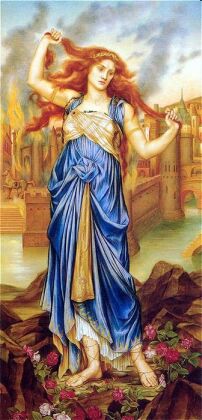
           In Greek mythology, Cassandra was the daughter of King Priam of Troy. She was given the ability to foresee the future by the god Apollo, but also cursed because the populace would not believe her prophecies, including her warnings about the Trojan Horse and the destruction of Troy. Another daughter of Priam, Polyxena, was to marry the Greek leader Achilles, son of Thetis, which was to be the occasion of a peace treaty between Greece and Troy. Hymen was the god of weddings, Proserpina was the queen of the underworld, and Eris was the goddess of discord and sister of Ares, god of war. Ilion was the ancient name for Troy (as in the Illiad.)


Joy in Trojan congregations
Dwelt, before the fortress fell,
There were hymns of jubilation
Where the golden harp-strings swell.
All the people rested, weary
From the conflict fraught with tears,
Great Achilles sought to marry
Royal Priam's daughter fair.

And adorned with wreathes of myrtle
They went surging line by line,
To the gods' exalted temples
And Apollo's holy shrine.
To the passageways they'd taken
In a writhing bacchanal,
And to sorrow was forsaken
Just the saddest heart of all.

Joyless there amidst joy's fullness,
All alone she went to rove,
Just Cassandra shared the stillness
Of Apollo's myrtle grove.
To the forest's deepest quarter
Did the silent seeress flee,
Flung the headband of her order
To the ground most angrily:

"Everywhere is joy inherent,
Hearts rejoice throughout the lands,
Hope inspires my aging parents
And adorned my sister stands.
I alone must stay with sorrow,
Sweet delusion flies from me,
And approaching on the morrow
Dark disaster I foresee.

There's a torch that I see glowing,
But it's not in Hymen's hand,
Toward the clouds I see it growing
But it lights no wedding band.
Festivals are making ready
Yet my troubled spirit hears
Godly footsteps, swift and steady,
Bringing tragedy and tears.

And they scold my lamentations
And they mock me for my pain,
I must bear my heart's vexations
On the lonely desert plain,
Happy folk avoid me cooly
And the cheerful call me fraud!
Thou hast burdened me so cruelly,
O Apollo! Wicked god!

So that I might speak thy tidings
I received a prescient mind,
Why then must I be abiding
In the city of the blind?
Why have I prophetic fire
Yet can't hinder what I fear?
What's decreed must now transpire,
And the fearsome thing draws near.

When it hides the lurking terror,
Is it wise to lift the veil?
Human lives are only error
And with knowledge, death prevails.
Take away the bloody vision,
Take this wretched clarity,
Terrible! to be the living
Vessel of thy verity.

Give me back my darkened senses,
I'll be gladly blind by choice,
No sweet song from me commences
Since I first became thy voice.
Thou didst give the Future to me
Yet the Moment now I lack,
I have lost my Present truly,
Take thy false gift - take it back!

Never have I decorated
With the bridal crown my hair,
Since when I was consecrated
At thy doleful altar there.
All my youth was only weeping,
All I knew was bitter smart,
With the loved ones I was keeping,
Every hardship hurt my heart.

All around I see them wheeling,
Youthful playmates I have known,
Living, loving with such feeling,
Troubled heart was mine alone.
Springtime is for me no treasure
That the earth so festive keeps,
Who can live his life with pleasure
After gazing in thy deeps!

Blessings I give Polyxena.
Balmy love writ on her face,
For the greatest Greek she means to
Welcome with a bride's embrace.
How her breast with pride is swelling,
She can hardly grasp her bliss,
Even Ye, in heaven dwelling,
She doth not count blest like this.

And the suitor who entrances,
Whom I choose most longingly,
He implores with lovely glances
Fired by passion's fervency.
Visiting his habitation,
Oh, it would be my delight,
Yet a shadow of damnation
Steps between us in the night.

Pallid larvas from down yonder
Proserpina sends to me,
And wherever I may wander
All her spirits I must see.
In my childhood recreations
They would gruesomely intrude,
With such dread abominations
I may have no blithesome mood.

And I see the death-blade gleaming
And the glowing murderer's eye,
Nowhere, left nor right, 'tis seeming,
May I from this horror fly.
Seeing, knowing, never flinching,
I may not avert my gaze,
Now my fate comes closer inching,
All alone I'll end my days." --

And as yet her words did echo,
Hark! There comes an eerie sound,
From the portal of the temple,
Thetis' son, dead on the ground!
Eris shakes her serpent tresses,
All the gods are quickly gone,
And the thunder cloud oppresses
Heavy over Ilion.


Cassandra

.   Mirth the halls of Troy was filling,
      Ere its lofty ramparts fell;
    From the golden lute so thrilling
      Hymns of joy were heard to swell.
    From the sad and tearful slaughter
      All had laid their arms aside,
    For Pelides Priam's daughter
      Claimed then as his own fair bride.

    Laurel branches with them bearing,
      Troop on troop in bright array
    To the temples were repairing,
      Owning Thymbrius' sovereign sway.
    Through the streets, with frantic measure,
      Danced the bacchanal mad round,
    And, amid the radiant pleasure,
      Only one sad breast was found.

    Joyless in the midst of gladness,
      None to heed her, none to love,
    Roamed Cassandra, plunged in sadness,
      To Apollo's laurel grove.
    To its dark and deep recesses
      Swift the sorrowing priestess hied,
    And from off her flowing tresses
      Tore the sacred band, and cried:

    "All around with joy is beaming,
      Ev'ry heart is happy now,
    And my sire is fondly dreaming,
      Wreathed with flowers my sister's brow
    I alone am doomed to wailing,
      That sweet vision flies from me;
    In my mind, these walls assailing,
      Fierce destruction I can see."

    "Though a torch I see all-glowing,
      Yet 'tis not in Hymen's hand;
    Smoke across the skies is blowing,
      Yet 'tis from no votive brand.
    Yonder see I feasts entrancing,
      But in my prophetic soul,
    Hear I now the God advancing,
      Who will steep in tears the bowl!"

    "And they blame my lamentation,
      And they laugh my grief to scorn;
    To the haunts of desolation
      I must bear my woes forlorn.
    All who happy are, now shun me,
      And my tears with laughter see;
    Heavy lies thy hand upon me,
      Cruel Pythian deity!"

    "Thy divine decrees foretelling,
      Wherefore hast thou thrown me here,
    Where the ever-blind are dwelling,
      With a mind, alas, too clear?
    Wherefore hast thou power thus given,
      What must needs occur to know?
    Wrought must be the will of Heaven—
      Onward come the hour of woe!"

    "When impending fate strikes terror,
      Why remove the covering?
    Life we have alone in error,
      Knowledge with it death must bring.
    Take away this prescience tearful,
      Take this sight of woe from me;
    Of thy truths, alas! how fearful
      'Tis the mouthpiece frail to be!"

    "Veil my mind once more in slumbers
      Let me heedlessly rejoice;
    Never have I sung glad numbers
      Since I've been thy chosen voice.
    Knowledge of the future giving,
      Thou hast stolen the present day,
    Stolen the moment's joyous living,—
      Take thy false gift, then, away!"

    "Ne'er with bridal train around me,
      Have I wreathed my radiant brow,
    Since to serve thy fane I bound me—
      Bound me with a solemn vow.
    Evermore in grief I languish—
      All my youth in tears was spent;
    And with thoughts of bitter anguish
      My too-feeling heart is rent."

    "Joyously my friends are playing,
      All around are blest and glad,
    In the paths of pleasure straying,—
      My poor heart alone is sad.
    Spring in vain unfolds each treasure,
      Filling all the earth with bliss;
    Who in life can e'er take pleasure,
      When is seen its dark abyss?"

    "With her heart in vision burning,
      Truly blest is Polyxene,
    As a bride to clasp him yearning.
      Him, the noblest, best Hellene!
    And her breast with rapture swelling,
      All its bliss can scarcely know;
    E'en the Gods in heavenly dwelling
      Envying not, when dreaming so."

    "He to whom my heart is plighted
      Stood before my ravished eye,
    And his look, by passion lighted,
      Toward me turned imploringly.
    With the loved one, oh, how gladly
      Homeward would I take my flight
    But a Stygian shadow sadly
      Steps between us every night."

    "Cruel Proserpine is sending
      All her spectres pale to me;
    Ever on my steps attending
      Those dread shadowy forms I see.
    Though I seek, in mirth and laughter
      Refuge from that ghastly train,
    Still I see them hastening after,—
      Ne'er shall I know joy again."

    "And I see the death-steel glancing,
      And the eye of murder glare;
    On, with hasty strides advancing,
      Terror haunts me everywhere.
    Vain I seek alleviation;—
      Knowing, seeing, suffering all,
    I must wait the consummation,
      In a foreign land must fall."

    While her solemn words are ringing,
      Hark! a dull and wailing tone
    From the temple's gate upspringing,—
      Dead lies Thetis' mighty son!
    Eris shakes her snake-locks hated,
      Swiftly flies each deity,
    And o'er Ilion's walls ill-fated
      Thunder-clouds loom heavily!

© by owner. provided at no charge for educational purposes 

Monday, December 28, 2015

Translation!

On ‘Translating’ Hölderlin

As a graduate student in comparative literature, I was warned, at times strenuously, about the philological and moral dangers of reading literature in translation. Even in the poststructuralist academy the text was still the text, suffused with a Benjaminian ‘aura.’ There was no substitute for the spiritual substance (what Muslim scholars call baraka) to be gained from contact with an author’s original words. But in the heedlessness of youth I read a lot of translations, and some of my favorite writers, from Tolstoy, to Lermontov, to Yasunari Kawabata and WG Sebald, wrote in languages of which I know little or nothing.


My favorite poet in any language, Friedrich Hölderlin, I know almost exclusively through translations—-albeit excellent ones—-by Michael Hamburger, David Constantine, Christopher Middleton, Nick Hoff, and others. Hölderlin wrote in German, of course, and not just any German but a formidable, syntactically contorted idiom barbed with Swabian regionalisms, recondite classical and biblical references, and an esoteric vocabulary of quasi-philosophical terms that often seem to have no fixed or definite meaning. To make matters worse, he became schizophrenic in his early thirties while he was writing his most ambitious work. Understanding Hölderlin, therefore, poses considerable challenges even to the educated native speaker. So it was the height of folly and want of scholarly tact that led me to undertake to translate even a few of his poems, yet that is what I did.


My familiarity with German is admittedly slightly better than the average tourist’s. I can read a newspaper with the help of a dictionary, order a meal, and follow conversations on everyday topics as long as I am not called on to contribute much. I know how to ask for directions. I can usually get to the Bahnhof, and, usually, when I get there, I can buy a ticket without lapsing into English more than half a dozen times. The post office, with its more complex bureaucracy, exceeds my competence. When reading poetry in German I can often decipher a few stanzas without referring to the English on the facing page. This gives me an illusion of greater fluency than I really possess, the way one can imagine that one understands the dialogue in a foreign film while reading the subtitles. For a few years in high school I enjoyed an undeserved reputation for being good at languages because of my knowledge of French and Spanish. But this ability apparently stops at the Rhine. I have struggled with German for years. My one attempt to learn a nonwestern language, Arabic, was a decisive checkmate. My attainments as a linguist are, in a word, modest.


My ambitions, however, were not. The first poem by Hölderlin I attempted to translate was ‘Patmos,’ which is not only one of his longest and most difficult but shows clear signs of incipient madness. The ostensible subject of the poem is the Apocalypse of John, whose visionary experience took place on the island that gives the poem its title—-an opaque enough choice in its own right, and Hölderlin weaves such an impenetrable tangle of theological and mythological associations around this source material that no commentary that I know of has been able to fully unravel it. ‘Patmos’ meanders through an imaginative geography that spans from Germany to the Greek islands to the Holy Land.

The poem’s diction is densely metaphorical; images spin wildly into one another in a kaleidoscopic confusion. Its religious syncretism is similarly baffling. For Hölderlin, Christ was ‘the son of the highest…the storm-bearer’: Zeus, in other words. He was therefore ‘Heracles’ brother’ and also Dionysus’s. Indeed these three ‘demigods’ tend to fuse into a trinity that is both imitation and parody of the orthodox Christian trinity. Yet one should not be led to think that Hölderlin saw any irony in his conception of this ‘lower’ trinity. Christ, like the Greek demigods, is for him a mediating figure whose direct contact with mortals is a token of divine concern for human existence and whose death and disappearance is evidence of a great religious catastrophe in man’s historical existence, one from which we have not emerged.


For Hölderlin, historically speaking, the present is fallow time, a hiatus between the ideal society of the past (Greece) and its anticipated future reestablishment. Hölderlin called this long-awaited rebirth the Hesperidian age (a term derived from Virgil’s ‘Hesperia,’ the western paradise in the Aeneid). His vision in ‘Patmos’ is a Christian-romantic challenge to the contemporary order issued in a spirit of radical disaffection. In the great elegy ‘Bread and Wine’ he expresses the situation of lost immanence with greater clarity:


My friends we have come too late. Though the gods are living,
Over our heads they live, up in a different world.
Endlessly they act and, such is their wish to spare us,
Little they seem to care whether we live or do not.
The gods, and the full existence their presence permits, have vanished. ‘Patmos,’ then, is a visionary work in the deepest sense. What it describes is a dream of returning to the great moment of crisis when man and divinity were severed, the final moment of the gods’ direct appearance among mortals.
I did not so much translate this complex work as rebuild it, following plans laid out by earlier architects and my own intuition. To my mind this is neither an act of creative plagiarism nor an anti-aesthetic reproduction (such as homophonic translation) though it has affinities with both. Readers will note many borrowings from Christopher Middleton’s masterful rendition of the poem. I openly acknowledge my debt to the better craftsman. Yet as the saying goes, copying one book is plagiarism, copying several is research. My appropriation of Middleton’s phrasings, where I deemed appropriate, was based on a sense that they could not be improved upon, a conclusion I arrived at after comparing all the extant English translations I could find (those of Christopher Middleton, Michael Hamburger, Richard Sieburth, David Constantine, and Scott Horton) with my own results arrived at independently based on my own knowledge of German, the use of a dictionary, and occasional consultation with a native German speaker.


The end result is a synthetic and critical retranslation of a poem that has received original renderings, in part or in whole, by hands no doubt more capable than mine. Yet I do not disclaim the results. Many translators ‘translate’ works with less knowledge of the original language and texts. Nearly all collaborative translations rely on some version of the method I used: when two translators work together, one is typically a native speaker who produces a rough and ready paraphrase of the original, while the other renders it into polished and idiomatic prose or verse in the target language. There are also translators who collaborate more indirectly: Pound muddled through Cathay with hardly any knowledge of Chinese using notes prepared by the Sinologist Ernest Fenellosa. My version of “Patmos” thus draws on a familiar practice.


In producing translations of poems by Baudelaire and Paul Éluard, both of whom wrote in French (the one foreign language in which I can claim expertise), I followed a more ‘authentic’ or conventional practice of writing early drafts without referring to existing English versions. But even here purity was not the ideal solution. I revised my translations after comparing them with published versions by Samuel Beckett, Mary Ann Caws, and others. I find my current versions satisfying in part because they incorporate a critical knowledge of the work of other translators.


No translator works in a void, especially in our time—-even less so when translating well-known poems from western languages into English. To invoke Schiller’s categories, no translator at this point can affect to rely on ‘naïve’ genius; we are all practitioners of a ‘sentimental’ art that requires us to take account of history and precedent. I use sentimental in the same sense as Schiller to denote a purposeful striving after artistic effect, as opposed to the naïve poet (such as Homer, in Schiller’s view) whose art is arrived at unreflectively and spontaneously. Hölderin too was in this sense a follower of the ‘sentimental’ school who deliberately imitated the Alcaic and Asclepiadic meters of Greek verse. My translation is thus, after a fashion, also a tribute.


(Above excerpts from Hölderlin, Friedrich. Poems and Fragments. Trans. Michael Hamburger. London: Anvil, 2004.)


*  *  *

Patmos

For the Landgrave of Homburg

Near and
Hard to grasp is the God.
But where danger is,
Deliverance also beckons.
Eagles dwell in darkness
And across chasms go
The fearless sons of the Alps,
On bridges lightly built.
Wherefore, since the peaks of time
Cluster high all around
And loved ones dwell near,
Languishing on most distant
Mountains, give us pure water,
O give us wings and a true mind,
That we may venture out and return.
Thus I spoke
And a spirit fast beyond all measure
Carried me far from my own house
To where I never thought to go.
The forest shadows lengthened
And in the twilight as I went
Over rivers of my homeland
Yearning, countries there were
I never knew; but soon
In the first sheen rose
Mysterious in golden haze,
Then rapidly full-grown
With sunlight’s paces, fragrant
With a thousand peaks,
Asia, before my vision, all in bloom
And dazzled I peered to find
One thing I knew, being not
Familiar with the spacious lanes down which
Pactolus travels gold-besmirched
From Tmolus,
And where Tauros stands,
And Messogis, and
The garden full of flowers,
A calm fire, but in the light
Higher up the blush of silver
Snow and, stuff of life immortal
On walls unapproachable,
Primordial the ivy grows,
And borne aloft
By living columns of cedar and laurel
The solemn god-built palaces.
But round the gates of Asia
Murmur, passing this way and that
On the sea’s uncertain plain
Shadowless roads enough
Though my seafarer knows
The islands. And since I had heard,
That among
Those near at hand
Was Patmos,
Much I desired to put in there
And be close to its dark cave.
For not like lordly Cyprus,
With its abounding waters,
Nor like any other island
Does Patmos dwell,
But still hospitable
In her poorer house is she,
And if a stranger comes
From shipwreck or grieving
For his lost homeland or
Distant friend
She listens, and her children,
Voices of the hot thicket,
A trickle of sand, earth
Splitting in a field, her sounds,
They hear him and a loving echo
Flows from his lament. Thus did
She care once for the god-beloved
Seer who in his blessed youth
Had walked
With the Son of the Highest, inseparably,
For the storm-bearer loved the simplicity
Of the boy and he, that very one,
Saw the God’s face clearly
When at supper they sat assembled
And it was the mystery of the vine,
And the Lord in his great soul
Calmly foreknowing, spoke of his death
And of all-surpassing love.
Of goodness abounding and more
He spoke enough, and of joy,
Seeing how the world rages.
For all is good. Whereupon he died.
Much might be said of that.
And they saw his triumphant look,
They, his friends, saw him most glad
At the end,
Yet they mourned, now
That night had fallen, and were astonished
At the great destiny they harbored
In their souls, these men
Who loved to live in the sun
And wished not to leave
The sight of their Lord
Or their native land. It was driven
Down deep, this was, like fire
In iron, and beside them walked
The shadow of him they loved.
So he sent them strength
Of spirit, and the house shook
And the storms of god thundered
Above their heads, all-knowing,
Where they gathered, heavy-hearted
Heroes of death,
And in valediction
He appeared to them once more.
Then the sun, in his majesty,
Went out, and he himself broke
The straight-shining scepter in holy agony
Knowing all should come round again
In good time.
For it would not have been
Well to break off then, or later,
The work of men; and bliss it was
To live in the now,
In the loving night, and keep eyes humbly fixed upon
The abyss of wisdom. And deep in the mountains
Now the living images come to fruition,
Though it is also terrible, how far and wide
God unendingly scatters all that lives.
And from his dear friends
How he, the holy spirit,
Turned his face away
And went alone, far over the mountains,
Once twice known; and it was not foretold, but
There, that very moment, the distant, vanishing God suddenly
Looked back, seized them by the hair
As they begged him to stop; as though with golden ropes
Bound now henceforth
They joined hands with one another
In naming evil—-
But when he dies then
To whom beauty most clung, making
This fleshly form a miracle, to whom the heavenly ones
Pointed, and when, a riddle ever after to each other,
They cannot embrace
Who once lived as one
In memory, and when not only the sand or only the willow
Is taken away but the temple
Pulled down, when the
Demigod himself and his disciples
Are scattered like dust
And even the Highest
Averts his gaze, when not a shred
Of immortality is seen in heaven or upon
This green earth—-what then?
It is the cast made by the sower
When he scoops wheat into the shovel
And sweeps it in an arc clear over the threshing floor.
If the husk falls at his feet, and
The grain does not reach its goal,
It is no bad thing if some is lost,
The live sound of voices fades.
Divine work is just like ours, the Highest does not want
All things at once.
True, the shaft bears iron
As Aetna glowing resins,
So might I have the means
To make an image, and likewise
To show Christ as he was.
But suppose someone spurring himself on,
And on the road, morosely babbling, set upon me
Defenseless, amazed at this fool,
A mere stool trying his hand at figuring God—-
In visible wrath I once saw the Lord of heaven,
Not that I am anything special but
Could still learn. They are kindly but hate most,
As long as they reign, falseness which
Nullifies our shared bond of humanity.
For even they do not rule; it is fate
That rules, and their wheels take fire
Of their own motion, now speeding to an end.
When heaven’s parade passes on exultant,
Even strong men call to the son of the Highest,
A beacon like the sun, and here is the trumpet
Of song pointing downward;
Nothing is what it seems. It wakes the dead
Who are not yet rotten. But many timid
Hoot owls still lurk about in the dark,
Wanting to avoid the piercing ray,
Not wanting to bloom,
But a golden halter curbs their mettle
In any case. But when,
As from darkly arched brows,
Forgetful of the world,
A glowing power seeps from the Book,
They may yet learn to be glad of grace
To come in that quiet gaze.
And if the gods of heaven now
Love me well as I believe,
How much greater is their love
For you, because
One thing I know is that the will
Of the eternal father means
Much to you. His sign is silent
In the thundering sky. And one stands underneath it
His life long. For still Christ lives.
But the heroes came, his sons, all,
And the Book came from him,
And the lightning stroke illuminates
The acts of the earth, even now,
In a ceaseless race. He is yet there. For known to him
Are all his works
From the beginning and for all time.
Too long, too long indeed
Have the gifts of the gods remained invisible.
For they must nearly guide our fingers,
And shamefully we give up the ghost.
For they clamor for a sacrifice, every one,
And if one be omitted
Good never came of it.
We have served our mother Earth
And lately, even the sunlight, unwittingly,
But the father, who rules,
Loves most of all that care be taken
In wielding of the pen, and speaking words
That endure. This end my song pursues.

Friedrich Hölderlin (1803), trans. Robert Huddleston

Tuesday, September 29, 2015

Poets

More Heym

Weirdfictionreview.com’s 101 Weird Writers: #7 – Georg Heym

The Expressionistic Power of Heym and "The Dissection"

This post is part of an ongoing series on 101 weird writers featured in The Weird compendium, the anthology that serves as the inspiration for this site. There is no ranking system; the order is determined by the schedule of posts.
Georg Heym (1887– 1912) was a German poet and playwright who also wrote one novel. Heym believed in the idea of the “demon city,” which symbolized his repudiation of romanticism in the midst of the rise of industrialism and repressive systems. Still, he lived a wild and passionate life, accompanied by depression and restlessness. In 1910 he dreamed of a death by drowning and two years later fell through the ice while skating.
Gio Clairval, the translator of the version of “The Dissection” featured in The Weird (and also recently featured on this site), has written an appreciation of both Heym and his story, by itself and in relation to the rest of his creative work. Despite his brief life, there is much to learn about Heym and his writing, with both full of the kinds of ideas that can invigorate artistic movements and individual authors, even now, 100 years since Heym’s death.
- Adam Mills, editor of “101 Weird Writers”
***
The Poet Who Dreamed in Light Blue
PART ONE — The Author
Juggler (The Surface and Beneath) by Heather Wilcoxon, Boulder Museum of Contemporary Art
In cities strange and yet weirdly familiar, women watched by monstrous demons give birth to headless infants, vast gods straddle apartment blocks and gaze balefully out on an urban hell, and the savage giant War dances wildly on the mountains while a mighty city sinks into an abyss. (in Georg Heym’s Poems,bilingual edition, translated from the German by Anthony Hasler, 2006, Northwestern University Press.)
Georg Heym’s works are an enthralling mixture of classical German lyricism and arresting visions of urban dysplastic images à la Metropolis. The city of Berlin, under the domination of the City God (Der Gott der Stadt), is the theater of Gothic horrors — visions of war and death where the romantic macabre walks hand in hand with images taken from Greek myths.  Heym is also known for the formal beauty of his sonnets, which place him amongst the greatest poets of the German tradition. Heym was saluted as the first expressionistic poet, a decade before Expressionism became the dominant artistic trend in post-WWI Germany.

I translated the short-short story “Die Dissektion” — in fact a poem of six hundred words packed with images so strong they hurt — for The Weird, and I fell in love with the author.
Two (very different) innovative authors and their similar upbringing
I recently translated one of Gustave Flaubert’s juvenile short stories, “Quidquid volueris“[1]. As I was trying to establish the first publication date, I found an uncanny resemblance between Flaubert and Heym’s formative years. There is no similarity between the two authors’ works in terms of the aesthetic of their writing, but both Flaubert and Heym tackled themes ahead of their times.
Flaubert unleashed a storm of criticism after the publication of his scandalous (for the time) novel Madame Bovary. The public outrage dragged him to court, and the author was condemned for describing the antics of a young housewife in search of evasion. A long, suggestive scene was censored (a case of too much showing instead of telling). As for Heym, his works were less known outside the literary circles, but had the larger public read about his headless infants and monstrous demons, he would have surely been branded unhinged and dangerous.
Heym was born in 1887, a year before Flaubert died; nevertheless, his family context – upper middle class – resembles Flaubert’s, and both authors received a classical education (high school classical teaching remained consistently the same across Europe until the late twentieth century). I wondered whether these ingredients were needed to obtain an individual who would later bring new themes to literature, breaking with the past.
Ernst-Ludwig Kirchner
Recipe for a Modern Poet (or “Bake Your Own Georg Heym”)
Take a well-to-do but sine nobilitate family and mix with lackluster results in school. Add an authoritarian and irascible father and a loving, sentimental mother. Sprinkle with blank, monochord verses later labeled as “juvenilia.” Encourage the subject to marinate in passionless high-education studies, preferably Law.
Your Heym-dough will seek solace in epic deeds (drinking, dueling, whoring and getting kicked out of several schools), and he will chant the fearless protagonists of past revolutions, thus cutting his poetic teeth on grand plays imbued with classical German lyricism.
Despite the stiff theatrical production produced in this early period, it is crucial that you do not skip this step: later on your poet will have to express his internal turmoil in perfectly formed verses.
At some point, your poet-dough may be exposed to the influence of the Nietzsche yeast. He may write in his diary that he longs to realize the Übermensch ideal in his own person (1906). Do not panic and do not take the dough out of the oven; a story will spurt from this idea: “The Madman,” in which madness is depicted as a form of ultimate salvation. Because madmen are above ordinary laws, insanity entails the most perfect form of freedom, as illustrated by the final image: the madman soaring like a bird high above reality.
If the previous procedure is correctly applied, the blooming author, disappointed with his contemporaries, will join a club of think-alike youths (it will be Der Neue Club, The New Club, in Berlin, 1910). Inspiring meetings will simmer in a café that should preferably sport an ironic name (the Neopathetische Cabaret or Neo-Pathetic Music-Hall). If you keep the fire going, the group leader, Kurt Hiller, will salute your artist as an expressionistic poet, which will brand him a true precursor; Expressionism — a creative movement in pre-WWI Germany fostering the idea that art’s purpose is to express the subjective feelings of artists — will be at its zenith during the 20s.
The baking is going well. You should now be satisfied to see the subject’s first poems appear (the same year, 1910) in the radical magazine Der Demokrat, and the first collection, Der ewige Tag (The Eternal Day), will be published in 1911, to be favorably reviewed by the famous poet Ernst Stadler. Given the positive critiques, your lyrical dough will decide to abandon his career in Law.
Meanwhile, let a resonant, clichéd tragedy, Atalanta, find its way into print (1911) and do not despair but look at your creation through the oven glass: the dough is now golden.
Take your poet out of the oven, for he is baked.
Portrait of Georg Heym
And from now on things become very, very serious, albeit for a very short time.
The new poet displays both an exquisite sensibility and a tormented spirit. A few poems, like his tragedies, are inspired by the French Revolution and its Napoleonic aftermath, but with more elegant results; others are haunted by classical myths and Gothic tropes; others still, from his later years, are widely considered some of the finest love poems ever written in the German language.
You have in fact created one of the most characteristic voices of German literature.
Too soon did he go
In contrast with his morbid visions, Georg Heym is known for his exuberant good health and stocky appearance. A friend says Georg makes him think of a butcher boy, and everyone thinks our romantic author a force of nature. But Heym dies young, at twenty-four years of age. In 1910, he had noted down a dream in which he advanced hesitantly across a kind of thin “stone slab,” which turned out to be a sheet of ice  (Hasler, op. cit.). Uncannily, Heym drowns during a skating expedition on the ice of the Havel River, in 1912. At his funeral, friends dance around his casket, declaiming Hölderlin (a major German poet, 1770 – 1843).
I do not know which verses were chosen to bid the young poet adieu, but here is a poem Georg wrote in 1905, in memory of Hölderlin:
To Hölderlin
And you, too, you are dead, son of the springtime
You, whose life only resembled
blazes shining in the night’s basements
where men forever look for
conclusion and liberty.
You are dead. For they have foolishly reached
for your pure flame
to put it out. For these beasts have always
hated the sublime.
And, as the Moirai
plunged into infinite pain
your spirit which faintly trembled,
God wrapped into a cloth of darkness
his virtuous son’s tortured head.
One of Hölderin’s poems that influenced Heym:
From “In Lovely Blue” (In lieblicher Blaue)
Translated by by George Kalogeris
Like the stamen inside a flower
The steeple stands in lovely blue
And the day unfolds around its needle;
The flock of swallows that circles the steeple
Flies there each day through the same blue air
That carries their cries from me to you;
We know how high the sun is now
As long as the roof of the steeple glows,
The roof that’s covered with sheets of tin;
Up there in the wind, where the wind is not
Turning the vane of the weathercock,
The weathercock silently crows in the wind.
Hölderlin’s style is more descriptive, more classical, compared with Heym’s verses, but we can recognize the theme that will find an echo in Heym’s formal sonnet “Reverie in Light Blue,” which you will find below, with the original text and my translation.
A collection of poems, Umbra Vitae, is published posthumously (1912), followed by a collection of short stories, Der Dieb (The Thief, 1913, English translation by Susan Bennet: The Thief and Other Stories, 1994, Libris, first published April 1985), and a collection of sonnets, Marathon (1914).

In 1924, Kurt Wolff publishes the collection of poems compiled by Heym’s literary group Der Neue Club: Umbra Vitae, including forty-seven xylographs by Ernst-Ludwig Kirchner.
After the poet’s untimely death, enthusiastic readers will find echoes of cataclysmic prophecies in his work, as in “Mit weissem Haar in den verrufnen Orten” (With White Hair, on Barren Plains), which foreshadows 1917. The poem describes the suffering of the enslaved working class in the mines of cold Russia. When night comes, the slaves dream of a head perched on top of a pole, riding the agitated waters of a “rebellious sea,” and it is the Czar’s head…

The City’s God
Georg Heym expressed the despair and solitude of urban life.
Fascinated by death, he was obsessed with the modern phenomenon of the metropolis: in his view the triumph of technology was destined to explode and unravel into apocalyptic involution. Nothing will change the city’s fate. Living in the city is unnatural.
In “Der Gott der Stadt” (The God of the City), sprawling cities kneel to Baal, who straddles blocks of buildings, his belly glowing red in the setting sun, and millions cower in the streets, booming their music made of praises and terror, while factory fumes and grime of smokestacks rise in the air towards the giant’s feet. And the elements themselves, perverted by the god, stare at the crushed humanity, sending tempests and seas of fire cracking on the asphalt.
We can read here the influence of a Belgian poet, Emile Verhaeren (1855 – 1916), one of the founders of Symbolism. In “L’âme des Ville” (The City’s Soul, in Les villes tentaculaires, Tentacular Cities, 1895), Verhaeren writes:
Un air de soufre et de naphte s’ exhale,
un soleil trouble et monstrueux s’ étale;
l’ esprit soudainement s’ effare
vers l’ impossible et le bizarre;
crime ou vertu, voit-il encor
ce qui se meut en ces décors,
où, devant lui, sur les places, s’ élève
le dressement tout en brouillards
d’ un pilier d’ or ou d’ un fronton blafard
pour il ne sait quel géant rêve?
An air of sulfur and naphtha exhales,
a hazy and monstrous sun expands;
the mind suddenly staggers
towards the impossible and the weird;
crime or virtue, can one still glimpse
something that moves in this decor,
where, right ahead, in each plaza, soars
the blurred height
of a golden pillar or a bleary pediment
for who knows what gigantic dream.
Fritz Lang’s 1927 German expressionist film Metropolis
Verhaeren’s verses — rhymed in the original French — strike me as overwrought and melodramatic. Still, these images inflamed the imaginations and influenced many artists of the time.
In Heym’s poems, however (and it is the difference between mere imagination and genius), the chill, perfectly stylized form frames and contains the vivid images, distancing the reader. The distance and “monumentality”, in John Holfson’s words, quoted by Hasler (ib.) make, by contrast, the excesses of Heym’s apocalyptic visions even more horrific.
Heym was a unique figure in the pre-war poetic landscape. His aggressive images set him apart as more than a mere harbinger of Expressionism. Georg Heym was the first poet to use the stylistic epitomes that would later become the movement’s most characteristic tropes.
Blood Red and Powdery Blue
On one side, the bleeding images of apocalyptic cities, on the other, soft landscapes of waters blending with the sky. Nature, when left to her own devices, embroiders the world with harmony.
Träumerei in Hellblau (Reverie in Light Blue)
Alle Landschaften haben
Sich mit Blau gefüllt.
Alle Büsche und Bäume des Stromes,
Der weit in den Norden schwillt.
Blaue Länder der Wolken,
Weiße Segel dicht,
Die Gestade des Himmels in Fernen
Zergehen in Wind und Licht.
Wenn die Abende sinken
Und wir schlafen ein,
Gehen die Träume, die schönen,
Mit leichten Füßen herein.
Zymbeln lassen sie klingen
In den Händen licht.
Manche flüstern, und halten
Kerzen vor ihr Gesicht.
Here is my take (as usual, not so literal):
All the expanses of land
Are filled with blue as are
All the bushes and trees of the river
That swells in the north afar.
Blue countries of clouds,
Sails scattered white,
The shore of the sky in the distance
Sprinkled in wind and light.
When the evening falls
And we close our eyes,
Lovely dreams tiptoe
With winged feet inside.
The cymbals they let clink
In their hands that glimmer.
Many whispers, and then shadows
Before your face they flicker.
PART II: Translating the Untranslatable
The hardest part of doing this translation
German is such a romantic language. Reading German authors like Heym or Rainer Maria Rilke (although the latter was Bohemian-Austrian), I often wonder if Romanticism, and particularly expressionism as a literary style, could only be invented by author who wrote in that particular language of Gothic ascent. In English, at least contemporary English, an ornate style can easily teeter on the banks of the purple sea, but the best romantic style flows so beautifully in German. As I translated “The Dissection,” I faced the difficulty of dealing with a prose that was so formally perfect in the original that the mere idea of “transporting” it into another system of references seemed iconoclastic to me.
Translating is making decisions, and sometimes the text lures the translator into the easy path, which is the most obvious translation of a word with multiple meanings. It is particularly difficult with German, which is a highly polysemous language. Still, the translator should resist the sirens of “first-level” or “most-common” meaning.
The strongest example of the above, and the most difficult translation decision in this text was the passage:
Die Ärzte traten ein. Ein paar freundliche Männer in weißen Kitteln mit Schmissen und goldenen Zwickern.
The most obvious translation is:
The doctors entered. Several amicable men in white gowns with duelling-scars and gold-rimmed pince-nez.[2]
But I wondered, why the duelling-scars ?
The translator explains in the footnote #5: ’”Schmiss”: “duelling-scar”. Traditionally, many male university students belonged to fraternities known as “Studentenverbin– dungen”. The members of a fraternity usually drink together
and engage in duelling. The scars resulting from the wounds received were considered a sign of bravery and boldness.’
This translation is plausible, given that Heym himself engaged in duels during his university years. Moreover, in one of his diary entries, he used “Schmissen” in a figurative way, referring to his heart with dueling scars.
On the other hand, the structure of the phrase in weißen Kitteln mit Schmissen indicates that “Schmissen” may refer back to “Kitteln” (gown, which I rendered with the more modern “coat”). How did the doctors’ white coats sport dueling scars? Did the frat boys carry out their dueling deeds in their surgeons’ gowns? It seemed more logical, and simpler, to me, to use the other meaning of “Schmiss”: rent, a hole in fabric.
I translated the sentence:
The doctors entered. A few friendly men in white coats with rents and gold-rimmed pince-nez.
Suddenly, the passage made more sense, even though the explanation based on duels was more romantic.
And the final version became:
The doctors entered. A few friendly men in frayed white coats and gold-rimmed pince-nez.
Those who have haunted hospitals wearing white, like I have, will recognize the much-washed coats that fray at the cuffs and hems…
But then again, the author may have wanted to imply both meanings: the down-to-earth frayed coats, and the remainders of ancient duels on the faces of the doctors, now older and wiser (because they wear glasses for near vision).
A short-short, a poem in prose
Translating a very short story is more difficult, given the relative weight of the words. Georg Heym was a poet above everything else, and the first expressionistic poet, at that: the use of images, and particularly colors, as vehicles of emotions is the foundation of the story itself. Colors serve to create similitudes and transitions from the gritty reality of the dissection table to the dream that forms in the dead man’s head, as a resonance of the doctors’ hammering on his skull.
Splendid reds and blues” sprout on the dead man’s body. Why “splendid”?  The colors of decomposing flesh announce new life more than decay, and the wonderful colors foreshadow the explosion of reds in the second part of the story, the memory of a past love in summer: poppy fields; the man’s lover “a flower of flames;” and a billowing dress as a “wave of fire in the setting sun.”
The contrast between the doctors, who were “friendly” a minute before, but now resemble “hideous torturers, blood flowing on their hands as they” dig “ever more deeply into the frigid corpse and” pull “out its innards, like white cooks gutting a goose.”
It is a poem, and every word carries a strong meaning.
Repetition as a style
To get across the author’s intent, I had to keep certain repetitions: in a six-hundred-fifty-seven-word story (a little more than two standard-manuscript pages), there are ten occurrences of the word “white.” It is typical of Heym’s style, as you can see in the poem “Reverie in Pale Blue.” In my translation of the poem I did not keep the repeated words as they did not have the same effect in English, the words being in too close proximity. In “The Dissection,” though, repetition could and was used to render as much as possible of the original style.
In Heym’s work, repetition serves two purposes: first, it creates a contrast, as the same word is used in a gruesome and then a lyrical context; second, repeating a word accentuates the rhythm of a sentence with an obsessive insistence.
In other places, in a variation around the sentence structure, the same word is found in a different position. A paragraph begins with Die Ärzte traten ein. And, in the next paragraph, the beginning is Sie traten an den Toten.
The word “traten” is a counter-example, as I made the decision of using two different translations because the repetition added little in English:
Die Ärzte traten ein. (“Traten” means, generically, “to join,” but the meaning changes in different contexts. The most logical translation was “The doctors entered.”)
Sie traten an den Toten (They stepped up to the dead man.)
How this story influenced me personally
The Dissection” influenced my writing directly. It was one of those famous multiple repetitions that inspired me:
In front of the large window, opened a wide sky filled with small white clouds that swam in the light, in the silent afternoon, like small white gods.
I liked the sound of this sentence so much I used a similar repetition as I was largely rewriting a story that was published in the magazine of my high school when I was fourteen (my first published story ever).  And the restyled story, “The Hand,” appeared in the #358 issue of Weird Tales (August 2011), edited by Ann VanderMeer.


[1] For the anthology edited by Rick Claw, The Apes of Wrath, forthcoming in March 2013 from Tachyon Publications.
[2] Arlene Elizabeth Sture, Georg Heym’s Der Dieh: Ein Novellenbuch. Five Short Stories in English Translation with an Introduction and Commentary, 1-1-1979, McMasters University