Saturday, November 12, 2011

About Poems
Michael Augustin (Germany, 1953)
About Poems
Poemsare not written,
poems
happen.
Poems
were there
before there were poets.
Poems
are scratched
window panes.
Poems
are decomposable
and therefore must not
under any circumstance
be burnt.
Poems
are open around the clock
(even the hermetic ones).
Poems
from foreign countries
do not require
a visa.
A good translator will do.
No one
should be forced
to read a poem
or even to write one.
Poems
cannot be held responsible
for their author.
Poems
don’t read poems.
Poems
can be exchanged
for other poems
at any time.
Michael Augustin was born in Lübeck, Germany, in 1953. A poet, translator and radio commentator, he works with Radio Bremen, where he conducts a poetry radio program and works as an editor of the weekly radio documentaries. He is the author of a number of poetry books, dramas and short stories, including: Kleines Brimborium and Das perfekte Glück. Some of his work has been translated into English, Italian, Polish, Gaelic and Dutch. He has translated works by Roger McGough, Adrian Mitchell and Raymond Carver, among others. He has participated in numerous poetry recitals and has received the Friedrich-Hebbel and Kurt-Magnus awards. In 1984 he was part of the International Writers program of Iowa University, and during 2003 he was the Max-Kade resident writer, at Dickinson College (USA).
More
Poem of the week
Michael Augustin delivers a rare treat: comic poetry that isn't reliant on performance or rhyme to raise a genuine laugh
& More
Michael Augustin (Alemania)
Sobre los poemas
Los poemasno se escriben,
los poemas ocurren.
Poemas
había ya
antes de que hubiera poetas.
Los poemas
son cristales de ventanas
arañados.
Los poemas
se pueden convertir en abono
y por ello
de ningún modo
se deben quemar.
Los poemas
están abiertos a cualquier cosa
(incluso los herméticos).
Los poemas
del extranjero
no requieren
permiso de residencia.
Sólo basta con un buen traductor.
Nadie debe
ser obligado
a leer un poema
y mucho menos a escribir uno.
Los poemas
no pueden responder
por su autor.
Los poemas
no leen poemas.
Los poemas
en cualquier momento
se pueden
intercambiar por otros.
Sobre los lectores
‘Los escritores están siempre al servicio’ – Borges
Los lectores tienen que leer todo.A los lectores les falta un tornillo
en la estantería de libros.
Los lectores sólo leen
lo que se ha escrito para ellos.
Los lectores conocen el mundo
sólo en blanco y negro.
Los lectores se saltan
precisamente aquello
digno de ser leído.
Los lectores persiguen sólo una cosa.
Los lectores se dejan
embaucar por autores
completamente desconocidos.
Los lectores con gusto
se dejan cautivar,
obedecen las palabras
y son voyeurs.
Los lectores pagan
para ser insultados por los escritores.
A los lectores les gustaría,
pero no pueden.
Cuando los lectores están borrachos
leen todo doble.
Cuando están sobrios,
leen sólo la mitad.
En el tintero
A veces,dice el poeta,
puedo casi
oírlos gritar,
a los poemas,
desde el fondo del tintero.
¡Sácame de aquí!
¡Sácame de aquí!
Traducciones de Ingrid Martínez-Rico
Michael Augustin Lübeck, Alemania, 1953. poeta, traductor y locutor de radio, trabaja en Radio Bremen, donde conduce un programa radial de poesía y sirve como editor de los documentales radiales semanales. Es autor de varios libros de poemas, drama y cuentos, entre ellos: Kleines Brimborium y Das perfekte Glück. Algunas de sus obras han sido traducidas al inglés, italiano, polaco, gaélico y holandés. Ha traducido obras de Roger McGough, Adrian Mitchell y Raymond Carver, entre otros. Ha recibido los premios Friedrich-Hebbel y Kurt-Magnus. En 1984 formó parte del programa internacional de escritura de la Universidad de Iowa, y durante el 2003 fue escritor en residencia Max-Kade, en Dickinson College (EEUU)
Friday, November 11, 2011
alpialdelapalabra: Michael Augustin, poemas.
alpialdelapalabra: Michael Augustin, poemas.: Algunas preguntas sobre poemas para Pearse Hutchinson y Martin Mooij ¿Pueden los poetas cambiar el mundo? --Gottfri...
para Pearse Hutchinson y Martin Mooij
¿Pueden los poetas cambiar el mundo?
--Gottfried Benn
¿Es la poesía
un continente
o un océano?
¿Hay más poemas escritos
o más no escritos?
¿Cuánto cuesta
la producción
de un poema?
¿Qué poema
dice más sobre su autor:
el primero o el último que escribe?
¿Cuántos poemas mensuales
necesita una familia
media de cuatro
para poder salir adelante?
¿Debe un poema
contener todo
lo que viene en el periódico
o todo lo que
no viene en el periódico?
¿Qué palabras
no han aparecido
nunca en
un poema?
¿Si se pone
un libro de poemas
sobre una báscula
y muestra 300 gramos,
indica esto
el peso del papel
o de los poemas?
¿Qué es
lo contrario
de un poema?
¿Son los poemas
más bien sonoros
o silenciosos?
¿Cuántos poemas viejos
caben en uno nuevo?
¿Y cuantos nuevos
en uno viejo?
¿Dónde radica la diferencia
entre un poema con título
y uno sin título,
cuando se considera
que uno tiene título
y el otro no lo tiene?
¿Dónde se encuentra
en un poema
la fecha de caducidad?
¿Se da la posibilidad
de prolongar la vida
de un poema antes
de que se le llegue la hora?
¿Pueden los poemas
resucitar a los muertos?
¿Tiene un poema
más o menos vidas
que un gato
y cuantas vidas
tiene un poema sobre gatos?
¿Se puede uno
vacunar
contra los poemas?
¿Adónde deben conducir
entonces los poemas?
¿Qué posibilidad hay
de que un poema
que se tiene que aprender de memoria
se vuelva a olvidar completamente?
¿Cómo se pueden
defender los poemas
de ser enjaulados
en antologías?
¿Qué requisitos
tiene que cumplir
un poema para
convertirse en un favorito?
¿Pueden los poemas
reproducirse
por autopolinación
o precisan siempre un poema sobre abejas?
¿Tiene que ser bueno en la cama
un poema de amor?
¿Qué poemas de amor
son mejores:
los pre coitales
o los post coitales?
¿Están los poemas de amor
unidos a una persona
o son transferibles?
¿Hasta dónde
puede llegar un poema corto
para que no peligre
ser confundido
por uno largo?
¿Se pueden reproducir
los poemas artificialmente?
¿Cuántos poemas
se pueden leer, como máximo,
si se tiene que conducir?
¿Cómo se pueden
prevenir los poemas?
¿Puede un poema
darse cuenta
cuando se le borra
de la historia de la literatura?
¿Se deben
dar poemas
con el apéndice de
“por favor borrar lo que no corresponda”?
¿Deben los poemas
rechazar la evidencia?
¿Se debe lanzar
poemas a los que se ahogan?
¿Qué recuerdan
los poemas memorables?
¿Representan
los poemas políticos
los intereses de
poemas apolíticos?
¿Qué calidad debe tener un poema
para ser prohibido?
¿Se evaporan los poemas
cuando el libro
permanece demasiado tiempo abierto?
¿Es la Tierra
el único planeta
en el que se
encuentran poemas?
¿Se debe
hacer uso de poemas
en lugares de crisis?
¿Se ha asegurado
a la población
el abastecimiento
de poemas?
¿En caso de emergencia
hay reservas de poemas
y cuánto
durarían?
¿Cuánto puede
sobrevivir
un ser humano
sin poemas?
Michael Augustin ( Lübeck, Alemania 1953). Poeta y Traductor.
Traducción Ingrid Martínez-Rico
alpialdelapalabra: Hans Bender: Poesía.
alpialdelapalabra: Hans Bender: Poesía.: Hans Bender, traducción Jorge R. Sagastume Dichtendes Ehepaar Beide schreiben schöne Gedichte. Wie aber sprechen sie...
Hans Bender nació el 1 de julio de 1919 en Mühlhausen/Kraichgau y actualmente reside en Colonia, Alemania. Fue el cofundador de la legendaria revista literaria alemana Akzente. Ha publicado novelas, cuentos, ensayos, poemas y varios volúmenes de notas autobiográficas (“Aufzeichnungen”). Ha editado numerosas y reconocidas antologías poéticas y puede ser considerado uno de los escritores más influyentes del mundo literario de la posguerra alemana. Todos los poemas que aquí se publican son inéditos tanto en alemán como en castellano.
Hans Bender nació el 1 de julio de 1919 en Mühlhausen/Kraichgau y actualmente reside en Colonia, Alemania. Fue el cofundador de la legendaria revista literaria alemana Akzente. Ha publicado novelas, cuentos, ensayos, poemas y varios volúmenes de notas autobiográficas (“Aufzeichnungen”). Ha editado numerosas y reconocidas antologías poéticas y puede ser considerado uno de los escritores más influyentes del mundo literario de la posguerra alemana. Todos los poemas que aquí se publican son inéditos tanto en alemán como en castellano.
 |
| J.R. Sagastume |
Jorge R. Sagastume (Buenos Aires, Argentina, 1963) Realizó sus estudios de doctorado en Vanderbilt University, EEUU, con especialización en literatura y filosofía. Es cuentista y crítico literario, y ha publicado tanto sobre autores argentinos como extranjeros, así como en el área de semiótica teatral y teorías de la traducción. En 2004 fundó la revista internacional y multilingüe Sirena: Poetry, Art and Criticism, publicada por la Johns Hopkins University Press. En la actualidad dicta clases de literatura hispanoamericana y estudios latinos en Dickinson College, Pensilvania, EEUU; universidad en la cual también cada año organiza el festival internacional de poesía Semana Poética.
Wednesday, November 9, 2011
Novalis: Spiritual Songs
Title: Novalis: Spiritual Songs
Translated by: George MacDonald [More Titles by MacDonald]
I.
Without thee, what were life or being!
Without thee, what had I not grown!
From fear and anguish vainly fleeing,
I in the world had stood alone;
For all I loved could trust no shelter;
The future a dim gulf had lain;
And when my heart in tears did welter,
To whom had I poured out my pain?
Consumed in love and longing lonely
Each day had worn the night's dull face
With hot tears I had followed only
Afar life's wildly rushing race.
No rest for me, tumultuous driven!
A hopeless sorrow by the hearth!--
Who, that had not a friend in heaven,
Could to the end hold out on earth?
But if his heart once Jesus bareth,
And I of him right sure can be,
How soon a living glory scareth
The bottomless obscurity!
Manhood in him first man attaineth;
His fate in Him transfigured glows;
On freezing Iceland India gaineth,
And round the loved one blooms and blows.
Life grows a twilight softly stealing;
The world speaks all of love and glee;
For every wound grows herb of healing,
And every heart beats full and free.
I, his ten thousand gifts receiving,
Humble like him, his knees embrace;
Sure that we share his presence living
When two are gathered in one place.
Forth, forth to all highways and hedges!
Compel the wanderers to come in;
Stretch out the hand that good will pledges,
And gladly call them to their kin.
See heaven high over earth up-dawning!
In faith we see it rise and spread:
To all with us one spirit owning--
To them with us 'tis opened.
An ancient, heavy guilt-illusion
Haunted our hearts, a changeless doom;
Blindly we strayed in night's confusion;
Gladness and grief alike consume.
Whate'er we did, some law was broken!
Mankind appeared God's enemy;
And if we thought the heavens had spoken,
They spoke but death and misery.
The heart, of life the fountain swelling--
An evil creature lay therein;
If more light shone into our dwelling,
More unrest only did we win.
Down to the earth an iron fetter
Fast held us, trembling captive crew;
Fear of Law's sword, grim Death the whetter,
Did swallow up hope's residue.
Then came a saviour to deliver--
A Son of Man, in love and might!
A holy fire, of life all-giver,
He in our hearts has fanned alight.
Then first heaven opened--and, no fable,
Our own old fatherland we trod!
To hope and trust we straight were able,
And knew ourselves akin to God.
Then vanished Sin's old spectre dismal;
Our every step grew glad and brave.
Best natal gift, in rite baptismal,
Their own faith men their children gave.
Holy in him, Life since hath floated,
A happy dream, through every heart;
We, to his love and joy devoted,
Scarce know the moment we depart.
Still standeth, in his wondrous glory,
The holy loved one with his own;
His crown of thorns, his faithful story
Still move our hearts, still make us groan.
Whoso from deadly sleep will waken,
And grasp his hand of sacrifice,
Into his heart with us is taken,
To ripen a fruit of Paradise.
II.
Dawn, far eastward, on the mountain!
Gray old times are growing young:
From the flashing colour-fountain
I will quaff it deep and long!--
Granted boon to Longing's long privation!
Sweet love in divine transfiguration!
Comes at last, our old Earth's native,
All-Heaven's one child, simple, kind!
Blows again, in song creative,
Round the earth a living wind;
Blows to clear new flames that rush together
Sparks extinguished long by earthly weather.
Everywhere, from graves upspringing,
Rises new-born life, new blood!
Endless peace up to us bringing,
Dives he underneath life's flood;
Stands in midst, with full hands, eyes caressing--
Hardly waits the prayer to grant the blessing.
Let his mild looks of invading
Deep into thy spirit go;
By his blessedness unfading
Thou thy heart possessed shalt know.
Hearts of all men, spirits all, and senses
Mingle, and a new glad dance commences.
Grasp his hands with boldness yearning;
Stamp his face thy heart upon;
Turning toward him, ever turning,
Thou, the flower, must face thy sun.
Who to him his heart's last fold unfoldeth,
True as wife's his heart for ever holdeth.
Ours is now that Godhead's splendour
At whose name we used to quake!
South and north, its breathings tender
Heavenly germs at once awake!
Let us then in God's full garden labour,
And to every bud and bloom be neighbour!
III.
Who in his chamber sitteth lonely,
And weepeth heavy, bitter tears;
To whom in doleful colours, only
Of want and woe, the world appears;
Who of the Past, gulf-like receding,
Would search with questing eyes the core,
Down into which a sweet woe, pleading,
Wiles him from all sides evermore--
As if a treasure past believing
Lay there below, for him high-piled,
After whose lock, with bosom heaving,
He breathless grasps in longing wild:
He sees the Future, waste and arid,
In hideous length before him stretch;
About he roams, alone and harried,
And seeks himself, poor restless wretch!--
I fall upon his bosom, tearful:
I once, like thee, with woe was wan;
But I grew well, am strong and cheerful,
And know the eternal rest of man.
Thou too must find the one consoler
Who inly loved, endured, and died--
Even for them that wrought his dolour
With thousand-fold rejoicing died.
He died--and yet, fresh each to-morrow,
His love and him thy heart doth hold;
Thou mayst, consoled for every sorrow,
Him in thy arms with ardour fold.
New blood shall from his heart be driven
Through thy dead bones like living wine;
And once thy heart to him is given,
Then is his heart for ever thine.
What thou didst lose, he keeps it for thee;
With him thy lost love thou shalt find;
And what his hand doth once restore thee,
That hand to thee will changeless bind.
IV.
Of the thousand hours me meeting,
And with gladsome promise greeting,
One alone hath kept its faith--
One wherein--ah, sorely grieved!--
In my heart I first perceived
Who for us did die the death.
All to dust my world was beaten;
As a worm had through them eaten
Withered in me bud and flower;
All my life had sought or cherished
In the grave had sunk and perished;
Pain sat in my ruined bower.
While I thus, in silence sighing,
Ever wept, on Death still crying,
Still to sad delusions tied,
All at once the night was cloven,
From my grave the stone was hoven,
And my inner doors thrown wide.
Whom I saw, and who the other,
Ask me not, or friend or brother!--
Sight seen once, and evermore!
Lone in all life's eves and morrows,
This hour only, like my sorrows,
Ever shines my eyes before.
V.
If I him but have,[1]
If he be but mine,
If my heart, hence to the grave,
Ne'er forgets his love divine--
Know I nought of sadness,
Feel I nought but worship, love, and gladness.
If I him but have,
Pleased from all I part;
Follow, on my pilgrim staff,
None but him, with honest heart;
Leave the rest, nought saying,
On broad, bright, and crowded highways straying.
If I him but have,
Glad to sleep I sink;
From his heart the flood he gave
Shall to mine be food and drink;
And, with sweet compelling,
Mine shall soften, deep throughout it welling.
If I him but have,
Mine the world I hail;
Happy, like a cherub grave
Holding back the Virgin's veil:
I, deep sunk in gazing,
Hear no more the Earth or its poor praising.
Where I have but him
Is my fatherland;
Every gift a precious gem
Come to me from his own hand!
Brothers long deplored,
Lo, in his disciples, all restored!
VI.
My faith to thee I break not,
If all should faithless be,
That gratitude forsake not
The world eternally.
For my sake Death did sting thee
With anguish keen and sore;
Therefore with joy I bring thee
This heart for evermore.
Oft weep I like a river
That thou art dead, and yet
So many of thine thee, Giver
Of life, life-long forget!
By love alone possessed,
Such great things thou hast done!
But thou art dead, O Blessed,
And no one thinks thereon!
Thou stand'st with love unshaken
Ever by every man;
And if by all forsaken,
Art still the faithful one.
Such love must win the wrestle;
At last thy love they'll see,
Weep bitterly, and nestle
Like children to thy knee.
Thou with thy love hast found me!
O do not let me go!
Keep me where thou hast bound me
Till one with thee I grow.
My brothers yet will waken,
One look to heaven will dart--
Then sink down, love-o'ertaken,
And fall upon thy heart.
VII.
HYMN.
Few understand
The mystery of Love,
Know insatiableness,
And thirst eternal.
Of the Last Supper
The divine meaning
Is to the earthly senses a riddle;
But he that ever
From warm, beloved lips,
Drew breath of life;
In whom the holy glow
Ever melted the heart in trembling waves;
Whose eye ever opened so
As to fathom
The bottomless deeps of heaven--
Will eat of his body
And drink of his blood
Everlastingly.
Who of the earthly body
Has divined the lofty sense?
Who can say
That he understands the blood?
One day all is body,
_One_ body:
In heavenly blood
Swims the blissful two.
Oh that the ocean
Were even now flushing!
And in odorous flesh
The rock were upswelling!
Never endeth the sweet repast;
Never doth Love satisfy itself;
Never close enough, never enough its own,
Can it _have_ the beloved!
By ever tenderer lips
Transformed, the Partaken
Goes deeper, grows nearer.
Pleasure more ardent
Thrills through the soul;
Thirstier and hungrier
Becomes the heart;
And so endureth Love's delight
From everlasting to everlasting.
Had the refraining
Tasted but once,
All had they left
To set themselves down with us
To the table of longing
Which will never be bare;
Then had they known Love's
Infinite fullness,
And commended the sustenance
Of body and blood.
VIII.
Weep I must--my heart runs over:
Would he once himself discover--
If but once, from far away!
Holy sorrow! still prevailing
Is my weeping, is my wailing:
Would that I were turned to clay!
Evermore I hear him crying
To his Father, see him dying:
Will this heart for ever beat!
Will my eyes in death close never?
Weeping all into a river
Were a bliss for me too sweet!
Hear I none but me bewailing?
Dies his name an echo failing?
Is the world at once struck dead?
Shall I from his eyes, ah! never
More drink love and life for ever?
Is he now for always dead?
_Dead?_ What means that sound of dolour?
Tell me, tell me thou, a scholar,
What it means, that word so grim.
He is silent; all turn from me!
No one on the earth will show me
Where my heart may look for him!
Earth no more, whate'er befall me,
Can to any gladness call me!
She is but one dream of woe!
I too am with him departed:
Would I lay with him, still-hearted,
In the region down below!
Hear, me, hear, his and my father!
My dead bones, I pray thee, gather
Unto his--and soon, I pray!
Grass his hillock soon will cover,
Soon the wind will wander over,
Soon his form will fade away.
If his love they once perceived,
Soon, soon all men had believed,
Letting all things else go by!
Lord of love him only owning,
All would weep with me bemoaning,
And in bitter woe would die!
IX.
He lives! he's risen from the dead!
To every man I shout;
His presence over us is spread,
Goes with us in and out.
To each I say it; each apace
His comrades telleth too--
That straight will dawn in every place
The heavenly kingdom new.
Now, to the new mind, first appears
The world a fatherland;
A new life men receive, with tears
Of rapture, from his hand.
Down into deepest gulfs of sea
Grim Death hath sunk away;
And now each man with holy glee,
Can face his coming day.
The darksome road that he hath gone
Leads out on heaven's floor:
Who heeds the counsel of the Son
Enters the Father's door.
Down here weeps no one any more
For friend that shuts his eyes;
For, soon or late, the parting sore
Will change to glad surprise.
And now to every friendly deed
Each heart will warmer glow;
For many a fold the fresh-sown seed
In lovelier fields will blow.
He lives--will sit beside our hearths,
The greatest with the least;
Therefore this day shall be our Earth's
Glad Renovation-feast.
X.
The times are all so wretched!
The heart so full of cares!
The future, far outstretched,
A spectral horror wears.
Wild terrors creep and hover
With foot so ghastly soft!
Our souls black midnights cover
With mountains piled aloft.
Firm props like reeds are waving;
For trust is left no stay;
Our thoughts, like whirlpool raving,
No more the will obey!
Frenzy, with eye resistless,
Decoys from Truth's defence;
Life's pulse is flagging listless,
And dull is every sense.
Who hath the cross upheaved
To shelter every soul?
Who lives, on high received,
To make the wounded whole?
Go to the tree of wonder;
Give silent longing room;
Issuing flames asunder
Thy bad dream will consume.
Draws thee an angel tender
In saftey to the strand:
Lo, at thy feet in splendour
Lies spread the Promised Land!
XI.
I know not what were left to draw me,
Had I but him who is my bliss;
If still his eye with pleasure saw me,
And, dwelling with me, me would miss.
So many search, round all ways going,
With face distorted, anxious eye,
Who call themselves the wise and knowing,
Yet ever pass this treasure by!
One man believes that he has found it,
And what he has is nought but gold;
One takes the world by sailing round it:
The deed recorded, all is told!
One man runs well to gain the laurel;
Another, in Victory's fane a niche:
By different Shows in bright apparel
All are befooled, not one made rich!
Hath He not then to you appeared?
Have ye forgot Him turning wan
Whose side for love of us was speared--
The scorned, rejected Son of Man?
Of Him have you not read the story--
Heard one poor word upon the wind?
What heavenly goodness was his glory,
Or what a gift he left behind?
How he descended from the Father,
Of loveliest mother infant grand?
What Word the nations from him gather?
How many bless his healing hand?
How, thereto urged by mere love, wholly
He gave himself to us away,
And down in earth, foundation lowly,
First stone of God's new city, lay?
Can such news fail to touch us mortals?
Is not to know the man pure bliss?
Will you not open all your portals
To him who closed for you the abyss?
Will you not let the world go faring?
For Him your dearest wish deny?
To him alone your heart keep baring,
Who you has shown such favour high?
Hero of love, oh, take me, take me!
Thou art my life! my world! my gold!
Should every earthly thing forsake me,
I know who will me scatheless hold!
I see Thee my lost loves restoring!
True evermore to me thou art!
Low at thy feet heaven sinks adoring,
And yet thou dwellest in my heart!
XII.
Earth's Consolation, why so slow?
Thy inn is ready long ago;
Each lifts to thee his hungering eyes,
And open to thy blessing lies.
O Father, pour him forth with might;
Out of thine arms, oh yield him quite!
Shyness alone, sweet shame, I know,
Kept him from coming long ago!
Haste him from thine into our arm
To take him with thy breath yet warm;
Thick clouds around the baby wrap,
And let him down into our lap.
In the cool streams send him to us;
In flames let him glow tremulous;
In air and oil, in sound and dew,
Let him pierce all Earth's structure through.
So shall the holy fight be fought,
So come the rage of hell to nought;
And, ever blooming, dawn again
The ancient Paradise of men.
Earth stirs once more, grows green and live;
Full of the Spirit, all things strive
To clasp with love the Saviour-guest,
And offer him the mother-breast.
Winter gives way; a year new-born
Stands at the manger's alter-horn;
'Tis the first year of that new Earth
Claimed by the child in right of birth.
Our eyes they see the Saviour well,
Yet in them doth the Saviour dwell;
With flowers his head is wreathed about;
From every flower himself smiles out.
He is the star; he is the sun;
Life's well that evermore will run;
From herb, stone, sea, and light's expanse
Glimmers his childish countenance.
His childlike labour things to mend,
His ardent love will never end;
He nestles, with unconscious art,
Divinely fast to every heart.
To us a God, to himself a child,
He loves us all, self un-defiled;
Becomes our drink, becomes our food--
His dearest thanks, a heart that's good.
The misery grows yet more and more;
A gloomy grief afflicts us sore:
Keep him no longer, Father, thus;
He will come home again with us!
XIII.
When in hours of fear and failing,
All but quite our heart despairs;
When, with sickness driven to wailing.
Anguish at our bosom tears;
Then our loved ones we remember;
All their grief and trouble rue;
Clouds close in on our December
And no beam of hope shines through!
Oh but then God bends him o'er us!
Then his love comes very near!
Long we heavenward then--before us
Lo, his angel standing clear!
Life's cup fresh to us he reaches;
Whispers comfort, courage new;
Nor in vain our prayer beseeches
Rest for our beloved ones too.
XIV.
Who once hath seen thee, Mother fair,
Destruction him shall never snare;
His fear is, from thee to be parted;
He loves thee evermore, true-hearted;
Thy grace remembered is the source
Whereout springs hence his spirit's highest force.
My heart is very true to thee;
My ever failing thou dost see:
Let me, sweet mother, yet essay thee--
Give me one happy sign, I pray thee.
My whole existence rests in thee:
One moment, only one, be thou with me.
I used to see thee in my dreams,
So fair, so full of tenderest beams!
The little God in thine arms lying
Took pity on his playmate crying:
But thou with high look me didst awe,
And into clouds of glory didst withdraw.
What have I done to thee, poor wretch?
To thee my longing arms I stretch!
Are not thy holy chapels ever
My resting-spots in life's endeavour?
O Queen, of saints and angels blest,
This heart and life take up into thy rest!
Thou know'st that I, beloved Queen,
All thine and only thine have been!
Have I not now, years of long measure,
In silence learned thy grace to treasure?
While to myself yet scarce confest,
Even then I drew milk from thy holy breast.
Oh, countless times thou stood'st by me!
I, merry child, looked up to thee!
His hands thy little infant gave me
In sign that one day he would save me;
Thou smiledst, full of tenderness,
And then didst kiss me: oh the heavenly bliss!
Afar stands now that gladness brief;
Long have I companied with grief;
Restless I stray outside the garden!
Have I then sinned beyond thy pardon?
Childlike thy garment's hem I pull:
Oh wake me from this dream so weariful!
If only children see thy face,
And, confident, may trust thy grace,
From age's bonds, oh, me deliver,
And make me thine own child for ever!
The love and truth of childhood's prime
Dwell in me yet from that same golden time.
XV.
In countless pictures I behold thee,
O Mary, lovelily expressed,
But of them all none can unfold thee
As I have seen thee in my breast!
I only know the world's loud splendour
Since then is like a dream o'erblown;
And that a heaven, for words too tender,
My quieted spirit fills alone.
Translated by: George MacDonald [More Titles by MacDonald]
I.
Without thee, what were life or being!
Without thee, what had I not grown!
From fear and anguish vainly fleeing,
I in the world had stood alone;
For all I loved could trust no shelter;
The future a dim gulf had lain;
And when my heart in tears did welter,
To whom had I poured out my pain?
Consumed in love and longing lonely
Each day had worn the night's dull face
With hot tears I had followed only
Afar life's wildly rushing race.
No rest for me, tumultuous driven!
A hopeless sorrow by the hearth!--
Who, that had not a friend in heaven,
Could to the end hold out on earth?
But if his heart once Jesus bareth,
And I of him right sure can be,
How soon a living glory scareth
The bottomless obscurity!
Manhood in him first man attaineth;
His fate in Him transfigured glows;
On freezing Iceland India gaineth,
And round the loved one blooms and blows.
Life grows a twilight softly stealing;
The world speaks all of love and glee;
For every wound grows herb of healing,
And every heart beats full and free.
I, his ten thousand gifts receiving,
Humble like him, his knees embrace;
Sure that we share his presence living
When two are gathered in one place.
Forth, forth to all highways and hedges!
Compel the wanderers to come in;
Stretch out the hand that good will pledges,
And gladly call them to their kin.
See heaven high over earth up-dawning!
In faith we see it rise and spread:
To all with us one spirit owning--
To them with us 'tis opened.
An ancient, heavy guilt-illusion
Haunted our hearts, a changeless doom;
Blindly we strayed in night's confusion;
Gladness and grief alike consume.
Whate'er we did, some law was broken!
Mankind appeared God's enemy;
And if we thought the heavens had spoken,
They spoke but death and misery.
The heart, of life the fountain swelling--
An evil creature lay therein;
If more light shone into our dwelling,
More unrest only did we win.
Down to the earth an iron fetter
Fast held us, trembling captive crew;
Fear of Law's sword, grim Death the whetter,
Did swallow up hope's residue.
Then came a saviour to deliver--
A Son of Man, in love and might!
A holy fire, of life all-giver,
He in our hearts has fanned alight.
Then first heaven opened--and, no fable,
Our own old fatherland we trod!
To hope and trust we straight were able,
And knew ourselves akin to God.
Then vanished Sin's old spectre dismal;
Our every step grew glad and brave.
Best natal gift, in rite baptismal,
Their own faith men their children gave.
Holy in him, Life since hath floated,
A happy dream, through every heart;
We, to his love and joy devoted,
Scarce know the moment we depart.
Still standeth, in his wondrous glory,
The holy loved one with his own;
His crown of thorns, his faithful story
Still move our hearts, still make us groan.
Whoso from deadly sleep will waken,
And grasp his hand of sacrifice,
Into his heart with us is taken,
To ripen a fruit of Paradise.
II.
Dawn, far eastward, on the mountain!
Gray old times are growing young:
From the flashing colour-fountain
I will quaff it deep and long!--
Granted boon to Longing's long privation!
Sweet love in divine transfiguration!
Comes at last, our old Earth's native,
All-Heaven's one child, simple, kind!
Blows again, in song creative,
Round the earth a living wind;
Blows to clear new flames that rush together
Sparks extinguished long by earthly weather.
Everywhere, from graves upspringing,
Rises new-born life, new blood!
Endless peace up to us bringing,
Dives he underneath life's flood;
Stands in midst, with full hands, eyes caressing--
Hardly waits the prayer to grant the blessing.
Let his mild looks of invading
Deep into thy spirit go;
By his blessedness unfading
Thou thy heart possessed shalt know.
Hearts of all men, spirits all, and senses
Mingle, and a new glad dance commences.
Grasp his hands with boldness yearning;
Stamp his face thy heart upon;
Turning toward him, ever turning,
Thou, the flower, must face thy sun.
Who to him his heart's last fold unfoldeth,
True as wife's his heart for ever holdeth.
Ours is now that Godhead's splendour
At whose name we used to quake!
South and north, its breathings tender
Heavenly germs at once awake!
Let us then in God's full garden labour,
And to every bud and bloom be neighbour!
III.
Who in his chamber sitteth lonely,
And weepeth heavy, bitter tears;
To whom in doleful colours, only
Of want and woe, the world appears;
Who of the Past, gulf-like receding,
Would search with questing eyes the core,
Down into which a sweet woe, pleading,
Wiles him from all sides evermore--
As if a treasure past believing
Lay there below, for him high-piled,
After whose lock, with bosom heaving,
He breathless grasps in longing wild:
He sees the Future, waste and arid,
In hideous length before him stretch;
About he roams, alone and harried,
And seeks himself, poor restless wretch!--
I fall upon his bosom, tearful:
I once, like thee, with woe was wan;
But I grew well, am strong and cheerful,
And know the eternal rest of man.
Thou too must find the one consoler
Who inly loved, endured, and died--
Even for them that wrought his dolour
With thousand-fold rejoicing died.
He died--and yet, fresh each to-morrow,
His love and him thy heart doth hold;
Thou mayst, consoled for every sorrow,
Him in thy arms with ardour fold.
New blood shall from his heart be driven
Through thy dead bones like living wine;
And once thy heart to him is given,
Then is his heart for ever thine.
What thou didst lose, he keeps it for thee;
With him thy lost love thou shalt find;
And what his hand doth once restore thee,
That hand to thee will changeless bind.
IV.
Of the thousand hours me meeting,
And with gladsome promise greeting,
One alone hath kept its faith--
One wherein--ah, sorely grieved!--
In my heart I first perceived
Who for us did die the death.
All to dust my world was beaten;
As a worm had through them eaten
Withered in me bud and flower;
All my life had sought or cherished
In the grave had sunk and perished;
Pain sat in my ruined bower.
While I thus, in silence sighing,
Ever wept, on Death still crying,
Still to sad delusions tied,
All at once the night was cloven,
From my grave the stone was hoven,
And my inner doors thrown wide.
Whom I saw, and who the other,
Ask me not, or friend or brother!--
Sight seen once, and evermore!
Lone in all life's eves and morrows,
This hour only, like my sorrows,
Ever shines my eyes before.
V.
If I him but have,[1]
If he be but mine,
If my heart, hence to the grave,
Ne'er forgets his love divine--
Know I nought of sadness,
Feel I nought but worship, love, and gladness.
If I him but have,
Pleased from all I part;
Follow, on my pilgrim staff,
None but him, with honest heart;
Leave the rest, nought saying,
On broad, bright, and crowded highways straying.
If I him but have,
Glad to sleep I sink;
From his heart the flood he gave
Shall to mine be food and drink;
And, with sweet compelling,
Mine shall soften, deep throughout it welling.
If I him but have,
Mine the world I hail;
Happy, like a cherub grave
Holding back the Virgin's veil:
I, deep sunk in gazing,
Hear no more the Earth or its poor praising.
Where I have but him
Is my fatherland;
Every gift a precious gem
Come to me from his own hand!
Brothers long deplored,
Lo, in his disciples, all restored!
[Footnote
1: Here I found the double or feminine rhyme impossible without the
loss of the far more precious simplicity of the original, which could be
retained only by a literal translation.]
VI.
My faith to thee I break not,
If all should faithless be,
That gratitude forsake not
The world eternally.
For my sake Death did sting thee
With anguish keen and sore;
Therefore with joy I bring thee
This heart for evermore.
Oft weep I like a river
That thou art dead, and yet
So many of thine thee, Giver
Of life, life-long forget!
By love alone possessed,
Such great things thou hast done!
But thou art dead, O Blessed,
And no one thinks thereon!
Thou stand'st with love unshaken
Ever by every man;
And if by all forsaken,
Art still the faithful one.
Such love must win the wrestle;
At last thy love they'll see,
Weep bitterly, and nestle
Like children to thy knee.
Thou with thy love hast found me!
O do not let me go!
Keep me where thou hast bound me
Till one with thee I grow.
My brothers yet will waken,
One look to heaven will dart--
Then sink down, love-o'ertaken,
And fall upon thy heart.
VII.
HYMN.
Few understand
The mystery of Love,
Know insatiableness,
And thirst eternal.
Of the Last Supper
The divine meaning
Is to the earthly senses a riddle;
But he that ever
From warm, beloved lips,
Drew breath of life;
In whom the holy glow
Ever melted the heart in trembling waves;
Whose eye ever opened so
As to fathom
The bottomless deeps of heaven--
Will eat of his body
And drink of his blood
Everlastingly.
Who of the earthly body
Has divined the lofty sense?
Who can say
That he understands the blood?
One day all is body,
_One_ body:
In heavenly blood
Swims the blissful two.
Oh that the ocean
Were even now flushing!
And in odorous flesh
The rock were upswelling!
Never endeth the sweet repast;
Never doth Love satisfy itself;
Never close enough, never enough its own,
Can it _have_ the beloved!
By ever tenderer lips
Transformed, the Partaken
Goes deeper, grows nearer.
Pleasure more ardent
Thrills through the soul;
Thirstier and hungrier
Becomes the heart;
And so endureth Love's delight
From everlasting to everlasting.
Had the refraining
Tasted but once,
All had they left
To set themselves down with us
To the table of longing
Which will never be bare;
Then had they known Love's
Infinite fullness,
And commended the sustenance
Of body and blood.
VIII.
Weep I must--my heart runs over:
Would he once himself discover--
If but once, from far away!
Holy sorrow! still prevailing
Is my weeping, is my wailing:
Would that I were turned to clay!
Evermore I hear him crying
To his Father, see him dying:
Will this heart for ever beat!
Will my eyes in death close never?
Weeping all into a river
Were a bliss for me too sweet!
Hear I none but me bewailing?
Dies his name an echo failing?
Is the world at once struck dead?
Shall I from his eyes, ah! never
More drink love and life for ever?
Is he now for always dead?
_Dead?_ What means that sound of dolour?
Tell me, tell me thou, a scholar,
What it means, that word so grim.
He is silent; all turn from me!
No one on the earth will show me
Where my heart may look for him!
Earth no more, whate'er befall me,
Can to any gladness call me!
She is but one dream of woe!
I too am with him departed:
Would I lay with him, still-hearted,
In the region down below!
Hear, me, hear, his and my father!
My dead bones, I pray thee, gather
Unto his--and soon, I pray!
Grass his hillock soon will cover,
Soon the wind will wander over,
Soon his form will fade away.
If his love they once perceived,
Soon, soon all men had believed,
Letting all things else go by!
Lord of love him only owning,
All would weep with me bemoaning,
And in bitter woe would die!
IX.
He lives! he's risen from the dead!
To every man I shout;
His presence over us is spread,
Goes with us in and out.
To each I say it; each apace
His comrades telleth too--
That straight will dawn in every place
The heavenly kingdom new.
Now, to the new mind, first appears
The world a fatherland;
A new life men receive, with tears
Of rapture, from his hand.
Down into deepest gulfs of sea
Grim Death hath sunk away;
And now each man with holy glee,
Can face his coming day.
The darksome road that he hath gone
Leads out on heaven's floor:
Who heeds the counsel of the Son
Enters the Father's door.
Down here weeps no one any more
For friend that shuts his eyes;
For, soon or late, the parting sore
Will change to glad surprise.
And now to every friendly deed
Each heart will warmer glow;
For many a fold the fresh-sown seed
In lovelier fields will blow.
He lives--will sit beside our hearths,
The greatest with the least;
Therefore this day shall be our Earth's
Glad Renovation-feast.
X.
The times are all so wretched!
The heart so full of cares!
The future, far outstretched,
A spectral horror wears.
Wild terrors creep and hover
With foot so ghastly soft!
Our souls black midnights cover
With mountains piled aloft.
Firm props like reeds are waving;
For trust is left no stay;
Our thoughts, like whirlpool raving,
No more the will obey!
Frenzy, with eye resistless,
Decoys from Truth's defence;
Life's pulse is flagging listless,
And dull is every sense.
Who hath the cross upheaved
To shelter every soul?
Who lives, on high received,
To make the wounded whole?
Go to the tree of wonder;
Give silent longing room;
Issuing flames asunder
Thy bad dream will consume.
Draws thee an angel tender
In saftey to the strand:
Lo, at thy feet in splendour
Lies spread the Promised Land!
XI.
I know not what were left to draw me,
Had I but him who is my bliss;
If still his eye with pleasure saw me,
And, dwelling with me, me would miss.
So many search, round all ways going,
With face distorted, anxious eye,
Who call themselves the wise and knowing,
Yet ever pass this treasure by!
One man believes that he has found it,
And what he has is nought but gold;
One takes the world by sailing round it:
The deed recorded, all is told!
One man runs well to gain the laurel;
Another, in Victory's fane a niche:
By different Shows in bright apparel
All are befooled, not one made rich!
Hath He not then to you appeared?
Have ye forgot Him turning wan
Whose side for love of us was speared--
The scorned, rejected Son of Man?
Of Him have you not read the story--
Heard one poor word upon the wind?
What heavenly goodness was his glory,
Or what a gift he left behind?
How he descended from the Father,
Of loveliest mother infant grand?
What Word the nations from him gather?
How many bless his healing hand?
How, thereto urged by mere love, wholly
He gave himself to us away,
And down in earth, foundation lowly,
First stone of God's new city, lay?
Can such news fail to touch us mortals?
Is not to know the man pure bliss?
Will you not open all your portals
To him who closed for you the abyss?
Will you not let the world go faring?
For Him your dearest wish deny?
To him alone your heart keep baring,
Who you has shown such favour high?
Hero of love, oh, take me, take me!
Thou art my life! my world! my gold!
Should every earthly thing forsake me,
I know who will me scatheless hold!
I see Thee my lost loves restoring!
True evermore to me thou art!
Low at thy feet heaven sinks adoring,
And yet thou dwellest in my heart!
XII.
Earth's Consolation, why so slow?
Thy inn is ready long ago;
Each lifts to thee his hungering eyes,
And open to thy blessing lies.
O Father, pour him forth with might;
Out of thine arms, oh yield him quite!
Shyness alone, sweet shame, I know,
Kept him from coming long ago!
Haste him from thine into our arm
To take him with thy breath yet warm;
Thick clouds around the baby wrap,
And let him down into our lap.
In the cool streams send him to us;
In flames let him glow tremulous;
In air and oil, in sound and dew,
Let him pierce all Earth's structure through.
So shall the holy fight be fought,
So come the rage of hell to nought;
And, ever blooming, dawn again
The ancient Paradise of men.
Earth stirs once more, grows green and live;
Full of the Spirit, all things strive
To clasp with love the Saviour-guest,
And offer him the mother-breast.
Winter gives way; a year new-born
Stands at the manger's alter-horn;
'Tis the first year of that new Earth
Claimed by the child in right of birth.
Our eyes they see the Saviour well,
Yet in them doth the Saviour dwell;
With flowers his head is wreathed about;
From every flower himself smiles out.
He is the star; he is the sun;
Life's well that evermore will run;
From herb, stone, sea, and light's expanse
Glimmers his childish countenance.
His childlike labour things to mend,
His ardent love will never end;
He nestles, with unconscious art,
Divinely fast to every heart.
To us a God, to himself a child,
He loves us all, self un-defiled;
Becomes our drink, becomes our food--
His dearest thanks, a heart that's good.
The misery grows yet more and more;
A gloomy grief afflicts us sore:
Keep him no longer, Father, thus;
He will come home again with us!
XIII.
When in hours of fear and failing,
All but quite our heart despairs;
When, with sickness driven to wailing.
Anguish at our bosom tears;
Then our loved ones we remember;
All their grief and trouble rue;
Clouds close in on our December
And no beam of hope shines through!
Oh but then God bends him o'er us!
Then his love comes very near!
Long we heavenward then--before us
Lo, his angel standing clear!
Life's cup fresh to us he reaches;
Whispers comfort, courage new;
Nor in vain our prayer beseeches
Rest for our beloved ones too.
XIV.
Who once hath seen thee, Mother fair,
Destruction him shall never snare;
His fear is, from thee to be parted;
He loves thee evermore, true-hearted;
Thy grace remembered is the source
Whereout springs hence his spirit's highest force.
My heart is very true to thee;
My ever failing thou dost see:
Let me, sweet mother, yet essay thee--
Give me one happy sign, I pray thee.
My whole existence rests in thee:
One moment, only one, be thou with me.
I used to see thee in my dreams,
So fair, so full of tenderest beams!
The little God in thine arms lying
Took pity on his playmate crying:
But thou with high look me didst awe,
And into clouds of glory didst withdraw.
What have I done to thee, poor wretch?
To thee my longing arms I stretch!
Are not thy holy chapels ever
My resting-spots in life's endeavour?
O Queen, of saints and angels blest,
This heart and life take up into thy rest!
Thou know'st that I, beloved Queen,
All thine and only thine have been!
Have I not now, years of long measure,
In silence learned thy grace to treasure?
While to myself yet scarce confest,
Even then I drew milk from thy holy breast.
Oh, countless times thou stood'st by me!
I, merry child, looked up to thee!
His hands thy little infant gave me
In sign that one day he would save me;
Thou smiledst, full of tenderness,
And then didst kiss me: oh the heavenly bliss!
Afar stands now that gladness brief;
Long have I companied with grief;
Restless I stray outside the garden!
Have I then sinned beyond thy pardon?
Childlike thy garment's hem I pull:
Oh wake me from this dream so weariful!
If only children see thy face,
And, confident, may trust thy grace,
From age's bonds, oh, me deliver,
And make me thine own child for ever!
The love and truth of childhood's prime
Dwell in me yet from that same golden time.
XV.
In countless pictures I behold thee,
O Mary, lovelily expressed,
But of them all none can unfold thee
As I have seen thee in my breast!
I only know the world's loud splendour
Since then is like a dream o'erblown;
And that a heaven, for words too tender,
My quieted spirit fills alone.
[The end]
George MacDonald's poem: Translations From Novalis: Spiritual Songs
George MacDonald's poem: Translations From Novalis: Spiritual Songs
Saturday, November 5, 2011
Novalis: Hymns to the Night
Home |
Full Text: 1 -
2 -
3 -
4 -
5 -
6 |
Links in german
Home | Full Text: 1 - 2 - 3 - 4 - 5 - 6 | Links
1
Before all the wondrous shows of the widespread space around him, what
living, sentient thing loves not the all-joyous light -- with its
colors, its rays and undulations, its gentle omnipresence in the form of
the wakening Day? The giant-world of the unresting constellations
inhales it as the innermost soul of life, and floats dancing in its blue
flood -- the sparkling, ever-tranquil stone, the thoughtful, imbibing
plant, and the wild, burning multiform beast inhales it -- but more than
all, the lordly stranger with the sense-filled eyes, the swaying walk,
and the sweetly closed, melodious lips. Like a king over earthly nature,
it rouses every force to countless transformations, binds and unbinds
innumerable alliances, hangs its heavenly form around every earthly
substance. -- Its presence alone reveals the marvelous splendor of the
kingdoms of the world.
Aside I turn to the holy, unspeakable, mysterious Night. Afar lies the
world -- sunk in a deep grave -- waste and lonely is its place. In the
chords of the bosom blows a deep sadness. I am ready to sink away in
drops of dew, and mingle with the ashes. -- The distances of memory, the
wishes of youth, the dreams of childhood, the brief joys and vain hopes
of a whole long life, arise in gray garments, like an evening vapor
after the sunset. In other regions the light has pitched its joyous
tents. What if it should never return to its children, who wait for it
with the faith of innocence?
What springs up all at once so sweetly boding in my heart, and stills
the soft air of sadness? Dost thou also take a pleasure in us, dark
Night? What holdest thou under thy mantle, that with hidden power
affects my soul? Precious balm drips from thy hand out of its bundle of
poppies. Thou upliftest the heavy-laden wings of the soul. Darkly and
inexpressibly are we moved -- joy-startled, I see a grave face that,
tender and worshipful, inclines toward me, and, amid manifold entangled
locks, reveals the youthful loveliness of the Mother. How poor and
childish a thing seems to me now the Light -- how joyous and welcome the
departure of the day -- because the Night turns away from thee thy
servants, you now strew in the gulfs of space those flashing globes, to
proclaim thy omnipotence -- thy return -- in seasons of thy absence.
More heavenly than those glittering stars we hold the eternal eyes which
the Night hath opened within us. Farther they see than the palest of
those countless hosts -- needing no aid from the light, they penetrate
the depths of a loving soul -- that fills a loftier region with bliss
ineffable. Glory to the queen of the world, to the great prophet of the
holier worlds, to the guardian of blissful love -- she sends thee to me
-- thou tenderly beloved -- the gracious sun of the Night, -- now am I
awake -- for now am I thine and mine -- thou hast made me know the Night
-- made of me a man -- consume with spirit-fire my body, that I,
turned to finer air, may mingle more closely with thee, and then our
bridal night endure forever.
2
Must the morning always return? Will the despotism of the earthly never
cease? Unholy activity consumes the angel-visit of the Night. Will the
time never come when Love's hidden sacrifice shall burn eternally? To
the Light a season was set; but everlasting and boundless is the
dominion of the Night. -- Endless is the duration of sleep. Holy Sleep
-- gladden not too seldom in this earthly day-labor, the devoted servant
of the Night. Fools alone mistake thee, knowing nought of sleep but the
shadow which, in the twilight of the real Night, thou pitifully castest
over us. They feel thee not in the golden flood of the grapes -- in the
magic oil of the almond tree -- and the brown juice of the poppy. They
know not that it is thou who hauntest the bosom of the tender maiden,
and makest a heaven of her lap -- never suspect it is thou, opening the
doors to Heaven, that steppest to meet them out of ancient stories,
bearing the key to the dwellings of the blessed, silent messenger of
secrets infinite.
3
Once when I was shedding bitter tears, when, dissolved in pain, my hope
was melting away, and I stood alone by the barren mound which in its
narrow dark bosom hid the vanished form of my life -- lonely as never
yet was lonely man, driven by anxiety unspeakable -- powerless, and no
longer anything but a conscious misery. -- As there I looked about me
for help, unable to go on or to turn back, and clung to the fleeting,
extinguished life with an endless longing: -- then, out of the blue
distances -- from the hills of my ancient bliss, came a shiver of
twilight -- and at once snapt the bond of birth -- the chains of the
Light. Away fled the glory of the world, and with it my mourning -- the
sadness flowed together into a new, unfathomable world -- Thou,
Night-inspiration, heavenly Slumber, didst come upon me -- the region
gently upheaved itself; over it hovered my unbound, newborn spirit. The
mound became a cloud of dust -- and through the cloud I saw the
glorified face of my beloved. In her eyes eternity reposed -- I laid
hold of her hands, and the tears became a sparkling bond that could not
be broken. Into the distance swept by, like a tempest, thousands of
years. On her neck I welcomed the new life with ecstatic tears. It was
the first, the only dream -- and just since then I have held fast an
eternal, unchangeable faith in the heaven of the Night, and its Light,
the Beloved.
4
Now I know when will come the last morning -- when the Light no more
scares away Night and Love -- when sleep shall be without waking, and
but one continuous dream. I feel in me a celestial exhaustion. Long and
weariful was my pilgrimage to the holy grave, and crushing was the
cross. The crystal wave, which, imperceptible to the ordinary sense,
springs in the dark bosom of the mound against whose foot breaks the
flood of the world, he who has tasted it, he who has stood on the
mountain frontier of the world, and looked across into the new land,
into the abode of the Night -- truly he turns not again into the tumult
of the world, into the land where dwells the Light in ceaseless unrest.
On those heights he builds for himself tabernacles -- tabernacles of
peace, there longs and loves and gazes across, until the welcomest of
all hours draws him down into the waters of the spring -- afloat above
remains what is earthly, and is swept back in storms, but what became
holy by the touch of love, runs free through hidden ways to the region
beyond, where, like fragrances, it mingles with love asleep.
Still wakest thou, cheerful Light, that weary man to his labor -- and
into me pourest joyous life -- but thou wilest me not away from Memory's
moss-grown monument. Gladly will I stir busy hands, everywhere behold
where thou hast need of me -- praise the lustre of thy splendor --
pursue unwearied the lovely harmonies of thy skilled handicraft --
gladly contemplate the clever pace of thy mighty, luminous clock --
explore the balance of the forces and the laws of the wondrous play of
countless worlds and their seasons. But true to the Night remains my
secret heart, and to creative Love, her daughter. Canst thou show me a
heart eternally true? has thy sun friendly eyes that know me? do thy
stars lay hold of my longing hand? and return me the tender pressure and
the caressing word? was it thou did adorn them with colors and a
flickering outline -- or was it she who gave to thy jewels a higher, a
dearer weight? What delight, what pleasure offers thy life, to outweigh
the transports of Death? Wears not everything that inspires us the color
of the Night? She sustains thee mother-like, and to her thou owest all
thy glory. Thou wouldst vanish into thyself -- in boundless space thou
wouldst dissolve, if she did not hold thee fast, if she swaddled thee
not, so that thou grewest warm, and flaming, begot the universe. Truly I
was, before thou wast -- the mother sent me with my brothers and
sisters to inhabit thy world, to hallow it with love that it might be an
ever-present memorial -- to plant it with flowers unfading. As yet they
have not ripened, these thoughts divine -- as yet is there small trace
of our coming revelation -- One day thy clock will point to the end of
time, and then thou shalt be as one of us, and shalt, full of ardent
longing, be extinguished and die. I feel in me the close of thy activity
-- heavenly freedom, and blessed return. With wild pangs I recognize
thy distance from our home, thy resistance against the ancient, glorious
heaven. Thy rage and thy raving are in vain. Unscorchable stands the
cross -- victory-banner of our breed.
Over I journey
And for each pain
A pleasant sting only
Shall one day remain.
Yet in a few moments
Then free am I,
And intoxicated
In Love's lap lie.
Life everlasting
Lifts, wave-like, at me,
I gaze from its summit
Down after thee.
Your lustre must vanish
Yon mound underneath --
A shadow will bring thee
Thy cooling wreath.
Oh draw at my heart, love,
Draw till I'm gone,
That, fallen asleep, I
Still may love on.
I feel the flow of
Death's youth-giving flood
To balsam and ether
Transform my blood --
I live all the daytime
In faith and in might
And in holy fire
I die every night.
5
In ancient times, over the widespread families of men an iron Fate ruled
with dumb force. A gloomy oppression swathed their heavy souls -- the
earth was boundless -- the abode of the gods and their home. From
eternal ages stood its mysterious structure. Beyond the red hills of the
morning, in the sacred bosom of the sea, dwelt the sun, the
all-enkindling, living Light. An aged giant upbore the blissful world.
Fast beneath mountains lay the first-born sons of mother Earth. Helpless
in their destroying fury against the new, glorious race of gods, and
their kindred, glad-hearted men. The ocean's dark green abyss was the
lap of a goddess. In crystal grottos revelled a luxuriant folk. Rivers,
trees, flowers, and beasts had human wits. Sweeter tasted the wine --
poured out by Youth-abundance -- a god in the grape-clusters -- a
loving, motherly goddess upgrew in the full golden sheaves -- love's
sacred inebriation was a sweet worship of the fairest of the god-ladies
-- Life rustled through the centuries like one spring-time, an
ever-variegated festival of heaven-children and earth-dwellers. All
races childlike adored the ethereal, thousand-fold flame as the one
sublimest thing in the world. There was but one notion, a horrible
dream-shape --
That fearsome to the merry tables strode,
A wrapt the spirit there in wild fright.
The gods themselves no counsel knew nor showed
To fill the anxious hearts with comfort light.
Mysterious was the monster's pathless road,
Whose rage no prayer nor tribute could requite;
'Twas Death who broke the banquet up with fears,
With anguish, dire pain, and bitter tears.
Eternally from all things here disparted
That sway the heart with pleasure's joyous flow,
Divided from the loved ones who've departed,
Tossed by longing vain, unceasing woe --
In a dull dream to struggle, faint and thwarted,
Seemed all was granted to the dead below.
Broke lay the merry wave of human bliss
On Death's inevitable, rocky cliff.
With daring spirit and a passion deep,
Did man ameliorate the horrid blight,
A gentle youth puts out his torch, to sleep --
The end, just like a harp's sigh, comes light.
Cool shadow-floods o'er melting memory creep,
So sang the song, into its sorry need.
Still undeciphered lay the endless Night --
The solemn symbol of a far-off might.
The old world began to decline. The pleasure-garden of the young race
withered away -- up into more open, desolate regions, forsaking his
childhood, struggled the growing man. The gods vanished with their
retinue -- Nature stood alone and lifeless. Dry Number and rigid Measure
bound it with iron chains. Into dust and air the priceless blossoms of
life fell away in words obscure. Gone was wonder-working Faith, and its
all-transforming, all-uniting angel-comrade, the Imagination. A cold
north wind blew unkindly over the rigid plain, and the rigid wonderland
first froze, then evaporated into ether. The far depths of heaven filled
with glowing worlds. Into the deeper sanctuary, into the more exalted
region of feeling, the soul of the world retired with all its earthly
powers, there to rule until the dawn should break of universal Glory. No
longer was the Light the abode of the gods, and the heavenly token of
their presence -- they drew over themselves the veil of the Night. The
Night became the mighty womb of revelations -- into it the gods went
back -- and fell asleep, to go abroad in new and more glorious shapes
over the transfigured world. Among the people who too early were become
of all the most scornful and insolently estranged from the blessed
innocence of youth, appeared the New World with a face never seen before
-- in the poverty of a poetic shelter -- a son of the first virgin and
mother -- the eternal fruit of mysterious embrace. The foreboding,
rich-blossoming wisdom of the East at once recognized the beginning of
the new age -- A star showed the way to the humble cradle of the king.
In the name of the distant future, they did him homage with lustre and
fragrance, the highest wonders of Nature. In solitude the heavenly heart
unfolded to a flower-chalice of almighty love -- upturned toward the
supreme face of the father, and resting on the bliss-foreboding bosom of
the sweetly solemn mother. With deifying fervor the prophetic eye of
the blooming child beheld the years to come, foresaw, untroubled over
the earthly lot of his own days, the beloved offspring of his divine
stem. Ere long the most childlike souls, by true love marvellously
possessed, gathered about him. Like flowers sprang up a strange new life
in his presence. Words inexhaustible and the most joyful tidings fell
like sparks of a divine spirit from his friendly lips. From a far shore,
born under the clear sky of Hellas, came a singer to Palestine, and
gave up his whole heart to the wonder-child:
The youth thou art who ages long hast stood
Upon our graves, so deeply lost in thought;
A sign of comfort in the dusky gloom
For high humanity, a joyful start.
What dropped us all into abyssmal woe,
Pulls us forward with sweet yearning now.
In everlasting life death found its goal,
For thou art Death who at last makes us whole.
Filled with joy, the singer went on to Hindustan -- his heart
intoxicated with the sweetest love; and poured it out in fiery songs
under the balmy sky, so that a thousand hearts bowed to him, and the
good news sprang up with a thousand branches. Soon after the singer's
departure, his precious life was made a sacrifice for the deep fall of
man -- He died in his youth, torn away from his beloved world, from his
weeping mother, and his trembling friends. His lovely mouth emptied the
dark cup of unspeakable woes -- in ghastly fear the birth of the new
world drew near. Hard he wrestled with the terrors of old Death -- Heavy
lay the weight of the old world upon him. Yet once more he looked
fondly at his mother -- then came the releasing hand of eternal love,
and he fell asleep. Only a few days hung a deep veil over the roaring
sea, over the quaking land -- countless tears wept his loved ones -- the
mystery was unsealed -- heavenly spirits heaved the ancient stone from
the gloomy grave. Angels sat by the Sleeper -- delicately shaped from
his dreams -- awoken in new Godlike glory; he clomb the limits of the
new-born world -- buried with his own hand the old corpse in the
abandoned hollow, and with a hand almighty laid upon it a stone which no
power shall ever again upheave.
Yet weep thy loved ones tears of joy, tears of feeling and endless
thanksgiving over your grave -- joyously startled, they see thee rise
again, and themselves with thee -- behold thee weep with sweet fervor on
the blessed bosom of thy mother, solemnly walking with thy friends,
uttering words plucked as from the Tree of Life; see thee hasten, full
of longing, into thy father's arms, bearing with thee youthful humanity,
and the inexhaustible cup of the golden future. Soon the mother
hastened after thee -- in heavenly triumph -- she was the first with
thee in the new home. Since then, long ages have flowed past, and in
ever-increasing splendor have stirred your new creation -- and thousands
have, away from pangs and tortures, followed thee, filled with faith
and longing and fidelity -- walking about with thee and the heavenly
virgin in the kingdom of love, serving in the temple of heavenly Death,
and forever thine.
Uplifted is the stone --
And all mankind is risen --
We all remain thine own.
And vanished is our prison.
All troubles flee away
Thy golden bowl before,
For Earth and Life give way
At the last and final supper.
To the marriage Death doth call --
The virgins standeth back --
The lamps burn lustrous all --
Of oil there is no lack --
If the distance would only fill
With the sound of you walking alone
And that the stars would call
Us all with human tongues and tone.
Unto thee, O Mary
A thousand hearts aspire.
In this life of shadows
Thee only they desire.
In thee they hope for delivery
With visionary expectation --
If only thou, O holy being
Could clasp them to thy breast.
With bitter torment burning,
So many who are consumed
At last from this world turning
To thee have looked and fled,
Helpful thou hast appeared
To so many in pain.
Now to them we come,
To never go out again.
At no grave can weep
Any who love and pray.
The gift of Love they keep,
From none can it be taken away.
To soothe and quiet his longing,
Night comes and inspires --
Heaven's children round him thronging
Watch and guard his heart.
Have courage, for life is striding
To endless life along;
Stretched by inner fire,
Our sense becomes transfigured.
One day the stars above
Shall flow in golden wine,
We will enjoy it all,
And as stars we will shine.
The love is given freely,
And Separation is no more.
The whole life heaves and surges
Like a sea without a shore.
Just one night of bliss --
One everlasting poem --
And the sun we all share
Is the face of God.
6
Longing for Death (español)
| Into the bosom of the earth, Out of the Light's dominion, Death's pains are but a bursting forth, Sign of glad departure. Swift in the narrow little boat, Swift to the heavenly shore we float. Blessed be the everlasting Night, And blessed the endless slumber. We are heated by the day too bright, And withered up with care. We're weary of a life abroad, And we now want our Father's home. What in this world should we all Do with love and with faith? That which is old is set aside, And the new may perish also. Alone he stands and sore downcast Who loves with pious warmth the Past. The Past where the light of the senses In lofty flames did rise; Where the Father's face and hand All men did recognize; And, with high sense, in simplicity Many still fit the original pattern. The Past wherein, still rich in bloom, Man's strain did burgeon glorious, And children, for the world to come, Sought pain and death victorious, And, through both life and pleasure spake, Yet many a heart for love did break. The Past, where to the flow of youth God still showed himself, And truly to an early death Did commit his sweet life. Fear and torture patiently he bore So that he would be loved forever. With anxious yearning now we see That Past in darkness drenched, With this world's water never we Shall find our hot thirst quenched. To our old home we have to go That blessed time again to know. What yet doth hinder our return To loved ones long reposed? Their grave limits our lives. We are all sad and afraid. We can search for nothing more -- The heart is full, the world is void. Infinite and mysterious, Thrills through us a sweet trembling -- As if from far there echoed thus A sigh, our grief resembling. Our loved ones yearn as well as we, And sent to us this longing breeze. Down to the sweet bride, and away To the beloved Jesus. Have courage, evening shades grow gray To those who love and grieve. A dream will dash our chains apart, And lay us in the Father's lap. |
Home | Full Text: 1 - 2 - 3 - 4 - 5 - 6 | Links
The power of reading: Enhancement
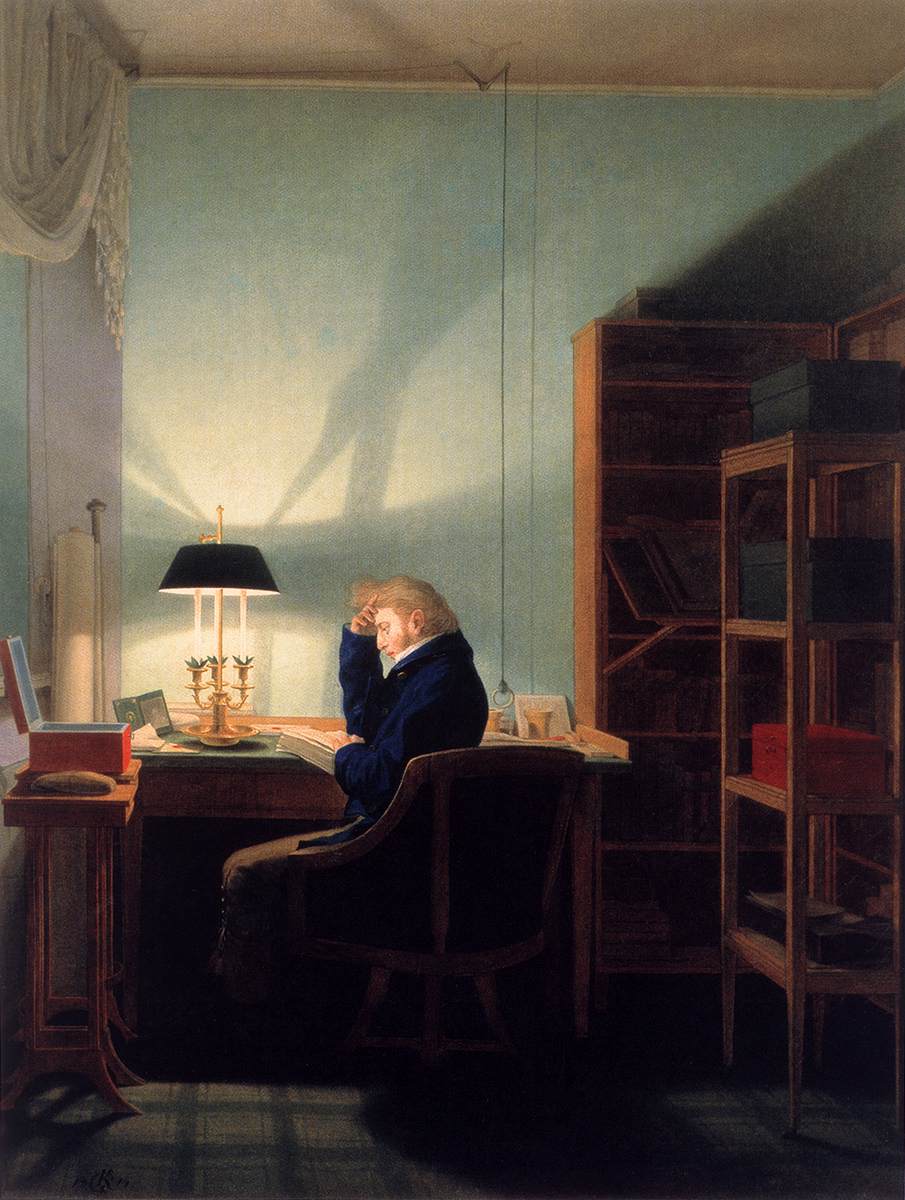 |
| (Man Reading by Lamplight by Georg Friedrich Kersting, 1814, Oil on canvas, 48 x 37 cm, Oskar Reinhart Collection, Winterthur) |
Thursday, November 3, 2011
Ignoria: Richard Dawkins - La improbabilidad de Dios (1998)...
Ignoria: Richard Dawkins - La improbabilidad de Dios (1998)...: La gente hace muchas cosas en nombre de Dios. Los irlandeses se vuelan los unos a los otros en su nombre. Los árabes ...
Monday, October 24, 2011
Mozart, Hölderlin y las doce variaciones de una cancioncita
Lo tomé de este post: Mozart, Hölderlin y las doce variaciones de una ca...
Se la cataloga como K (o KV) 265 o K (o KV) 265/300e. Su título original sería Zwölf Variationen in C über das französische Lied «Ah, vous dirai-je Maman» (KV 265), que es, más o menos, Doce Variaciones para piano en do mayor sobre la canción francesa «Ah vous dirai-je, Maman». La partitura consta de trece partes, la cancioncita original (ya me dirán si la conocen) y las variaciones I, II, III... hasta la XII. Sólo las variaciones XI y XII tienen indicaciones sobre el tempo (adagio la XI y allegro la XII) y el resto quedan a discreción del pianista. Se publicaron por primera vez en 1785, aunque fueron compuestas, dicen, entre 1781 y 1782.
******************
Se la cataloga como K (o KV) 265 o K (o KV) 265/300e. Su título original sería Zwölf Variationen in C über das französische Lied «Ah, vous dirai-je Maman» (KV 265), que es, más o menos, Doce Variaciones para piano en do mayor sobre la canción francesa «Ah vous dirai-je, Maman». La partitura consta de trece partes, la cancioncita original (ya me dirán si la conocen) y las variaciones I, II, III... hasta la XII. Sólo las variaciones XI y XII tienen indicaciones sobre el tempo (adagio la XI y allegro la XII) y el resto quedan a discreción del pianista. Se publicaron por primera vez en 1785, aunque fueron compuestas, dicen, entre 1781 y 1782.
Años después, la pieza protagonizaría un episodio más bien curioso (si bien irritante) de la vida de Hölderlin.
Johann Christian Friedrich Hölderlin, que así
se llamaba, fue un grandísimo poeta, uno de los más grandes que ha
parido Alemania. Es inseparable del Romanticismo y del idealismo alemán,
que le inspiró y al que inspiró. Como ven, nadie es perfecto, pero aún
así, insisto, escribió grandes poemas y tradujo a Píndaro al alemán,
compartiendo el amor de Goethe y Schiller por Grecia. Fue compañero de
pupitre de Hegel (también es mala suerte) y compañero de clase de
Schelling (lo mismo). Semejante compañía acabaría afectándole (aunque
digan que no), porque se le diagnosticó hipocondría en 1800, lo que hoy vendríamos a clasificar más técnicamente como chaladura.
Declarado mentalmente incapacitado por los tribunales y deshauciado por
el doctor Autenrieth (inventor de la máscara que lleva el personaje
Hannibal Lecter en The Silence of the Lambs), éste lo hechó de
su clínica de Tubinga pronosticándole apenas tres meses de vida y un
estado mental irrecuperable. ¡Qué gran persona, este médico!
Un carpintero de Tubinga, Ernst Zimmer, un
personaje culto que había leído algunos poemas de Hölderlin, se apiadó
de él y le dejó una habitación en lo alto de un torreón desde la cual
contemplar el paisaje del río Neckar los últimos días de su vida. Pero
lejos de diñarla en tres meses, Hölderlin vivió ¡cuarenta años!
en esa habitacioncita de quince metros cuadrados, donde escribió
grandísimos poemas, puso patas arriba la literatura europea y se dedicó a
tocar su espineta (una especie de piano pequeñito) todos los días,
varias veces al día, para desesperación de Zimmer y los demás vecinos.
Porque, he aquí la conexión entre Mozart, Hölderlin y la cancioncita
francesa, Hölderlin sólo sabía tocar las variaciones de Mozart de «Ah, vous dirai-je Maman», ésas que tocaba día tras día, una y otra vez, y otra, y otra...
******************
******************
******************
Curiosity
Hölderlin and Version Control
Sometimes he wrote a rough sketch on the lower part of next page that was separated by a continuous line from the rest of the manuscript. As this sketch was worked out, he transferred its contents to the upper part of the page.
This approach was not unusual for the eighteenth century and various versions of it survived into the twentieth century. Thus, I was taught (late fifties, early sixties) to divide every page in a notebook in half by folding it (and then flatten it again). The first draft was to be written on one the right half of the page. The other half was to be used for revisions. What makes Hölderlin's approach remarkable is that he planned for three times the revisions (and apparently used up the space as well). Among other things, this shows that his poetry was not the result of sudden inspiration, but of gradual reworking of the first draft. The editors of the Frankfurt Edition of Hölderlin's work like to speak of "ideal growth."
Whether "ideal" or not, this kind of growth is difficult to see in an electronic text, unless, of course, the author used version control. This may not be a bad thing entirely
Friday, October 21, 2011
EL SEÑOR SCARDANELLI de Pere Gimferrer en Dietario
Para visitar al señor Scardanelli había que ir a casa del carpintero. Un carpintero cultivado, de todos modos; un buen hombre si los hay. El señor Scardanelli vive en una torre, sobre el río Neckar, tutelado por el carpintero. Al llegar a la habitación oís una voz; pero no, no hay nadie de visita: es el señor Scardanelli hablando solo. Cuando llamáis a la puerta, pidiendo permiso para entrar, esa voz os responde en tono resuelto, brusco, casi violento. Pero, en cambio, cuando véis al Bibliotecario (porque Scardanelli, recluido en la torre desde hace treinta años, continúa dándose este título), os encontráis con una silueta frágil, magra, que hace reverencias y se deshace en cumplidos. El señor Scardanelli, el bibliotecario, habla medio en alemán medio en francés, y a veces medio en griego o latín; pasa muchas horas mirando el río y la larga perspectiva de los prados en el horizonte verde y límpido, montañoso; a veces, hace leña con las ramas muertas del ciruelo del jardín; a menudo, toca el clavicémbalo, con elegancia y precisión, pero con el ruido, angustioso y sórdido, de las uñas demasiado largas —que no se deja cortar— rozando las teclas. En detalles como este notamos que el señor Scardanelli está loco.
De vez en cuando alguien le pide unos poemas. El señor Scardanelli improvisa alguna composición muy breve, casi siempre una variación paisajística sobre la armonía entre el hombre y el mundo visible en el curso de las estaciones del año, y firma: «Vuestro humilde servidor, Scardanelli.» Al entregar sus versos al visitante, Scardanelli lo mantiene a distancia mientras lo abruma con títulos hiperbólicos y exageradas muestras de ceremonioso respeto. Lo más impresionante, sin embargo, es el contraste entre la serenidad luminosa de los versos transparentes y seguros y la falta de continuidad —como una disolución interior de la conciencia— en los pensamientos de Scardanelli.
Antes, Scardanelli no se llamaba Scardanelli; se llamaba Hölderlin, y mientras vive encerrado en la torre del carpintero, se van publicando buena parte de las obras, escritas antes, que hacen de él uno de los más grandes poetas del Romanticismo. El precio que ha pagado es, sin embargo, muy alto. A los treinta y un años, Hölderlin escribía a un amigo: «Tengo miedo de que me ocurra como a Tántalo, que recibió de los dioses más de lo que podía digerir.» Es el primer aviso: cuatro años más tarde, un médico dirá que su locura se ha hecho frenética; cinco años más tarde habrá que internarlo. Morirá, dulcemente, a los setenta y tres, sin agonía.
(14 de noviembre)
De vez en cuando alguien le pide unos poemas. El señor Scardanelli improvisa alguna composición muy breve, casi siempre una variación paisajística sobre la armonía entre el hombre y el mundo visible en el curso de las estaciones del año, y firma: «Vuestro humilde servidor, Scardanelli.» Al entregar sus versos al visitante, Scardanelli lo mantiene a distancia mientras lo abruma con títulos hiperbólicos y exageradas muestras de ceremonioso respeto. Lo más impresionante, sin embargo, es el contraste entre la serenidad luminosa de los versos transparentes y seguros y la falta de continuidad —como una disolución interior de la conciencia— en los pensamientos de Scardanelli.
Antes, Scardanelli no se llamaba Scardanelli; se llamaba Hölderlin, y mientras vive encerrado en la torre del carpintero, se van publicando buena parte de las obras, escritas antes, que hacen de él uno de los más grandes poetas del Romanticismo. El precio que ha pagado es, sin embargo, muy alto. A los treinta y un años, Hölderlin escribía a un amigo: «Tengo miedo de que me ocurra como a Tántalo, que recibió de los dioses más de lo que podía digerir.» Es el primer aviso: cuatro años más tarde, un médico dirá que su locura se ha hecho frenética; cinco años más tarde habrá que internarlo. Morirá, dulcemente, a los setenta y tres, sin agonía.
El destino de Hölderlin es una inmolación. Como la locura de Schumann, la de Hölderlin parece la señal suprema de la posesión del hombre por un absoluto demasiado fuerte y que lo cuartea. El individuo extravagante, sometido y exageradamente educado, para quien el mundo se había reducido a las dimensiones de una habitación y al paisaje que le era visible desde la ventana, no desmiente quizá, sino que corrobora, el poeta amplio y visionario de los años de lucidez. Quizá lo que Hölderlin llegó a conocer, al convertirse en Scardanelli, no era sino la síntesis final de lo que buscó, convulsiva y patéticamente, mientras se mantuvo cuerdo. En la paz de la locura vio la otra cara del mundo.
(14 de noviembre)
Sol y Carne [fragmento] de Arthur Rimabud
III
¡Si el tiempo retomara, el tiempo que ya fue...!
––¡El Hombre está acabado, se acabó su teatro!
Y un día, a plena luz, harto de romper ídolos,
libre renacerá, libre de tantos dioses,
buceando en los cielos, pues pertenece al cielo.
¡El Ideal, eterno pensamiento invencible,
ese dios que se agita en la camal arcilla,
subirá, subirá, y arderá en su cabeza!
Y, cuando lo sorprendas mirando el horizonte,
libre de viejos yugos que desprecia sin miedos,
vendrás a concederle la santa Redención
––Espléndida, radiante, del seno de los mares
nacerás, derramando por el vasto Universo
el Amor infinito en su infinita risa:
el Mundo vibrará como una lira inmensa
en el temblor sin límites de un beso repetido.
––¡El Hombre está acabado, se acabó su teatro!
Y un día, a plena luz, harto de romper ídolos,
libre renacerá, libre de tantos dioses,
buceando en los cielos, pues pertenece al cielo.
¡El Ideal, eterno pensamiento invencible,
ese dios que se agita en la camal arcilla,
subirá, subirá, y arderá en su cabeza!
Y, cuando lo sorprendas mirando el horizonte,
libre de viejos yugos que desprecia sin miedos,
vendrás a concederle la santa Redención
––Espléndida, radiante, del seno de los mares
nacerás, derramando por el vasto Universo
el Amor infinito en su infinita risa:
el Mundo vibrará como una lira inmensa
en el temblor sin límites de un beso repetido.
––El Mundo está sediento de Amor: aplácalo.
Complete English version: Soleil et Chair
III
If only the times which have come and gone might come again!
- For Man is finished! Man has played all the parts!
In the broad daylight, wearied with breaking idols
He will revive, free of all his gods,
And, since he is of heaven, he will scan the heavens!
The Ideal, that eternal, invincible thought, which is
All; The living god within his fleshly clay,
Will rise, mount, burn beneath his brow!
An when you see him plumbing the whole horizon,
Despising old yokes, and free from all fear,
You will come and give him holy Redemption!
- Resplendent, radiant, from the bosom of the huge seas
You will rise up and give to the vast Universe
Infinite Love with its eternal smile!
The World will vibrate like an immense lyre
In the trembling of an infinite kiss!
- For Man is finished! Man has played all the parts!
In the broad daylight, wearied with breaking idols
He will revive, free of all his gods,
And, since he is of heaven, he will scan the heavens!
The Ideal, that eternal, invincible thought, which is
All; The living god within his fleshly clay,
Will rise, mount, burn beneath his brow!
An when you see him plumbing the whole horizon,
Despising old yokes, and free from all fear,
You will come and give him holy Redemption!
- Resplendent, radiant, from the bosom of the huge seas
You will rise up and give to the vast Universe
Infinite Love with its eternal smile!
The World will vibrate like an immense lyre
In the trembling of an infinite kiss!
- The World thirsts for love: you will come and slake its thirst.
Complete French version: Soleil et Chair
III
Si les temps revenaient, les temps qui sont venus !
- Car l'Homme a fini ! l'Homme a joué tous les rôles !
Au grand jour, fatigué de briser des idoles
Il ressuscitera, libre de tous ses Dieux,
Et, comme il est du ciel, il scrutera les cieux !
L'idéal, la pensée invincible, éternelle,
Tout ; le dieu qui vit, sous son argile charnelle,
Montera, montera, brûlera sous son front !
Et quand tu le verras sonder tout l'horizon,
Contempteur des vieux jougs, libre de toute crainte,
Tu viendras lui donner la Rédemption sainte !
- Splendide, radieuse, au sein des grandes mers
Tu surgiras, jetant sur le vaste Univers
L'Amour infini dans un infini sourire !
Le Monde vibrera comme une immense lyre
Dans le frémissement d'un immense baiser
- Car l'Homme a fini ! l'Homme a joué tous les rôles !
Au grand jour, fatigué de briser des idoles
Il ressuscitera, libre de tous ses Dieux,
Et, comme il est du ciel, il scrutera les cieux !
L'idéal, la pensée invincible, éternelle,
Tout ; le dieu qui vit, sous son argile charnelle,
Montera, montera, brûlera sous son front !
Et quand tu le verras sonder tout l'horizon,
Contempteur des vieux jougs, libre de toute crainte,
Tu viendras lui donner la Rédemption sainte !
- Splendide, radieuse, au sein des grandes mers
Tu surgiras, jetant sur le vaste Univers
L'Amour infini dans un infini sourire !
Le Monde vibrera comme une immense lyre
Dans le frémissement d'un immense baiser
- Le Monde a soif d'amour : tu viendras l'apaiser.
Subscribe to:
Posts (Atom)