Showing posts with label Expresionismo. Show all posts

Sunday, December 13, 2020

Poemas de Heym en español varios traductores

POEMAS DE GEORG HEYM
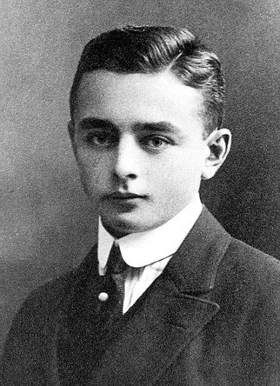

(30 de octubre de 1887, Jelenia Góra, Polonia - 16 de enero de 1912, Berlín, Alemania)

Después de la batalla


En los sembrados yacen apretados cadáveres,
en el verde lindero, sobre flores, sus lechos.
Armas perdidas, ruedas sin varillas
y armazones de acero vueltos del revés.

Muchos charcos humean con vapores de sangre
que cubren de negro y rojo el pardo campo de batalla.
Y se hincha blanquecino el vientre de caballos
muertos, sus patas extendidas en el amanecer.

En el viento frío aún se congela el llanto
de los moribundos, y por la puerta este
una luz pálida aparece, un verde resplandor,
la cinta diluida de una aurora fugaz.
Versión de Jenaro Talens
"Tres poetas expresionistas alemanes" Ediciones Hiperión 1998
  

Duermevela


La tiniebla cruje como un vestido,
los árboles vacilan en el horizonte.

Refúgiate en el corazón de la noche,
excava dentro de la oscuridad un escondrijo
como la abeja en el panal. Hazte pequeño,
baja de tu yacija.

Algo desea atravesar los puentes,
piafa curvando las pezuñas,
descarriadas, empalidecen las estrellas .

Como una anciana la luna se mueve
de un lado para otro
con el lomo encorvado.
Versión de Jenaro Talens

Ofelia


I
Ratas de agua anidan en su pelo,
y anillos en sus manos, que como aletas son
sobre las olas; nada en la sombría
selva grande que en el agua reposa.

El sol postrero que va errante y a oscuras
se hunde profundamente en su cabeza.
¿Por qué murió? ¿Por qué tan sola nada
sobre el agua que enreda los helechos?

El viento acecha en los espesos juncos
como mano que espanta los murciélagos.
Húmedos por el agua, con sus alas sombrías
en el oscuro río se alzan como humo,

como nocturnas aves. Largas anguilas blanquecinas
sobre el pecho resbalan. Una luciérnaga aparece
en su frente. Sus hojas llora un sauce
sobre ella y su pena silenciosa.
II
Granos. Sembrados. Y el rojo sudor en la mitad del día.
Los amarillos vientos de los campos duermen silenciosos.
Ofelia quiere dormir, un pájaro, se acerca.
Le abrigan, blancas, las alas de los cisnes.

Los párpados azules sombrean dulcemente
y entre el aire que brilla en las guadañas
sueña en el carmesí de algún abrazo
sueño eterno en su eterna sepultura.

Pasa, vuelve a pasar. Donde la orilla sueña
con el bullicio de la ciudad, y el río blanco
rompe diques y el eco largamente
retumba. Donde se oye, río abajo,

el son de llenas calles. Repique de campanas.
El silbido de un tren. Lucha. Cae al oeste
sobre cristales empañados una sorda luz crepuscular
en que con brazos gigantescos una grúa amenaza,

tirano poderoso, la frente ennegrecida,
Moloc al que rodean sus siervos de rodillas.
Carga de puentes que atraviesan con pesadez el río
tal si lo encadenaran, dura condenación.

Nada invisible que acompañan las olas.
Pero allí donde cruza ahuyenta multitudes,
con grandes alas, un pesar profundo
que ambas orillas ensombrece a lo ancho.

Pasa, vuelve a pasar. Cuando se entrega tarde a la tiniebla
el alto día oeste del verano,
donde en el verde oscuro de los prados reposa
el cansancio sutil de la tarde lejana.

Lejos la arrastra el río, mientras se hunde
en luctuosos puertos invernales.
Tiempo abajo. Por entre eternidades
cuyo horizonte humea como fuego.
Versión de Ernst Edmund Keil
"Tres poetas expresionistas alemanes" Ediciones Hiperión 1998


Última vigilia


Qué oscuras son tus sienes,
tus manos, qué pesadas.
¿Tan lejos ya de mí
que no me escuchas?

Bajo las llamaradas de la luz
estás tan triste y tan envejecida.
Tus labios cruelmente
crispados en eterna rigidez.

Mañana será ya todo silencio,
y quizá esté en el aire
todavía el crujir de las coronas,
y un olor a podrido.

Pero las noches cada año
se vacían aún más.
Aquí, donde yacía tu cabeza
y ligera fue siempre tu respiración.
Versión de Ernst Edmund Keil
"Tres poetas expresionistas alemanes" Ediciones Hiperión 1998


Umbra Vitae


Adelante se inclinan los hombres por las calles,
contemplando los signos de los cielos,
en donde los cometas, con narices de fuego,
amenazantes se deslizan en torno de las torres.

Los astrólogos llenan los tejados
y clavan en el cielo largos tubos,
y hay hechiceros: brotan de desvanes
retorcidos, a oscuras, conjurando los astros.

Los suicidas andan en grandes hordas
buscando entre la noche su existencia perdida,
encorvados sobre los puntos cardinales,
barriendo el polvo con escobas como brazos pobres.

Polvo que apenas dura,
perdiendo en el camino sus cabellos,
brincan, aprisa mueren
y yacen en el campo con la cabeza rota,

pataleando, a veces, todavía. Y las bestias del campo
alrededor transitan ciegamente y les clavan
los cuernos en el vientre. Se enfrían sepultados
bajo salvias y espinos.

Pero los mares se detienen. Los barcos,
suspendidos en olas, con aflicción se pudren,
dispersos, y no hay corriente móvil
y los patios celestes están todos cerrados.

Los árboles no cambian estaciones,
eternamente muertos en su fin
y abren sus largas manos, sus dedos de madera
por caminos ruinosos.

Quien va a morir se sienta para levantarse
y acaba de decir sus últimas palabras.
Se desvanece de pronto. ¿En dónde está su vida?
Sus ojos se quiebran como el cristal.

Muchos son sombras. Escondidas y turbias.
Sueños que rozan sobre puertas mudas.
Quien despierta agobiado por otras madrugadas
debe quitar la pesadez del sueño de sus párpados grises.
Versión de Ernst Edmund Keil
"Tres poetas expresionistas alemanes" Ediciones Hiperión 1998


LOS DEMONIOS DE LAS CIUDADES


(1910)

Recorren la noche de las ciudades,
Que negras se doblegan bajo su pie.
Como barbas de marinero en torno a su mentón
Están negras las nubes por el humo y el hollín.

Su larga sombra se balancea en el mar de casas
Y apaga las hileras luminosas de las calles.
Ella se desliza con dificultad como niebla sobre pavimento
Y lenta anda a tientas casa por casa.

Sobre una plaza ha colocado un pie,
Y arrodillado apoya el otro sobre una torre,
Así se alzan, donde cae negra la lluvia,
Tocando las flautas de Pan en la tormenta de nubes.

En torno a sus pies gira el ritornello
Del mar de las ciudades con música triste,
Un gran canto fúnebre. Ya sordo, ya estridente
Cambia el tono, que se eleva en lo oscuro.

Caminan junto al río, que negro y ancho
Como un reptil, su espalda manchada de amarillo
Por las farolas, se retuerce triste
En la oscuridad, que cubre de negro el cielo.

Se apoyan con dificultad sobre un muro de un puente
Y hunden sus manos en el enjambre
De hombres, como faunos que al borde
De los pantanos hurgan con su brazo en el fango.

Uno se levanta. Cuelga ante la luna blanca
Una máscara negra. La noche, que cae
Como plomo del cielo sombrío, profundamente
Empuja las casas al pozo de lo oscuro.

Crujen los hombros de las ciudades. Y estalla
Un tejado, del que brota un fuego rojo.
Se sientan despatarrados en su cima
Y como gatos maúllan al firmamento.

En un cuarto cubierto de tinieblas
Grita una parturienta con dolores.
Su cuerpo fuerte sobresale enorme de las almohadas,
Y en torno a él, de pie, los grandes diablos.

Se aferra temblando al potro del dolor.
En torno a ella, la habitación oscila por su grito.
Llega el feto. Se abren sus entrañas, rojas y largas,
Y sangrantes las desgarra el feto.

Los cuellos de los diablos se alargan como jirafas.
El niño, sin cabeza. La madre lo tiende
Ante sí. Cae hacia atrás, en su espalda,
Hendidos, los dedos de rana del espanto.

Pero los demonios se hacen enormes.
El cuerno de su sien desgarra rojo el cielo.
En torno a su pezuña, el terremoto truena
Por el seno de las ciudades, propaga el fuego.


EL DIOS DE LA CIUDAD

(1910)

Se sienta despatarrado sobre un bloque de casas.
Los vientos se acumulan sombríos en torno a su frente.
Lleno de furia mira a lo lejos, adonde
En soledad se pierden las últimas casas en el campo.

Desde el atardecer le brilla a Baal su panza roja,
Las grandes ciudades se arrodillan en torno a él.
Las innumerables campanas de las iglesias
Se alzan hacia él desde un mar de negros campanarios.

Como danza de coribantes brama la música
De multitudes por las calles.
El humo de las chimeneas, las nubes de la fábrica
Hacia él se elevan, igual que azulea el aroma de incienso.

La tormenta se inflama en sus cejas.
El oscuro atardecer se adormece en la noche.
Las tempestades revolotean, y como buitres miran
Desde su cabellera que se eriza de cólera.

Él levanta en la oscuridad su puño carnicero.
Lo agita. Un mar de fuego, veloz, recorre
Una calle. Y el vapor ardiente ruge
Y la devora, hasta que tarde despunta la mañana.


LAS CIUDADES

(1911)

Accidentadas calles de ciudades
Que se oscurecen agazapadas en la tarde,
Multitud de perros ladrando en el vacío.
Y sobre los puentes, vimos grandes coches,

Voces temblorosas, traídas por el soplo del viento.
Y ojos redondos nos observaban tristes
Y grandes rostros, sobre los que fluía
La remota carcajada de maliciosas frentes.

Dos pasaron por delante con abrigos amarillos,
Llevaban nuestras cabezas ante sí
Cubiertas de sangre, y en sus mejillas hundidas
Todavía por secarse un último rojo.

Huimos por miedo. Pero un río de blancas ondas
Nos impedía el paso con dientes regañados.
Y tras nosotros, el inflamado sol poniente
Ahuyentaba calles muertas con espada feroz.

Robespierre


Emite unos balidos. Los ojos, fijos
en la paja del carro. Masca unas blancas
flemas que absorbe y traga por los carrillos.
El pie desnudo le cuelga entre dos trancas.

Se sacude el carro. A lo alto lo lanza.
Las cadenas en sus brazos: sonajero.
Unos críos chillan sus risas en chanza;
los alzan sus madres entre el hervidero.

Las cosquillas en la pierna, ni las nota.
El carro para. Y él ve al alzar los ojos,
negro, un cadalso donde la calle acaba.

La frente, ceniza, de sudor rociada.
Una mueca horrible el rostro le deforma.
Se espera un grito. Mas no se escucha nada.


¿Por qué vienes, polillas blancas ...


? ¿Por qué vienes, polillas blancas, tan a menudo para mí?
Las almas de los dea, ¿por qué revoloteas tanto
sobre mi mano? su aleteo a menudo
Leaven luego un pequeño rastro de cenizas.

Tú que
moras cerca de las urnas, en un lugar donde reposan los sueños,
encorvado en sombras eternas, en la tenue extensión
Como en las bóvedas de las tumbas, los murciélagos se
alejan en el tumulto todas las noches.

A menudo no escucho en sueños los ladridos de los vampiros;
Suenan como si la luna sombría se estuviera riendo.
Y veo profundamente en las cavernas vacías
Las velas de las sombras sin hogar.

¿Qué es toda la vida? El breve estallido de las antorchas
rodeadas de sustos distorsionados en la negrura oscura
Y algunos de ellos ya se acercan
y con manos delgadas alcanzan las llamas.

¿Qué es toda la vida? Pequeño recipiente en los abismos
del mar olvidado. Terribles cielos rígidos.
O como en la noche, a través de los campos desnudos, la luz de la luna se
apaga hasta que desaparece.

Ay de aquel que una vez vio a alguien morir,
Cuando en la calma de la fría muerte de otoño
Inadvertidamente se acercó al lecho húmedo del enfermo
y le ordenó que pasara, mientras que como el silbido

y el traqueteo de una tubería de órgano oxidado,
su garganta exhalaba su último aliento con un silbido.
¡Ay de tales testigos! Llevan para siempre
La flor pálida de un horror de plomo.

¿Quién abrirá las tierras más allá de nuestra muerte?
Y quién será la puerta de la gigantesca runa.
¿Qué ven los moribundos que les hace rodar
El blanco ciego de sus ojos tan terriblemente?

Traducido por Reinhold Grimm

Sunday, December 27, 2015

Imagining The Great War, Part Two

Imagining The Great War, Part Two

The Coming Apocalypse: Ludwig Meidner and the Poets
In the winter of 1912, the German poet Georg Heym fell through a hole in the ice and drowned. The strange death of the twenty-four year of poet was surrounded by an odd mixture of conjecture and fact. It was thought that on January 16th, he was attempting to rescue his friend, Ernst Balcke, also a poet, who had plunged into the icy waters of the river. This assumption was based upon the apparent fact that Heym was able to hang on to the edge of the ice and shout for help, his cries reaching foresters working at the banks of the Havel. For some reason, the woodsmen were unwilling to lend their ropes or ladders to help one of the poetic geniuses of twentieth century poetry. Eventually Heym’s fingers slipped off the ice and he sank to his death. When the two bodies were recovered two days later, it was unclear whether Blaeke and Heym, two poets on a skating trip, died from drowning or hypothermia. In his 1971 article,”Ogling through Ice: The Sullen Lyricism of Georg Heym,” one of Heym’s English translators, Peter Viereck reported that when his friends saw Heym in his coffin, he was still frozen enough for his features to have retained “The bitter expression of his lips, twisted by the horror of fifteen minutes of continuous screaming for help to onlookers.” What makes the death of Heym even more eerie is that he dreamed that he would die by falling through the ice and in 1910 wrote down his dream, a dream that horribly came true, but without the happy ending:
I found myself standing on the banks of a great lake which seemed to be covered with a type of stone coating. It struck me as a sort of frozen water. On occasion it seemed to be like the sort of skin that forms on top of milk. Some people were moving on the lake, people with bags or baskets, perhaps they were going to market. I ventured a couple of steps, and the plates held. I felt that they were very thin, since as I stepped upon them they swayed back and forth. I had gone for some time and then a woman encountered me, who cautioned me to turn back, the plates would soon break. But I persisted. And suddenly I felt that the plates were dissolving beneath me, but I did not fall. I proceeded further, walking upon the water. Then the thought occurred to me that I might fall. In that moment, I sank into green, slimy, kelp-infested waters. Still, I did not feel lost, I began to swim. As though by a miracle, the shore, though first distant, drew closer and closer, and with a few strokes I landed in a sandy, sunny harbor.
Georg Heym (1887-1912) wasn’t the only prophet who was having dreams. A year later, Carl Jung (1875-1961) also had a prophetic dream, one he dreamed three times. In October 1913, a year after the death of Heym, Jung reported in his book, Memories, Dreams, Reflections,
..while I was alone on a journey, I was suddenly seized by an overpowering vision: I saw a monstrous flood covering all the northern and low-lying lands between the North Sea and the Alps. When it came up to Switzerland I saw that the mountains grew higher and higher to protect our country. I realized that a frightful catastrophe was in progress. I saw the mighty yellow waves, the floating rubble of civilization, and the drowned bodies of uncounted thousands. Then the whole sea turned to blood. This vision last about one hour. I was perplexed and nauseated, and ashamed of my weakness.
Two weeks passed; then the vision recurred, under the same conditions, even more vividly than before, and the blood was more emphasized. An inner voice spoke. “Look at it well; it is wholly real and it will be so. You cannot doubt it.” That winter someone asked me what I thought were the political prospects of the world in the near future. I replied that I had no thoughts on the matter, but that I saw rivers of blood.
I asked myself whether these visions pointed to a revolution, but could not really imagine anything of the sort. And so I drew the conclusion that they had to do with me myself, and decided that I was menaced by a psychosis. The idea of war did not occur to me at all.
Soon afterward, in the spring and early summer of 1914, I had a thrice-repeated dream that in the middle of summer an Arctic cold wave descended and froze the land to ice. I saw, for example, the whole of Lorraine and its canals frozen and the entire region totally deserted by human beings. All living green things were killed by frost. This dream came in April and May, and for the last time in June, 1914.
In the third dream frightful cold had again descended from out of the cosmos. This dream, however, had an unexpected end. There stood a leaf-bearing tree, but without fruit (my tree of life, I thought), whose leaves had been transformed by the effects of the frost into sweet grapes full of healing juices. I plucked the grapes and gave them to a large, waiting crowd…
On August 1 the world war broke out.
24962
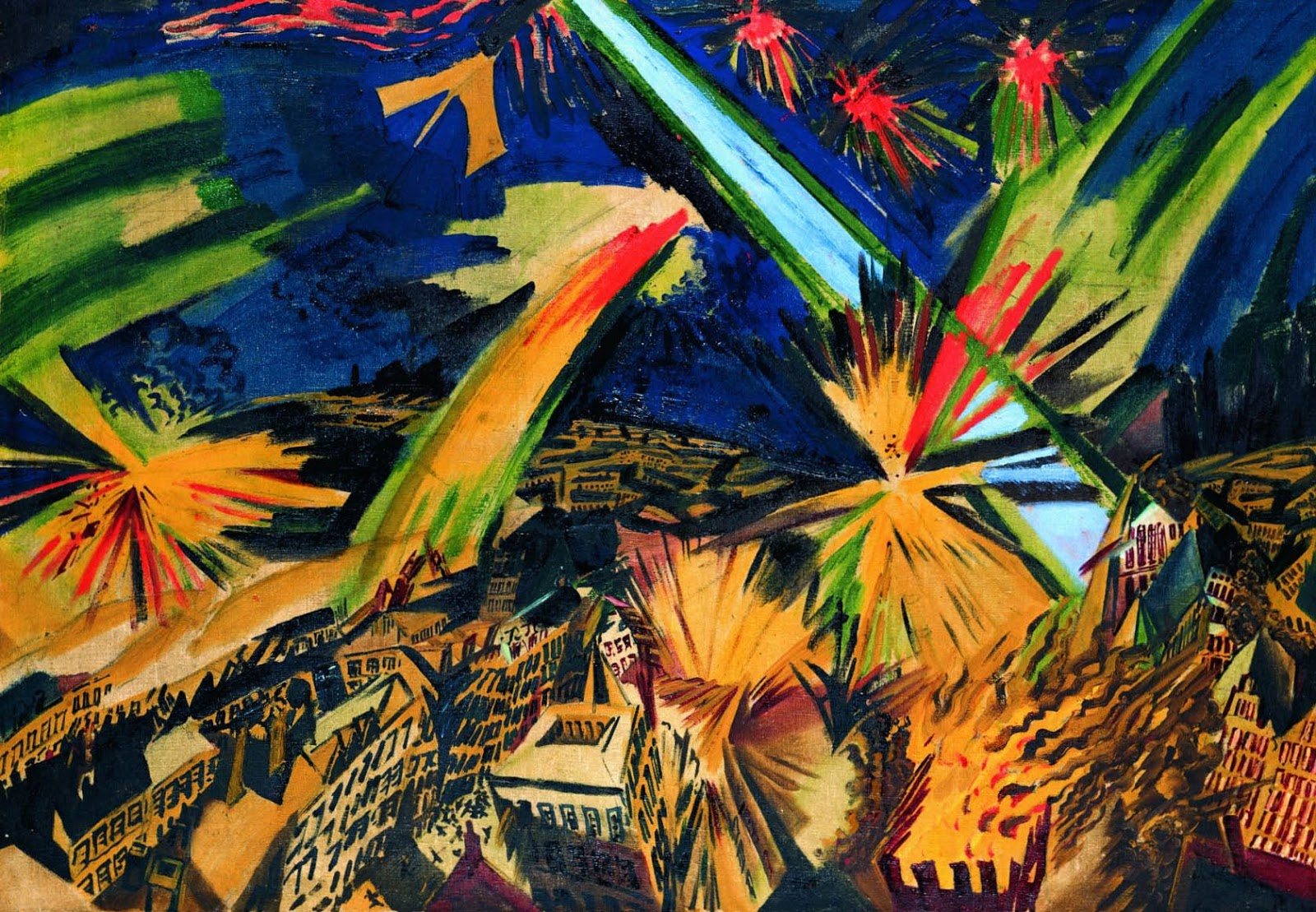
Ludwig Meidner. Apocalyptic Landscape (1913)
The coming of the war, known later as the “Great War,” had been foretold by astrology, Biblical prophecies, individual dreams, art and poetry. Georg Heym wrote his best poetry in the year of his death and these poems of a few months reflected the apocalyptic mood that had descended over Germany just before the Great War. He was part of a group of like-minded young poets, seething with rebellion and disgust for the bourgeois life in the “miserable Prussian shitstate.” He longed, as did many of his generation for a war, complaining, “If only someone would start a war, it needn’t even be a just one.” He was part of the loosely organized group of Expressionists who drifted in and out of Berlin, writers, poets and artists, all of whom were questioning the stultifying Wilhemine society in the famous Neue Club, a quarrelsome group of new poets who met at the avant-garde gathering place, Café des Westens. The 2012 article, “Apocalypse Then: Georg Heym & the Art of Cultural Divination,” noted that Heym was one of an even smaller and more radical splinter of the Club that broke and became part of Neopathetische Cabaret, more or less organized by Jakob Van Hoddis (1887-1942). Heym, fascinated with the doomed French Revolutionaries, Robespierre and Danton, was remembered by Dada artist, Emmy Hennings as “half bandit… half angel.” The poet Alfred Lichenstein (1889-1914) was also a member of this loosely composed group of Expressionists, transfixed by a somewhat undigested stew of Nietzsche, Vincent van Gogh, Edvard Munch, Charles Baudelaire, Paul Verlaine and Arthur Rimbaud, and even the writings of Sigmund Freud, all overseen by the overarching patronage of Herwarth Walden’s gallery and journal, Der Stürm. Heym, Van Hoddis and Lichtenstein all wrote poems, half-mad with tormented dreams of disaster, and all came to tragic ends. Lichenstein died in the second month of the First World War he had foreseen, Van Hoddis, a friend of the artist, Ludwig Meidner, went mad, was placed in a Jewish care home, from which he and his fellow inmates were taken and put to death by the Nazis at Sobibor in 1942, and Heym was quite forgotten until someone one noticed, after the Second World War, that he may have predicted the carpet bombing of cities.
Meidner_TheBurningCity1913
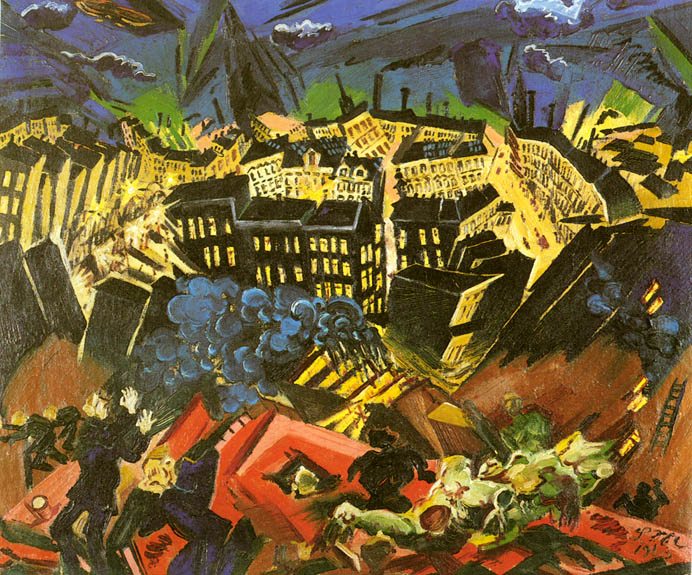
Ludwig Meidner. Burning City (reverse) (1913)
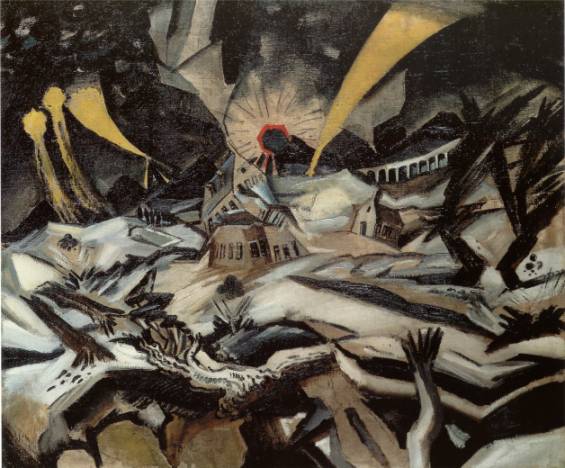
One of the problems of translation–whether of poems or paintings–is interpretation. Choosing the right words or the precise turn of phrase to create  a consistency of meaning between languages is one thing, but understanding the work of art in its own context is yet another necessary element in comprehending its original meaning. The apocalyptic paintings of Ludwig Meidner (1884-1966) imagined the destruction of the city, probably the city of Berlin, where he lived..uneasily. His works precisely parallel the poems of the poets who mingled freely with the artists at Café des Westens. It is no coincidence that he formed the counterpoint of the poets’ Neopathetische Cabaret, Die Pathetiker, for visual artists. What makes these two linked and distinct bodies of art particularly complex is that their meanings were historically divided. Before the war, the paintings of Meidner were commentaries on the rapidly changing city of Berlin, newly modern and oppressively modern. After the “Great War,” such works became retroactively apocalyptic, predictive of things to come, of events that arrived. During the same years as Heym, Van Hoddis and Litchenstein were writing their apocalyptic poems, Meidner was painting his apocalyptic landscapes. Van Hoddis’ poem End of the World (1911) is often credited with setting off a series of powerful and extremely visual poems, but what did they mean? Imagining the destruction of what–the cramped middle class world the poets protested against–the newly crowded and modern Berlin–the aging civilization of the Belle Epoch, the lingering decadence of the nineteenth century? In its eight lines, Weltende called for an end, a deluge, a destruction of anything and everything.
World’s End
1911
Whisked from the Bourgeois’ pointy head hat flies,
Throughout the heavens, reverberating screams,
Down tumble roofers, shattered ‘cross roof beams
And on the coast – one reads – floodwaters rise.
The storm is here, rough seas come merrily skipping
Upon the land, thick dams to rudely crush.
Most people suffer colds, their noses dripping
While railroad trains from bridges headlong rush.
Translated by Richard John Ascárate
Written two years later, Litchenstein’s Prophecy, a bit longer and no less violent, appeared. The young poet would be killed a year later, early in the war, as his poem seems to predict. Ironically he died on a piece of land that would be retaken by British troops, a company which included the poet Wilfred Owen, fighting for the soil where Litchenstein had fallen. What is clear, in reading these foretelling poems, is the difference between Expressionism in Berlin and that of Murnau, where Vassily Kandinsky (1866-1944) and Franz Marc (1880-1916) were exploring a very different version of this broad movement. Kandinsky and Marc both painted the end of the world and even wrote poetry about the end of time, but their end is more of a spiritual apocalypse, a collapse of a psychological state of yearning for a better world. Their paintings, rendered on the verge of a conflict, reflected the social uneasiness and cultural impetus towards an event or events that would end the ordered world of international exchange among the artistic fraternity. In Berlin, the dis-ease was more related to the social, cultural and political changes rippling across the capital. The “apocalypse” in all of these poems was material and real, just as Meidner’s landscapes were illustrative and representative of imagined horrors to come–the destruction of cities (Berlin) and perhaps the future to come.
Prophecy
1913
Alfred Litchtenstein
Some day – I have signs – a mortal storm
Is coming from the far north.
Everywhere is the smell of corpses.
The great killing begins.
The lump of sky grows dark,
Storm-death lifts its clawed paws;
All the lumps fall down,
Mimes burst. Girls explode.
Horses’ stables crash to the ground.
Not a fly can ecape.
Handsome homosexuals roll
Out of their beds.
The walls of houses develop fissures.
Fish rot in the stream.
Everything meets its own disgusting end.
Groaning buses tip over.


Prophezeiung 
 
Einmal kommt - ich habe Zeichen -
Sterbesturm aus fernem Norden.
Überall stinkt es nach Leichen.
Es beginnt das große Morden.
Finster wird der Himmelsklumpen.
Sturmtod hebt die Klauentatzen:
Nieder stürzen alle Lumpen.
Mimen bersten. Mädchen platzen.
Polternd fallen Pferdeställe.
Keine Fliege kann sich retten.
Schöne homosexuelle
Männer kullern aus den Betten.
Rissig werden Häuserwände.
Fische faulen in dem Flusse.
Alles nimmt sein ekles Ende.
Krächzend kippen Omnibusse.
 
Of course, whether referring to poetry or painting, the term “Expressionism” is a highly problematic one and is especially confusing when it is recalled that manifestations of the movement in Germany differed from city to city, from region to region, and from artist to artist. It is safe to say that in Berlin, the ideas of Friedrich Nietzsche (1844-1900) were appropriated by the artists and poets for their own purposes, while in Dresden his ideas were seized upon for very different reasons. And as has been seen, the situation among artists in Munich was unique to southern Germany. The contrasts were one of political revolution where the Übermensch would overthrow tradition and the elevation of Dionysus, where the irrational and the emotional would overthrow the reasonable and logical, existing among the many interpretations of the writer in a relatively new nation, composed of many principalities. The philosopher was, for the artists in general, a renegade voice, one of the many critical tools that they could pick up in their generational war with the conventional. In its own way, Thomas Mann’s Buddenbrooks: The Decline of a Family (1901) was as powerful an indictment of German society–not to mention a more recent and pertinent critique–as the clarion calls of Nietzsche for an overthrow of the old order.  But, according to Neil H. Donahue in his 2005 book A Companion to the Literature of German Expressionism, Mann disapproved of Expressionism: “We should recognize however that inherent to the Expressionist tendency in the arts there is an intellectual impetus to do violence to life.”
meidner2
Ludwig Meidner. Apocalyptic Landscape (1913)
Given the fragmentation of “expressionism” in Germany, the term has limited use. Expressionism, essentially an art dealer designation, today refers to the pre-war period in art and literature. Expressionism in Berlin was more linked to “modernism” than the version of Expressionism in either Dresden or Munich. Modernism, in Berlin, was Janus-faced, both utopian and destructive, laden with the fin-de-siècle pessimism and despair that was an international response to industrialization and the new technology that was both the beginning and end of a new era, the shape of which could not be foreseen–except as struggle and dark madness. Poetry and the paintings of slice of time before the world tilted into the abyss were full of violent forebodings. The posthumously famous poem, War, by Georg Heym became the hallmark of these years of nervousness.
War
1911
Georg Heym
He is risen now that was so long asleep
Risen out of vaulted places dark and deep.
In the growing dusk the faceless demon stands,
And the moon he crushes in his strong black hands.

In the nightfall noises of great cities fall
Frost and shadow of unfamiliar pall.
And the maelstrom of the markets turns to ice.
Silence grows. They look around. And no one knows.

Something touching them in side-streets makes them quail
Questions. There’s on answer. Someone’s face turns pale.
Far away a peal of church-bells trembles, thin,
Causes beards to tremble around their pointed chins.

On the mountains he’s begun his battle-dance,
Calling: Warriors, up and at them, now’s your chance!
There’s a rattling when he shakes his brute black head
Round which crudely hang the skulls of countless dead.

Like a tower he tramples out the dying light.
Rivers are brim-full of blood by fall of night.
Legion are the bodies laid out in the reeds,
Covered white with the strong birds of death.

Ever on he drives the fire and nightward-bound,
To the screams that come from wild mouths, a red hound.
Out of darkness springs the black domain of Nights,
Edges weirdly lit up by volcanic lights.

Pointed caps unnumbered, flickering, extend
Over the satanic plains from end to end.
And he casts allfleeing things down on the roads
Into fiery forests where the swift flame roars.

Forests fall to the consuming flames in sheaves,
Yellow bats whose jagged fangs claw at the leaves.
Like a charcoal burner in the trees he turns
His great poker, making them more fiercely burn.

A great city quietly sank in yellow smoke,
Hurled itself down into that abysmal womb.
But gigantic over glowing ruins stands
He who thrice at angry heavens shakes his brand.

Over storm-torn clouds’ reflected livid glow
At cold wastelands of dead darkness down below.
That his hellfire may consumer this night of horror
He pours pitch and brimstone down on their Gomorrha.

Translated by Patrick Bridgwater
It would be Ludwig Meidner who would bring these poetic visions of death and destruction to material life in painting over the few years that were left before an actual war made the violence very real.
If you have found this material useful, please give credit to
Dr. Jeanne S. M. Willette and Art History Unstuffed.   Thank you.
Filed Under: Modern Tagged With: , , , , , , , , , , , , , , , , , , , , , , , , , ,