Saturday, August 1, 2015

MONOLOGO DE NOVALIS


Es una cosa ciertamente extraña el hablar y el escribir; el verdadero diálogo es un mero juego de palabras. Es de admirar el ridículo error de que la gente crea que habla para decir las cosas. Precisamente lo propio del lenguaje, que sólo se preocupa de sí mismo, no lo sabe nadie. Por eso es un misterio tan maravilloso y fecundo que cuando uno habla sólo por hablar, justamente entonces, exprese las verdades más espléndidas y originales. Quiere, sin embargo, hablar de algo determinado, y el caprichoso lenguaje consigue que diga las cosas más ridículas y equivocadas. De ahí proviene también el odio que mucha gente seria siente contra el lenguaje. Nota su petulancia, pero no nota que aquel charlar que desprecian es la cara infinitamente seria del lenguaje. Si se pudiera hacer comprender a la gente que el lenguaje es como las fórmulas matemáticas – constituyen un mundo en sí – sólo juegan consigo mismas, no expresan otra cosa que su maravillosa naturaleza, y precisamente por eso son tan expresivas – y por eso se refleja en ellas el singular juego de relaciones de las cosas. Sólo por su libertad son miembros de la naturaleza y sólo en sus movimientos libres se manifiesta el alma del mundo y las convierte en una delicada medida y compendio de las cosas. Lo mismo sucede con el lenguaje – quien posea un fino sentido de su digitación, su compás, su espíritu musical, quien perciba el delicado efecto de su naturaleza interior, y mueva según éstos su lengua o su mano, llegará a ser un profeta, por el contrario, quien lo sepa, pero no tenga oído ni sentido suficiente, escribirá verdades como ésta, pero el lenguaje mismo le engañará y los hombres se burlarán de él como los troyanos hicieron con Casandra. Si con ello creo haber indicado de la forma más clara la esencia y la función de la poesía, sé que ningún hombre puede entenderlo y que he dicho una tontería, porque he querido decirlo y de esta forma no surge poesía. Pero ¿y si tuviera que hablar? ¿Y si este instinto del lenguaje que me hace hablar fuese la marca de la inspiración y los efectos del lenguaje en mí? ¿Y si mi voluntad sólo quisiera todo aquello que debe; así podría esto ser finalmente, sin yo saberlo ni creerlo, poesía y hacer comprensible un misterio del lenguaje? ¿Y así yo sería un escritor porque el destino me ha llamado, pues un escritor no es otra cosa que alguien poseído por el entusiasmo y el espíritu del lenguaje?
 
Novalis, Monólogo, Estudios sobre Fichte y otros escritos, R. Caner-Liese, Madrid, Ediciones Akal, 2007
Read in German


Novalis: Monologue


The excellent piece on Novalis in this week’s TLS quoted a bit of his brilliant Monolog, and it’s short enough I figured I’d just post the whole thing here:
Speaking and writing is a crazy state of affairs really; true conversation is just a game with words. It is amazing, the absurd error people make of imagining they are speaking for the sake of things; no one knows the essential thing about language, that it is concerned only with itself. That is why it is such a marvellous and fruitful mystery – for if someone merely speaks for the sake of speaking, he utters the most splendid, original truths. But if he wants to talk about something definite, the whims of language make him say the most ridiculous false stuff. Hence the hatred that so many serious people have for language. They notice its waywardness, but they do not notice that the babbling they scorn is the infinitely serious side of language. If it were only possible to make people understand that it is the same with language as it is with mathematical formulae – they constitute a world in itself – their play is self-sufficient, they express nothing but their own marvellous nature, and this is the very reason why they are so expressive, why they are the mirror to the strange play of relationships among things. Only their freedom makes them members of nature, only in their free movements does the world-soul express itself and make of them a delicate measure and a ground-plan of things. And so it is with language – the man who has a fine feeling for its tempo, its fingering, its musical spirit, who can hear with his inward ear the fine effects of its inner nature and raises his voice or hand accordingly, he shall surely be a prophet; on the other hand the man who knows how to write truths like this, but lacks a feeling and an ear for language, will find language making a game of him, and will become a mockery to men, as Cassandra was to the Trojans. And though I believe that with these words I have delineated the nature and office of poetry as clearly as I can, all the same I know that no one can understand it, and what I have said is quite foolish because I wanted to say it, and that is no way for poetry to come about. But what if I were compelled to speak? What if this urge to speak were the mark of the inspiration of language, the working of language within me? And my will only wanted to do what I had to do? Could this in the end, without my knowing or believing, be poetry? Could it make a mystery comprehensible to language? If so, would I be a writer by vocation, for after all, a writer is only someone inspired by language?
Novalis, “Monologue” (1798), tr. Joyce Crick
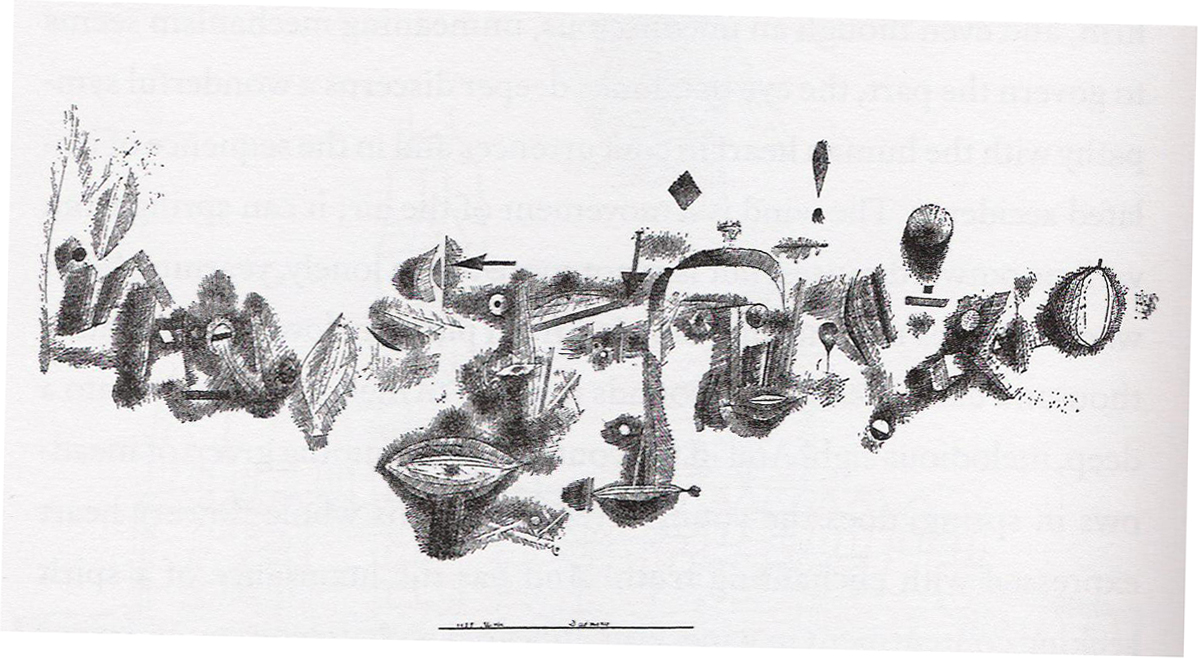
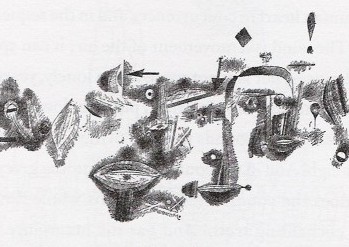
This, together with Kleist’s “On the Gradual Production of Thoughts Whilst Speaking”, make the deconstructionists seem rather late to their own game. The artistic complement to Novalis here is Paul Klee, whose drawings inspired by The Novices of Sais capture some of what Novalis is saying. This one is called “Demony”:


MONOLOGUE
Novalis,
Friedrich von Hardenberg.
From The Philosophical and Theoretical Works
, pp. 438-439.

Read in German
Matters concerning speech and writing are genuinely strange; proper conversation is a mere play of words. We can only marvel at the laughable error people make--believing that they speak about things. No one knows precisely what is peculiar to language, that it concerns itself merely with itself. For that reason, it is a wonderful and fertile mystery--that when someone speaks merely in order to speak, one precisely then expresses the most splendid and most original truths. Yet if one wishes to speak of something determinate, then temperamental language has them say the most laughable and perverse things. That is the reason too for the hatred that so many earnest people have toward language. They recognize their own willfulness, but do not observe that contemptible chatter is the infinitely earnest side of language. If only one could make people grasp that the case of language is similar to the case of mathematical formulae--they constitute a world for themselves-- they play with themselves alone, express nothing other than their wonderful nature, and precisely for that reason they are so expressive--precisely for that reason they mirror in themselves the curious play of relations in things. Only by way of freedom are they members of nature and only in their free movements does the world soul give utterance, making them a delicate standard of measure and blueprint for things. Thus it is with language too--whoever has a subtle sense of its application, its cadence, its musical spirit, whoever perceives in oneself the delicate effects of its inner nature, and moves one’s tongue and hand in accordance with it will be a prophet; in contrast, whoever knows it but does not have sufficient ear and sensibility for language, writes truths such as these, will be held hostage by language itself and will be mocked by human beings, as was Cassandra among the Trojans. If I believe I have hereby declared most precisely the essence and office of poesy, I know nonetheless that no human being can understand it, and that I have said something quite foolish, for the mere reason that I wanted to say it, so that no poesy comes to be. Yet what would happen if I had to talk? and if this linguistic drive to speak were the characteristic of inspiration of language, and of the efficacy of language in me? and if my will only willed precisely everything that I had to will--then in the end this could be without my knowledge or belief poesy and could make a mystery of language comprehensible? and thus I would be a writer by vocation, inasmuch as a writer is only an enthusiast of language?--

Translation by Ferit Güven


MONOLOG
Novalis,
Friedrich von Hardenberg.
Das philosophisch-theoretische Werk
, pp. 438-439.
 
Es ist eigentlich um das Sprechen und Schreiben eine närrische Sache; das rechte Gespräch ist ein bloßes Wortspiel.  Der lächerliche Irrthum ist nur zu bewundern, daß die Leute meinen--sie sprächen um der Dinge willen.  Gerade das Eigenthümliche der Sprache, daß sie sich blos um sich selbst bekümmert, weiß keiner.Darum ist sie ein so wunderbares und fruchtbares Geheimniß,-- daß wenn einer blos spricht, um zu sprechen, er gerade die herrlichsten, originellsten Wahrheiten ausspricht.  Will er aber von etwas Bestimmten sprechen, so läßt ihn die launige Sprache das lächerlichste und verkehrste Zeug sagen.  Daraus entsteht auch der Haß, den so manche ernsthafte Leute gegen die Sprache haben.  Sie merken ihren Muthwillen, merken aber nicht, daß das verächtliche Schwatzen die unendlich ernsthafte Seite der Sprache ist. Wenn man den Leuten nur begreiflich machen könnte, daß es mit der Sprache wie mit den mathematischen Formeln sei--Sie machen eine Welt für sich aus--Sie spielen nur mit sich selbst, drücken nichts als ihre wunderbare Natur aus, und eben darum sind sie so ausdruckvoll--eben darum spiegelt sich in ihnen das Werhältnißspiel der Dinge.  Nur durch ihre Freiheit sind sie Glieder der Natur und nur in ihren freien Bewegungen äußert sich die Weltseele und macht sie zu einem zarten Maaßstab und Grundriß der Dinge.  So ist es auch mit der Sprache--wer ein feines Gefühl ihrer Applicatur, ihres Takts, ihres musikalischen Geistes hat, wer in sich das zarte Wirken ihrer innern Natur vernimmt, und danach seine Zunge oder seine Hand bewegt, der wird ein Prophet sein, dagegen wer es wohl weiß, aber nicht Ohr und Sinn genug für sie hat, Wahrheiten wie diese schreiben, aber von der Sprache selbt zum Besten gehalten und von den Menschen, wie Cassandra von den Trojanern, verspottet werden wird.  Wenn ich damit das Wesen und Amt der Poesie auf das deutlichste angegeben zu haben glaube, so weiß ich doch, daß es kein Mensch verstehn kann, und ich ganz was albernes gesagt habe, wiel ich es habe sagen wollen, und so keine Poesie zu Stande kommt.  Wie, wenn ich aber reden müßte? und dieser Sprachtrieb zu sprechen das Kennzeichen der Eingebung der Sprache, der Wirksamkeit der Sprache in mir wäre? und mein Wille nur auch alles wollte, was ich müßte, so könnte dies ja am Ende ohne mein Wissen und Glauben Poesie sein und ein Geheimniß der Sprache verständlich machen? und so wär' ich ein berufner Schriftsteller, denn ein Schriftsteler ist wohl nur ein Sprachbegeisterter?--


Hyacinth and Rosebud: Treading a Path to a Parable by Novalis via Thalmann’s Literary Sign Language of German Romanticism

August 22, 2013
Image
Marianne Thalmann The Literary Sign Language of German Romanticism Figure 2 Novalis Hyazinth (1798).
This amazing little exposition of Marianne Thalmann’s Literary Sign Language of German Romanticism (1967) I found when trying to track down an image by Novalis which inspired Joyce’s diagram on page 293 of Finnegans Wake. It could be that I’m completely mistaken about the existence of such an image (‘something’ I vaguely remember reading about ‘somewhere’, years ago), but the pathway it’s revealed looks very promising. Novalis is very much neglected in Anglo-American intellectual culture, partly because he doesn’t accord with its pragmatic, utilitarian outlook. This is a bit of a journey into the unknown for me, the parable of Hyacinth and Rosebud (Hyazinth und Rosenblütchen) seems like a good place to start.
Long ago, there lived far to the west a very young man, good, but extremely odd. He tormented himself continually about this nothing and that nothing, always walked in silence and straight before him, sat down alone when the others were at their sports and merry-makings, and brooded over strange things. Caves and woods were his dearest haunts; and there he talked on and on with beasts and birds, with trees and rocks–of course not one rational word, but mere idiotic stuff, to make one laugh to death. He continued, however, always moody and serious, in spite of the utmost pains that the squirrel, the monkey, the parrot, and the bullfinch could take to divert him, and set him in the right way. The goose told stories, the brook jingled a ballad between, a great thick stone cut ridiculous capers, the rose stole lovingly about him from behind and crept through his locks, while the ivy stroked his troubled brow. But his melancholy and gravity were stubborn. His parents were much troubled, and did not know what to do. He was in good health, and ate well enough; they had never caused him any offence; and, until a few years ago, he had been the liveliest and merriest of them all, foremost in all their games, and a favourite with all the maidens. He was very handsome, looked like a picture, and danced like an angel. Amongst the maidens was one, a charming and beautiful creature, who looked like wax, had hair like golden silk, and cherry-red lips, was a doll for size, and had coal-black, yes, raven-black eyes. Whoever saw her was ready to swoon, she was so lovely. Now Rosebud, for that was her name, was heartily fond of the handsome Hyacinth, for that was his name, and he loved her fit to die. The other children knew nothing of it. A violet told them of it first. The little house-cats had been quite aware of it, for the houses of their parents lay near each other. So when Hyacinth stood at night by his window, and Rosebud at hers, and the cats ran past mouse-hunting, they saw the two standing there, and often laughed and tittered so loud that they heard it and were offended. The violet told it in confidence to the strawberry, and she told it to her friend, the raspberry, who never ceased rasping when Hyacinth came along; so that by and by the whole garden and wood were in the secret, and when Hyacinth went out, he heard on all sides the cry: “Little Rosy is my posy!” This vexed him; but the next moment he could not help laughing from the bottom of his heart, when the little lizard came slipping along, sat down on a warm stone, waggled his tail, and sang–
“Little Rosebud, good and wise,
All at once has lost her eyes:
Taking Hyacinth for her mother,
Round his neck her arms she flings;
Then perceiving ’tis another–
Starts with terror?–no, but clings–
Think of that!–fast as before,
Only kissing all the more!”
Alas, how soon was the grand time over! There came a man out of strange lands, who had travelled wondrous far and wide, had a long beard, deep eyes, frightful eyebrows, and a strange garment with many folds, and inwoven with curious figures. He seated himself before the house of Hyacinth’s parents. Hyacinth at once became very inquisitive, and sat down beside him, and brought him bread and wine. Then parted he his white beard, and told stories deep into the night; and Hyacinth never stirred or tired of listening. This much they learned afterward, that he talked a great deal about strange lands, unknown countries, and amazingly wonderful things; stopped there three days, and crept with Hyacinth down into deep shafts. Little Rosebud execrated the old sorcerer pretty thoroughly, for Hyacinth was altogether absorbed in his conversation, and paid no heed to anything else, hardly even to the swallowing of a mouthful of food. At length the man took his departure, but left with Hyacinth a little book which no man could read. Hyacinth gave him fruit, and bread, and wine to take with him, and accompanied him a long way. Then he came back sunk in thought, and thereafter took up a quite new mode of life. Rosebud was in a very sad way about him, for from that time forward he made little of her, and kept himself always to himself. But it came to pass that one day he came home, and was like one born again. He fell on his parents’ neck and wept. “I must away to a foreign land!” he said: “the strange old woman in the wood has told me what I must do to get well; she has thrown the book into the fire, and has made me come to you to ask your blessing. Perhaps I shall be back soon, perhaps never more. Say good-bye to Rosebud for me. I should have been glad to have a talk with her; I do not know what has come to me: I must go! When I would think to recall old times, immediately come thoughts more potent in between; my rest is gone, and my heart and love with it; and I must go find them! I would gladly tell you whither, but do not myself know; it is where dwells the mother of things, the virgin with the veil; for her my spirit is on fire. Farewell!” He tore himself from them, and went out. His parents lamented and shed tears. Rosebud kept her chamber, and wept bitterly.
Hyacinth now ran, as fast as he could, through valleys and wildernesses, over mountains and streams, toward the land of mystery. Everywhere he inquired–of men and beasts, of rocks and trees,–after the sacred goddess Isis. Many laughed, many held their peace; nowhere did he get an answer. At first he passed through a rugged wild country; mists and clouds threw themselves in his way, but he rushed on impetuously. Then he came to boundless deserts of sand–mere glowing dust; and as he went his mood changed also; the time became tedious to him, and his inward unrest abated; he grew gentler, and the stormy impulse in him passed by degrees into a mild yet powerful attraction, wherein his whole spirit was dissolved. It seemed as if many years lay behind him.
And now the country became again richer and more varied, the air soft and blue, the way smoother. Green bushes enticed him with their pleasant shadows, but he did not understand their speech; they seemed indeed not to speak, and yet they filled his heart with their green hues, and their cool, still presence. Ever higher in him waxed that same sweet longing, and ever broader and juicier grew the leaves, ever louder and more jocund the birds and beasts, balmier the fruits, darker the heavenly blue, warmer the air, and more ardent his love. The time went ever faster, as if it knew itself near the goal.
One day he met a crystal rivulet, and a multitude of flowers, coming down into a valley between dark, columnar cliffs. They greeted him friendlily, with familiar words. “Dear country-folk,” said he, “where shall I find the sacred dwelling of Isis? Hereabouts it must be, and here, I guess, you are more at home than I.” “We also are but passing through,” replied the flowers; “a spirit-family is on its travels, and we are preparing for them their road and quarters. A little way back, however, we passed through a country where we heard her name mentioned. Only go up, where we came down, and thou wilt soon learn more.” The flowers and the brook smiled as they said it, offered him a cool draught, and went on their way. Hyacinth followed their counsel, kept asking, and came at last to that dwelling he had sought so long, which lay hid among palms and other rare plants. His heart beat with an infinite longing, and the sweetest apprehension thrilled him in this abode of the eternal seasons. Amid heavenly odours he fell asleep, for Dream alone could lead him into the holy of holies. In marvellous mode Dream conducted him through endless rooms full of strange things, by means of witching sounds and changeful harmonies. All seemed to him so familiar, and yet strange with an unknown splendour; then vanished the last film of the perishable as if melted into air, and he stood before the celestial virgin. Then he lifted the thin glistening veil, and–Rosebud sank into his arms. A far-off music surrounded the mysteries of love’s reunion and the outpouring of their longings, and shut out from the scene of their rapture everything alien to it.
Hyacinth lived a long time after with Rosebud and his happy parents and old playmates; and numberless grandchildren thanked the wonderful old wise woman for her counsel and her uprousing; for in those days people had as many children as they pleased. (Translated by George MacDonald. Found here).
Priestess Tarot Crowley
The veiled figure of Isis depicted by Lady Frieda Harris in Aleister Crowley’s Thoth Tarot (1944)
As Robert Lee Wolff points out in The Golden Key (1961 New Haven: University of Yale Press, p.86), Hyacinth lifts the veil of Isis (Wisdom) and discovers Rosebud (Erotic love).

rose_photo_65

NOTE TO READERS OF THIS BLOG: I disassociate myself from, and repudiate, any adverts you may see with my blog posts. I don’t see why I should pay $99 a year for the privilege of having the ‘ad-free upgrade’, so please ignore the corporate rubbish…
Posted in Uncategorized | Tagged , , ,

Friday, July 31, 2015

Seven Myths About the Band Chicago


Seven Myths About the Band Chicago

As in HUGE fan.  They’re nearly all I’ve listened to for over eight months.  I’d be lying if I said I didn’t enjoy the raised eyebrows that I get sometimes when I confess this, but there’s a lot more to them than 80’s power ballads and the launching of Peter Cetera’s solo career.  Since first getting into them, I’ve spent lots of my free time learning about their history, including (and peaking with) the autobiography of the original drummer, Danny Seraphine.  As is the typical situation when one learns a lot about a subject, I’ve noticed that there are plenty of people around that pretend to know what they’re talking about when it comes to Chicago, but don’t.  They’ve been fed myths, and they believe them all.  Well, I’m going to set the record straight on some of these.  They come from comments I’ve seen from people on the internet, my own misconceptions that I’ve noticed other people shared, and some that are more widely known and are almost “urban legend,” if I could actually call it that.  I’m going to do seven of them, because there were seven original members and I needed to pick a number somehow.
Take note that if you know Chicago even remotely as well as I do, you won’t find new information here.  This is for the masses.

MYTH #1: CHICAGO IS JUST AN ADULT CONTEMPORARY BAND FROM THE 80’S.

Okay, let’s start with the bare-bones basics.  Prior to being told otherwise in the early 2000’s, I thought this.  My wife thought this prior to me getting into them several months ago.  Many of my friends that are kind of annoyed that I’m still listening to them so much thought this.  Tons and tons and tons of people who have heard of Chicago have heard the songs “You’re the Inspiration” and “Hard to Say I’m Sorry” and assumed that the ballads and soft rock is what Chicago is . . .

Now let’s get one thing clear.  I love 80’s Chicago.  Saying they “wrote some 80’s power ballads” is like saying Rembrandt “painted some pictures” or Frank Lloyd Wright “built some buildings.”
I’ll admit the video is completely nuts, though.  I can’t figure out exactly what’s going on in it, Peter Cetera is NOT left handed, everyone except Peter and Danny (drums) are playing keyboards, with the third exception of Walt (sax) who appears to be taking a dump in the heating register behind Jimmy at 2:12.  But it was 1984, and we really need to demonstrate a lot of grace and not judge bands or songs on their early-80’s music videos; it was an odd time.  Plus, for my purposes, the song is the point.  That’s our image of this band.  Yet, for more than 10 years, THIS was the image of Chicago:

Chicago was a hard-rocking, big-concept, high-art, almost avant-garde rock ‘n roll band.  They were a group made to make music, not to create stars.  This was especially true for their first three albums.  A great example of this, though it is only one of many, is the full piece “Ballet for a Girl in Buchannon.”   It was written on the road by trombonist Jimmy Pankow, who had been listening to a lot of classical music and wanted to do an extended rock piece with movements and sections the way a lot of larger classical pieces did.  If someone were to do that today, I feel it would be easy to write them off as pretentious or hipster.  But this was 1969 or 1970, meaning that rock music as art was just coming into form, and yet here’s the band destined to be known as the group that the “Glory of Love” guy left, and they’re at the forefront.
The band then was known most for their intricate horn section, but the whole group was made up of top-notch musicians who were all masters at their instruments (most of them classically trained), and they all played at the peak of their abilities for every song.
Clearly this is not a band that deserves to be ranked among Toto and Hall & Oates.

MYTH #2:  PETER CETERA JOINED CHICAGO AND USED THEM TO LAUNCH HIS OWN SOLO CAREER.

We’re knocking out the two myths that were most prevalent in my mind until seven months ago, first.  I’ve heard at least one other person equally ignorant of the band as I was state this myth.  Peter Cetera is known by those of us 30-ish and younger as Mr. Soft Rock.  The guy who not only did that song from the Karate Kid Part II soundtrack, but did that duet with Amy Grant and recently was thetheme of a beer commercial that insists he could only be “cool” because the ladies like him (there must be an age gap for that fact, because my wife can’t stand him).
Well, many people learn, if they didn’t already know, that Cetera got his start in Chicago.  When the Chicago you know is “Hard Habit to Break,” it’s not too far of a shot to conclude that Cetera was a pretty powerful driving force in the band.  That much is true.  When you then learn that Chicago had a very rock-based past, coupled with the fact that the band continued after Cetera left, some people (such as myself) conclude that Cetera was a late-comer who treated the band as a springboard to his own success.
Well, I don’t know if you caught it, but he’s in that photo from 1970 and the older video up there.  Far left in the photo, 1:24 in the video (as well as other places).  He was an original member, and was part of the band for 17 years.
The band was formed with the first six members and were playing shows around the city of Chicago under the moniker “The Big Thing.”  They had guitar, drums, keyboard, sax, trumpet, and trombone, but no bass.  Apparently around that time it was a cool thing to have your keyboardist carry the bass line with bass pedals.  A perfect storm occurred only months after getting started in 1968 when The Big Thing decided they needed a third vocalist, a high tenor, since the two they had were more baritone and were getting lost behind their horn section.
It just so happened that around the same time the lead singer of a well-known Chicago band, The Exceptions, was looking to move on from that group.  Turns out the guy was a high tenor and also played bass.  That was Peter Cetera.  The Big Thing easily convinced him to join, and within a matter of months their name changed and their real career began.
I’ll expand further on the misconceptions about Cetera’s role in Chicago a bit later.

MYTH #3:  THEIR FIRST ALBUM, “CHICAGO TRANSIT AUTHORITY,” WAS SELF-TITLED.

Up until a few days ago, I had Myth #3 here as something else regarding their well-known name change in 1969 from “Chicago Transit Authority” to simply “Chicago.”  Well I recently came across some information that mildly invalidated what I originally said, and was actually much more interesting.
I’ve already mentioned that their first name was “The Big Thing.” According to drummer Danny Seraphine, their very first manager named them that after they refused his first idea, “Top Banana.”  Well they switched up managers after a year or so to a guy that some of the members knew named Jim Guercio.  Jim heard the band and loved them and immediately went into getting them noticed.  Step one: everyone moves to Los Angeles.  By 1969, The Big Thing didn’t live in Chicago anymore.  Also, right away, Guercio changed their name to one he had thought of years before when working in Chicago, “The Chicago Transit Authority.”  The band soon started referring to themselves as CTA.
At some point early on, they played a well-received show back in their hometown.  Their success drew more eyes to them, such as the eyes of the actual Chicago Transit Authority.  The REAL CTA informed Guercio that they would sue if the band name didn’t change.  They had already had issues with people getting the name wrong on marquees (a rather funny one was “The Chicago Transients”), so it was an easy decision and they shortened it to just “Chicago.”  Plenty of people know that story, and if you didn’t, you do now.  What many people don’t know, and what I thought up until just a couple weeks ago, was that this all happened shortly AFTER the release of their first album.  This is a reasonable assumption, since the album is called “Chicago Transit Authority.”  However, in the liner notes, Guercio emphasizes that the band chose to name their first album after their moniker up to that point, but the name had already changed.  So the name of the album would technically be “Chicago Transit Authority, by Chicago.”
One quick note: knowing what I know about Guericio, I could probably state that it’s a myth that “the band” chose to name the album anything, let alone name any album anything, but I can’t back that up with much.

MYTH #4: “25 OR 6 TO 4″ IS ABOUT DRUGS.

If  you spend any time looking into information on Chicago, you’re bound to quickly run into the controversy over the hit single off their second album, “25 or 6 to 4.”  As with many songs with ambiguous titles or subjects, especially from the 60’s and 70’s, it is concluded that the song must be about drug use.  “25 or 6 to 4″ is Chicago’s very own “Lucy in the Sky with Diamonds.”

If you listen to the lyrics, you can figure out where these assumptions are coming from.
“Flashing lights against the sky”
“Sitting cross-legged on the floor”
“Wondering how much I can take”
“Should I try to do some more?”
“Spinning room is sinking deep”
Yeah, it’s not completely out of left field, that’s for sure.  Add to that the kinds of music fans who KNOW that a song is about drugs when a song is about drugs, and you’ve got a one-way ticket to myth-city.
Let’s look at some facts.  First, Chicago didn’t write songs about drugs.  None of their other songs (and there are a lot) have anything close to a drug reference in them.  All of their songs are about girls, relationships, social issues, personal experiences, and playing music.  So a song about dropping acid is not in familiar company.  That doesn’t definitively prove anything, I know, but keep going . . .
Second, we need to ask if the lyrics really make sense in the context of a drug reference.  Well, the ones I already listed do.  But what about these?
“Waiting for the break of day, searching for something to say.”
” . . . giving up I close my eyes.”
“Getting up to splash my face, wanting just to stay awake.”
“Feeling like I ought to sleep, searching for something to say”
I guess if you squint a little, they kind of do, but that takes us to the third and main point.  Chicago’s keyboardist Robert Lamm wrote the song.  Very early on people were asking him about its meaning, including his band members.  He said back then, he said all through the 70’s, 80’s, 90’s, and he has said up to now, that this song is about writing a song.  That he was up late one night trying to finish one more song for their new album and he was tired and frustrated but didn’t want to go to bed until he finished it.  The title means he can’t tell if the clock says 3:35 or 3:34 a.m.  That’s twenty five minutes or twenty six minutes until four in the morning.  He’s never altered his story.
So listen to the lyrics again.  They all make sense in the “I’m staying up late and really want to go to bed and need to finish this song” context.  They don’t all make sense in a “doing drugs” context.  Plus, the guys in Chicago were never incredible lyricists.  I don’t mean the lyrics are bad–not at all, but they’re not especially poetic or cryptic.  People debate over lines in “Saturday in the Park,” but that’s really the extent of their deep and artistic lyrical prowess.  Most of the time, they sang what they meant.
Now with that in mind, I bring you some of the geniuses of the internet.
“This song is about being wasted from drugs, simply. 25 or 6 to 4 is the site of a clock. Look at a clock when its 3:54 or “6 to 4″. Then look at that same clock upside down and its 9:25 or 10:25. The song is about losing track of time and seeing the clock and you can’t tell exactly if its 9:25 or 3:54.”
“This song is written (or at least everything points to) about a trip on acid. Specifically LSD-25…The big question that I see is that it’s 6:24 (Six Two Four perhaps?) and our hero is wondering if he should ‘drop’ more ’25’…or maybe it’s just about forcing writing…cause that works really well…”
“You are ALL wrong!!! …”25″ is LSD 25, which was popular in the late 60’s. “6 to 4″ is the amount of time the drugs effects last in your system. LSD would last 10 hours in your system. In this case, from 6pm to 4am. The lyrics clearly explain an acid trip. You must remember the time frame when this song was written (1968). Hendrix had “Purple Haze” and the psychadelic era was happening. The band members of Chicago always avoided telling the real meaning of this song, but if you’re an old hippie like I am, you know what it is about.”
“I ran a small investigation and I go for the LSD-25 story, even though that for all of you who dont now what is 6 to 4, its not an hour, it is a reference for 624-Qualudes which were “hypnotic sedatives” used in the 60s and 70’s, and LSD 25 was the second most popular lsd of the time, so it makes perfect tense, and taking more qualudes to sleep cos the LSD has you with insomia its a pretty good idea…”
“”LSD’s action was about 6 hours. Short term tolerance (24 hours) meant you would have to take 2x/3x when you were coming down to get the same (but lower quality) high. Too much sensory input and you could get a “bad trip” which is emotionally wrenching. To cancel the LSD high one would take tranquilizers, quite often methylqualone or Qualudes (or ‘Ludes for short) which were large flat yellow tablets with the numbers 624 on them, hence 25 or 624, should I continue the trip or stop it.”
“Actually it’s a drug reference, on qualudes (pills) the numbers 624 are inscribed on the tablet, then, the scientific code for acid is LSD25. So we have a choice my friend, take some Ritalin or some good ol’ LSD?”
I really did not have to search hard for those.  Amazing how far some people will go to prove that a song is about drugs.  There’s some very interesting psychology there.  (Also, I did a quick search for “quaalude 624″ in Google, and the only results were about how this song is about them.  That’s not huge, but something to take note of.)
One last thing.  I’m not a druggie, never was, and I’m certainly not an old hippie, but I’m someone who’s written songs.  I can read the lyrics and get how they’re about not wanting to give up on finishing a song.  It’s usually the case that leaving a song unfinished now means it will remain unfinished forever, or at the very least finished in a way you didn’t intend.  So you’ve got to stick with it.  But hey–what do I know?

MYTH #5: GUITARIST TERRY KATH DIED WHILE PLAYING RUSSIAN ROULETTE.

I had thought this one was put to rest decades ago, but I saw a couple comments somewhere within the two weeks prior to writing this in which people stated this myth.
Let’s examine all the angles of this.  First, Terry Kath was the guitarist of the group, and one of the founding members (with Danny Seraphine and Walt Parazaider).  Second, the guy was a freakin’ monster on guitar.  He is my hero on the six-string.

So getting straight to it: Terry Kath did shoot himself in the head.  But it was not suicide (in the strictest definition of the term) nor was it “Russian roulette.”  The gun wasn’t even a revolver.
On the evening of January 23, 1978, Kath was at a party at the house of some guy named Don Johnson.  Unfortunately, it wasn’t THAT Don Johnson; I think it was his guitar tech or something.  So things have wound down, and I’ve read or heard from sources I don’t recall that Kath and this guy were actually going to start working on Terry’s solo album.  (To greatly paraphrase Peter Cetera and add in my own assumptions based off of stuff I’ve read and seen, Kath would have likely been out of the band by the end of 1978 had he lived, especially if their career had taken the same dive in the late 70’s with him there).  Johnson and Kath were the only ones at home, and Kath was most likely either drunk and/or high.  All band members have noted since his death that his drug usage was out of control.  Also, Kath was a gun enthusiast and often carried a gun on his person.  Don Johnson had a couple hand guns, and Kath was messing around with them.  He took an unloaded .38 revolver to his head and pulled the trigger several times, laughing at Don’s pleas for  him to stop.  He put the gun down and picked up a 9 mm semiautomatic, took out the clip and saw that there were no bullets in it, replaced the clip, put it to his temple, laughed at Don and said, “Don’t worry, it’s not loaded” and pulled the trigger.  You probably guessed there was a bullet in the chamber.  He died instantly.
Another side of this myth says that his wife and daughter were in the room when it happened.  That’s not true at all; no accounts of this mention them being there.  In fact, in the Behind the Music episode on Chicago, his widow actually talks about walking from the door to the gate of her home where police were waiting to tell her what had happened.
Of all the things that people can get wrong about Chicago, this is the one that I find the hardest to keep from stepping in and correcting.  It’s tragic enough from all angles, so we don’t really need to have the truth embellished or stretched.

MYTH #6:  AFTER TERRY KATH’S DEATH, PETER CETERA TOOK CONTROL OF THE BAND AND TURNED THEM INTO THE BALLAD BAND THEY’RE KNOWN MOST FOR BEING.

This is one that I see a lot that gets under my skin.  It makes it sound as if Kath died, and shortly after Cetera took over and said, “Okay, now we’re going to do soft rock hits!”  It’s actually ludicrous if you think about it for even a second.  The evolution of Chicago-the-hard-hitting-rock-band into Chicago-the-band-who-writes-songs-for-weddings-and-proms is much more complex than that.
First, before the band stepped into the studio to record their fifth album Chicago V, they made a conscious decision to not do overly-long songs.  This is according to Seraphine.  This choice is perfectly understandable, since their first album didn’t get any radio play in its early days due mostly to the length of the songs.  Their second album made it big only because some jerk somewhere chopped up “Ballet for a Girl in Buchannon” and named it after the first movement, “Make Me Smile.”  It’s good in the sense that it got the band noticed, but it became practice to trim down their songs for radio play, and that bugged the band as it would most song writers and musicians.  So to save themselves the heartache, they decided to take their songwriting into a more radio-friendly-format direction.  Seraphine insists that this was the most important moment in them becoming who they were to become, and notice that the year was 1972.
That’s the first part.  The second part is that apparently around that same time, Columbia Records (their label) made it official that they would only pay artists royalties on the first ten tracks of an album.  Naturally that means that artists are only going to put ten songs on an album.
The style jump from Chicago III to Chicago V was very significant (“IV” was a live album recorded at Carnegie Hall).  III had styles all over the place, including jazz, country, rock, 20th century modern, and even spoken word.  The only song to really get any attention was the middle part of one of the larger pieces, called “Free.”  I say it’s a great album as a whole, but it’s not celebrated on the large scale as being one of their best since so little came from it.
V on the other hand has ten songs on it that go down easily.  The styles are less diverse, but some of them are still pretty edgy, especially my personal favorite Chicago song of all time, “A Hit by Varese.”  Then they showed how they still had a hard time keeping away from multiple-movement songs with “Dialogue Pt. 1″ and “Dialogue Pt. 2.”

I don’t own or even really know much about the albums VI-IX first-hand.  But I’ve heard some things here and there, and this is a song that shows they still had their chops and were rock-minded for Chicago VI . . . but it was fading.  Very slightly, but still fading.
As I said, I don’t know much about their stuff through Chicago IX.  But I haveChicago X on vinyl.  Aaaaand . . . I’m not much for it.  I’ve enjoyed it as I was focusing on things like washing dishes, but really paying attention?  The songs are either pillowy soft or uneasily jumpy.  The true rock edge is almost all but gone, with maybe the exception of the opener “Once or Twice,” but that’s “rock” in the way that Bob Seger’s “Old Time Rock ‘n Roll” is rock.
It’s crazy how much changed in the four years between V and X, but keep in mind that by the time came out, it was 1976, and they were entering into the late 70’s.  In that time, you were a hard-ass rocker (a la AC/DC, KISS, etc.) or you were goofy pop music (a la The Captain and Tennille, most disco, etc.). The band really could have gone either way at that point . . .
And Cetera happened to write a cute little ditty for Chicago X called “If You Leave Me Now.”

Seraphine says in his book that no one, not even Cetera, expected that song of all the others to get much attention, but it went to #1!  It caught everyone off guard, and when that sort of thing happens, your record label says, “Keep ’em coming!”  At that point, they knew they needed to have a slow ballad-type song on each album.
And Kath was still alive and part of the band.
They had one more album prior to Kath’s death, Chicago XI, and the ballad on that one (again penned by Cetera, admittedly) was “Baby What a Big Surprise.”  That’s two major ballads by the band before Terry died.
Shortly after the release of XI, the band split with manager Jim Guercio.  Suddenly they are the masters of their own destinies . . . and then Kath dies.  Kath’s death wasn’t devastating just because of the personal loss, but his guitar style and distinct voice were a significant part of the group’s sound.  (It’s interesting how much difference a single person can make in a group’s sound, even when they’re not the leader.  I always think of the differences between Weezer’s first two albums and their later stuff, the personnel change being only bassist Matt Sharp.)
Take a look at where we’re standing now.  Kath is gone.  Around that time, their sales started to slip, too.  They tried a few things to climb back on top, includingtouching into disco a bit on one album.  It all failed.  They were forced out of Columbia Records and all of them thought the end was in sight.  But by 1982, Chicago bounced back with Chicago 16, new band member Bill Champlain, new producer and co-songwriter David Foster, and the hit ballad “Hard to Say I’m Sorry.”  Two years later, they really hit it out of the park with Chicago 17, which included “You’re the Inspiration” along with several other of their most recognizable 80’s hits.  The ballads actually saved the group.
The story of Chicago ending up what they were in the 80’s is similar in spirit to the story of many musical artists who change dramatically at one point or another.  It is a series of artistic choices mixed with business pressures, market needs, and current culture.  But where I have seen some groups go from artistic mastery to pop-radio trash in a single album . . .

How do I put parentheses around a photo?
. . . Chicago slowly altered and changed, album to album, and fought through loss and years of struggling to keep going, all to end up where they did.  It certainly was not evil Dr. Cetera spitting on the grave of the holy Terry Kath and taking the band hostage into adult contemporary hell.

MYTH #7:  CHICAGO BROKE UP IN THE 80’S.

Yeah, this one’s a little weak.  I admit it.  But I promised seven myths, and hot darnit I’m going to deliver.
Chicago is still together, though rather pathetically in my opinion.
Cetera left in 1985.  He was replaced by a guy named Jason Scheff, who is literally the only person I’ve ever seen that I want to punch just because of how he looks.

Tell me you don't want to punch that dude. Ugh . . . those CURLS!
They fired Danny Seraphine in 1990.  He and the band have said it was because he was too involved in the business side of things (Bill Champlain in the Behind the Music from 2000 said, “Danny wasn’t focusing on what he should have been focusing on, which is drumming.”)  Reading his autobiography, however, it kind of appears that part of their reasoning might be because of his tendency for violent outbursts, one of them that may have indirectly led to the death of a long-time friend of the band.  But neither Seraphine nor the remaining band has ever suggested that.
Champlain left a year or two ago, after close to 30 years with the band.
Their drummer is the same drummer who replaced Seraphine, and their guitarist has been the same guy since the mid-90’s.  Original members Robert Lamm, Lee Loughnane, James Pankow, and Walt Parazaider are still in the group, touring the country regularly.
They released Chicago XXX in 2005, and finally got their long-awaited Stone of Sisyphus album released in 2008.  That’s currently their latest release.  I’ve only heard snippets of each.  I intend to really listen to them as I get through all the older stuff first, but honestly it sounds like they’re trapped in the early 90’s.  Their concerts show that they’re trapped in their former success.  And it’s all very sad to me because even if Seraphine and Cetera came back for a special reunion tour (and trust me, the Beatles reuniting with two new members is more likely), Kath couldn’t be there and he was the heart of the group.
So . . . yes, Chicago is still technically together.  But is it worth it?
_________________
Sources:
Street Player: My Chicago Story by Danny Seraphine, 2010
InnerVIEWS with Earnie Manouse: Peter Cetera2009
VH1 Behind the Music: Chicago, 2000
Chicago NBC TV Special1970
Liner notes to the albums Chicago Transit Authority, Chicago (II), Chicago III,and Chicago V.
Songmeanings.net, You Tube, and of course Wikipedia.


Saturday, July 25, 2015

Photo 51... & IT'S SCIENCE!

A Mighty Girl's photo.
Rosalind Franklin
 
Today in Mighty Girl history, Rosalind Franklin, the British scientist who first discovered the helix shape of DNA, was born in 1920. Franklin, who graduated with a doctorate in physical chemistry from Cambridge University in 1945, used her knowledge of x-ray diffraction techniques to take the first photo of DNA, referred to as Photo 51.

Without her permission, fellow researcher Maurice Wilkins later showed her photo to James Watson and Francis Crick, who were also trying to determine the structure of DNA. Franklin's photo allowed them to deduce the structure and, shortly thereafter, they published a series of articles about the discovery, only mentioning Franklin's contributions in a footnote. While Watson, Crick and Wilkins received the Nobel Prize in 1962 for their contributions to science, Franklin had passed away due to cancer four years prior and was not eligible for the award.

While Franklin has become increasingly recognized for her immense contributions to molecular biology, even today, students everywhere learn the story of Watson and Crick's discovery but few are taught about the critical contributions of Rosalind Franklin to understanding the nature of DNA. Franklin's story remains one of the most famous and egregious examples of a female scientist being denied credit for her work due to sexism.

For older teens and adults who would like to learn more about Franklin's story, we recommend the excellent biography "Rosalind Franklin: The Dark Lady of DNA" at http://amzn.to/UsaGsr
Rosalind Franklin is also one of the 52 female scientists profiled in the excellent recent release “Headstrong: 52 Women Who Changed Science – and The World," which is highly recommended for teens and adults alike at http://www.amightygirl.com/headstrong-52-women

For several posters that feature Rosalind Franklin, check out this fantastic art print (http://www.amightygirl.com/rosalind-franklin-art), this minimalist poster (http://www.amightygirl.com/rosalind-franklin-poster), and the History of Women in Science poster (http://www.amightygirl.com/history-women-science-poster).

To introduce women's important scientific contributions to a new generation, in our "Scientists" section, we feature a variety of books for children and teens about real-life female scientists at http://www.amightygirl.com/boo…/history-biography/biography…
To encourage your Mighty Girl's interest in science, check out our blog post: "Science At Play: Top 20 Science Toys for Mighty Girls" at http://www.amightygirl.com/blog?p=7692 or browse our entire STEM section at http://www.amightygirl.com/toys/toys-games/science-math