Saturday, November 5, 2011

Novalis: Hymns to the Night

Home | Full Text: 1 - 2 - 3 - 4 - 5 - 6 | Links in german


1

Before all the wondrous shows of the widespread space around him, what living, sentient thing loves not the all-joyous light -- with its colors, its rays and undulations, its gentle omnipresence in the form of the wakening Day? The giant-world of the unresting constellations inhales it as the innermost soul of life, and floats dancing in its blue flood -- the sparkling, ever-tranquil stone, the thoughtful, imbibing plant, and the wild, burning multiform beast inhales it -- but more than all, the lordly stranger with the sense-filled eyes, the swaying walk, and the sweetly closed, melodious lips. Like a king over earthly nature, it rouses every force to countless transformations, binds and unbinds innumerable alliances, hangs its heavenly form around every earthly substance. -- Its presence alone reveals the marvelous splendor of the kingdoms of the world.
Aside I turn to the holy, unspeakable, mysterious Night. Afar lies the world -- sunk in a deep grave -- waste and lonely is its place. In the chords of the bosom blows a deep sadness. I am ready to sink away in drops of dew, and mingle with the ashes. -- The distances of memory, the wishes of youth, the dreams of childhood, the brief joys and vain hopes of a whole long life, arise in gray garments, like an evening vapor after the sunset. In other regions the light has pitched its joyous tents. What if it should never return to its children, who wait for it with the faith of innocence?
What springs up all at once so sweetly boding in my heart, and stills the soft air of sadness? Dost thou also take a pleasure in us, dark Night? What holdest thou under thy mantle, that with hidden power affects my soul? Precious balm drips from thy hand out of its bundle of poppies. Thou upliftest the heavy-laden wings of the soul. Darkly and inexpressibly are we moved -- joy-startled, I see a grave face that, tender and worshipful, inclines toward me, and, amid manifold entangled locks, reveals the youthful loveliness of the Mother. How poor and childish a thing seems to me now the Light -- how joyous and welcome the departure of the day -- because the Night turns away from thee thy servants, you now strew in the gulfs of space those flashing globes, to proclaim thy omnipotence -- thy return -- in seasons of thy absence. More heavenly than those glittering stars we hold the eternal eyes which the Night hath opened within us. Farther they see than the palest of those countless hosts -- needing no aid from the light, they penetrate the depths of a loving soul -- that fills a loftier region with bliss ineffable. Glory to the queen of the world, to the great prophet of the holier worlds, to the guardian of blissful love -- she sends thee to me -- thou tenderly beloved -- the gracious sun of the Night, -- now am I awake -- for now am I thine and mine -- thou hast made me know the Night -- made of me a man -- consume with spirit-fire my body, that I, turned to finer air, may mingle more closely with thee, and then our bridal night endure forever.


2

Must the morning always return? Will the despotism of the earthly never cease? Unholy activity consumes the angel-visit of the Night. Will the time never come when Love's hidden sacrifice shall burn eternally? To the Light a season was set; but everlasting and boundless is the dominion of the Night. -- Endless is the duration of sleep. Holy Sleep -- gladden not too seldom in this earthly day-labor, the devoted servant of the Night. Fools alone mistake thee, knowing nought of sleep but the shadow which, in the twilight of the real Night, thou pitifully castest over us. They feel thee not in the golden flood of the grapes -- in the magic oil of the almond tree -- and the brown juice of the poppy. They know not that it is thou who hauntest the bosom of the tender maiden, and makest a heaven of her lap -- never suspect it is thou, opening the doors to Heaven, that steppest to meet them out of ancient stories, bearing the key to the dwellings of the blessed, silent messenger of secrets infinite.


3

Once when I was shedding bitter tears, when, dissolved in pain, my hope was melting away, and I stood alone by the barren mound which in its narrow dark bosom hid the vanished form of my life -- lonely as never yet was lonely man, driven by anxiety unspeakable -- powerless, and no longer anything but a conscious misery. -- As there I looked about me for help, unable to go on or to turn back, and clung to the fleeting, extinguished life with an endless longing: -- then, out of the blue distances -- from the hills of my ancient bliss, came a shiver of twilight -- and at once snapt the bond of birth -- the chains of the Light. Away fled the glory of the world, and with it my mourning -- the sadness flowed together into a new, unfathomable world -- Thou, Night-inspiration, heavenly Slumber, didst come upon me -- the region gently upheaved itself; over it hovered my unbound, newborn spirit. The mound became a cloud of dust -- and through the cloud I saw the glorified face of my beloved. In her eyes eternity reposed -- I laid hold of her hands, and the tears became a sparkling bond that could not be broken. Into the distance swept by, like a tempest, thousands of years. On her neck I welcomed the new life with ecstatic tears. It was the first, the only dream -- and just since then I have held fast an eternal, unchangeable faith in the heaven of the Night, and its Light, the Beloved.


4

Now I know when will come the last morning -- when the Light no more scares away Night and Love -- when sleep shall be without waking, and but one continuous dream. I feel in me a celestial exhaustion. Long and weariful was my pilgrimage to the holy grave, and crushing was the cross. The crystal wave, which, imperceptible to the ordinary sense, springs in the dark bosom of the mound against whose foot breaks the flood of the world, he who has tasted it, he who has stood on the mountain frontier of the world, and looked across into the new land, into the abode of the Night -- truly he turns not again into the tumult of the world, into the land where dwells the Light in ceaseless unrest.
On those heights he builds for himself tabernacles -- tabernacles of peace, there longs and loves and gazes across, until the welcomest of all hours draws him down into the waters of the spring -- afloat above remains what is earthly, and is swept back in storms, but what became holy by the touch of love, runs free through hidden ways to the region beyond, where, like fragrances, it mingles with love asleep.
Still wakest thou, cheerful Light, that weary man to his labor -- and into me pourest joyous life -- but thou wilest me not away from Memory's moss-grown monument. Gladly will I stir busy hands, everywhere behold where thou hast need of me -- praise the lustre of thy splendor -- pursue unwearied the lovely harmonies of thy skilled handicraft -- gladly contemplate the clever pace of thy mighty, luminous clock -- explore the balance of the forces and the laws of the wondrous play of countless worlds and their seasons. But true to the Night remains my secret heart, and to creative Love, her daughter. Canst thou show me a heart eternally true? has thy sun friendly eyes that know me? do thy stars lay hold of my longing hand? and return me the tender pressure and the caressing word? was it thou did adorn them with colors and a flickering outline -- or was it she who gave to thy jewels a higher, a dearer weight? What delight, what pleasure offers thy life, to outweigh the transports of Death? Wears not everything that inspires us the color of the Night? She sustains thee mother-like, and to her thou owest all thy glory. Thou wouldst vanish into thyself -- in boundless space thou wouldst dissolve, if she did not hold thee fast, if she swaddled thee not, so that thou grewest warm, and flaming, begot the universe. Truly I was, before thou wast -- the mother sent me with my brothers and sisters to inhabit thy world, to hallow it with love that it might be an ever-present memorial -- to plant it with flowers unfading. As yet they have not ripened, these thoughts divine -- as yet is there small trace of our coming revelation -- One day thy clock will point to the end of time, and then thou shalt be as one of us, and shalt, full of ardent longing, be extinguished and die. I feel in me the close of thy activity -- heavenly freedom, and blessed return. With wild pangs I recognize thy distance from our home, thy resistance against the ancient, glorious heaven. Thy rage and thy raving are in vain. Unscorchable stands the cross -- victory-banner of our breed.
Over I journey
And for each pain
A pleasant sting only
Shall one day remain.
Yet in a few moments
Then free am I,
And intoxicated
In Love's lap lie.
Life everlasting
Lifts, wave-like, at me,
I gaze from its summit
Down after thee.
Your lustre must vanish
Yon mound underneath --
A shadow will bring thee
Thy cooling wreath.
Oh draw at my heart, love,
Draw till I'm gone,
That, fallen asleep, I
Still may love on.
I feel the flow of
Death's youth-giving flood
To balsam and ether
Transform my blood --
I live all the daytime
In faith and in might
And in holy fire
I die every night.


5

In ancient times, over the widespread families of men an iron Fate ruled with dumb force. A gloomy oppression swathed their heavy souls -- the earth was boundless -- the abode of the gods and their home. From eternal ages stood its mysterious structure. Beyond the red hills of the morning, in the sacred bosom of the sea, dwelt the sun, the all-enkindling, living Light. An aged giant upbore the blissful world. Fast beneath mountains lay the first-born sons of mother Earth. Helpless in their destroying fury against the new, glorious race of gods, and their kindred, glad-hearted men. The ocean's dark green abyss was the lap of a goddess. In crystal grottos revelled a luxuriant folk. Rivers, trees, flowers, and beasts had human wits. Sweeter tasted the wine -- poured out by Youth-abundance -- a god in the grape-clusters -- a loving, motherly goddess upgrew in the full golden sheaves -- love's sacred inebriation was a sweet worship of the fairest of the god-ladies -- Life rustled through the centuries like one spring-time, an ever-variegated festival of heaven-children and earth-dwellers. All races childlike adored the ethereal, thousand-fold flame as the one sublimest thing in the world. There was but one notion, a horrible dream-shape --
That fearsome to the merry tables strode,
A wrapt the spirit there in wild fright.
The gods themselves no counsel knew nor showed
To fill the anxious hearts with comfort light.
Mysterious was the monster's pathless road,
Whose rage no prayer nor tribute could requite;
'Twas Death who broke the banquet up with fears,
With anguish, dire pain, and bitter tears.

Eternally from all things here disparted
That sway the heart with pleasure's joyous flow,
Divided from the loved ones who've departed,
Tossed by longing vain, unceasing woe --
In a dull dream to struggle, faint and thwarted,
Seemed all was granted to the dead below.
Broke lay the merry wave of human bliss
On Death's inevitable, rocky cliff.

With daring spirit and a passion deep,
Did man ameliorate the horrid blight,
A gentle youth puts out his torch, to sleep --
The end, just like a harp's sigh, comes light.
Cool shadow-floods o'er melting memory creep,
So sang the song, into its sorry need.
Still undeciphered lay the endless Night --
The solemn symbol of a far-off might.
The old world began to decline. The pleasure-garden of the young race withered away -- up into more open, desolate regions, forsaking his childhood, struggled the growing man. The gods vanished with their retinue -- Nature stood alone and lifeless. Dry Number and rigid Measure bound it with iron chains. Into dust and air the priceless blossoms of life fell away in words obscure. Gone was wonder-working Faith, and its all-transforming, all-uniting angel-comrade, the Imagination. A cold north wind blew unkindly over the rigid plain, and the rigid wonderland first froze, then evaporated into ether. The far depths of heaven filled with glowing worlds. Into the deeper sanctuary, into the more exalted region of feeling, the soul of the world retired with all its earthly powers, there to rule until the dawn should break of universal Glory. No longer was the Light the abode of the gods, and the heavenly token of their presence -- they drew over themselves the veil of the Night. The Night became the mighty womb of revelations -- into it the gods went back -- and fell asleep, to go abroad in new and more glorious shapes over the transfigured world. Among the people who too early were become of all the most scornful and insolently estranged from the blessed innocence of youth, appeared the New World with a face never seen before -- in the poverty of a poetic shelter -- a son of the first virgin and mother -- the eternal fruit of mysterious embrace. The foreboding, rich-blossoming wisdom of the East at once recognized the beginning of the new age -- A star showed the way to the humble cradle of the king. In the name of the distant future, they did him homage with lustre and fragrance, the highest wonders of Nature. In solitude the heavenly heart unfolded to a flower-chalice of almighty love -- upturned toward the supreme face of the father, and resting on the bliss-foreboding bosom of the sweetly solemn mother. With deifying fervor the prophetic eye of the blooming child beheld the years to come, foresaw, untroubled over the earthly lot of his own days, the beloved offspring of his divine stem. Ere long the most childlike souls, by true love marvellously possessed, gathered about him. Like flowers sprang up a strange new life in his presence. Words inexhaustible and the most joyful tidings fell like sparks of a divine spirit from his friendly lips. From a far shore, born under the clear sky of Hellas, came a singer to Palestine, and gave up his whole heart to the wonder-child:
The youth thou art who ages long hast stood
Upon our graves, so deeply lost in thought;
A sign of comfort in the dusky gloom
For high humanity, a joyful start.
What dropped us all into abyssmal woe,
Pulls us forward with sweet yearning now.
In everlasting life death found its goal,
For thou art Death who at last makes us whole.
Filled with joy, the singer went on to Hindustan -- his heart intoxicated with the sweetest love; and poured it out in fiery songs under the balmy sky, so that a thousand hearts bowed to him, and the good news sprang up with a thousand branches. Soon after the singer's departure, his precious life was made a sacrifice for the deep fall of man -- He died in his youth, torn away from his beloved world, from his weeping mother, and his trembling friends. His lovely mouth emptied the dark cup of unspeakable woes -- in ghastly fear the birth of the new world drew near. Hard he wrestled with the terrors of old Death -- Heavy lay the weight of the old world upon him. Yet once more he looked fondly at his mother -- then came the releasing hand of eternal love, and he fell asleep. Only a few days hung a deep veil over the roaring sea, over the quaking land -- countless tears wept his loved ones -- the mystery was unsealed -- heavenly spirits heaved the ancient stone from the gloomy grave. Angels sat by the Sleeper -- delicately shaped from his dreams -- awoken in new Godlike glory; he clomb the limits of the new-born world -- buried with his own hand the old corpse in the abandoned hollow, and with a hand almighty laid upon it a stone which no power shall ever again upheave.
Yet weep thy loved ones tears of joy, tears of feeling and endless thanksgiving over your grave -- joyously startled, they see thee rise again, and themselves with thee -- behold thee weep with sweet fervor on the blessed bosom of thy mother, solemnly walking with thy friends, uttering words plucked as from the Tree of Life; see thee hasten, full of longing, into thy father's arms, bearing with thee youthful humanity, and the inexhaustible cup of the golden future. Soon the mother hastened after thee -- in heavenly triumph -- she was the first with thee in the new home. Since then, long ages have flowed past, and in ever-increasing splendor have stirred your new creation -- and thousands have, away from pangs and tortures, followed thee, filled with faith and longing and fidelity -- walking about with thee and the heavenly virgin in the kingdom of love, serving in the temple of heavenly Death, and forever thine.
Uplifted is the stone --
And all mankind is risen --
We all remain thine own.
And vanished is our prison.
All troubles flee away
Thy golden bowl before,
For Earth and Life give way
At the last and final supper.

To the marriage Death doth call --
The virgins standeth back --
The lamps burn lustrous all --
Of oil there is no lack --
If the distance would only fill
With the sound of you walking alone
And that the stars would call
Us all with human tongues and tone.

Unto thee, O Mary
A thousand hearts aspire.
In this life of shadows
Thee only they desire.
In thee they hope for delivery
With visionary expectation --
If only thou, O holy being
Could clasp them to thy breast.

With bitter torment burning,
So many who are consumed
At last from this world turning
To thee have looked and fled,
Helpful thou hast appeared
To so many in pain.
Now to them we come,
To never go out again.

At no grave can weep
Any who love and pray.
The gift of Love they keep,
From none can it be taken away.
To soothe and quiet his longing,
Night comes and inspires --
Heaven's children round him thronging
Watch and guard his heart.

Have courage, for life is striding
To endless life along;
Stretched by inner fire,
Our sense becomes transfigured.
One day the stars above
Shall flow in golden wine,
We will enjoy it all,
And as stars we will shine.

The love is given freely,
And Separation is no more.
The whole life heaves and surges
Like a sea without a shore.
Just one night of bliss --
One everlasting poem --
And the sun we all share
Is the face of God.


6

Longing for Death (español)


Into the bosom of the earth,
Out of the Light's dominion,
Death's pains are but a bursting forth,
Sign of glad departure.
Swift in the narrow little boat,
Swift to the heavenly shore we float.

Blessed be the everlasting Night,
And blessed the endless slumber.
We are heated by the day too bright,
And withered up with care.
We're weary of a life abroad,
And we now want our Father's home.

What in this world should we all
Do with love and with faith?
That which is old is set aside,
And the new may perish also.
Alone he stands and sore downcast
Who loves with pious warmth the Past.

The Past where the light of the senses
In lofty flames did rise;
Where the Father's face and hand
All men did recognize;
And, with high sense, in simplicity
Many still fit the original pattern.

The Past wherein, still rich in bloom,
Man's strain did burgeon glorious,
And children, for the world to come,
Sought pain and death victorious,
And, through both life and pleasure spake,
Yet many a heart for love did break.

The Past, where to the flow of youth
God still showed himself,
And truly to an early death
Did commit his sweet life.
Fear and torture patiently he bore
So that he would be loved forever.

With anxious yearning now we see
That Past in darkness drenched,
With this world's water never we
Shall find our hot thirst quenched.
To our old home we have to go
That blessed time again to know.

What yet doth hinder our return
To loved ones long reposed?
Their grave limits our lives.
We are all sad and afraid.
We can search for nothing more --
The heart is full, the world is void.

Infinite and mysterious,
Thrills through us a sweet trembling --
As if from far there echoed thus
A sigh, our grief resembling.
Our loved ones yearn as well as we,
And sent to us this longing breeze.

Down to the sweet bride, and away
To the beloved Jesus.
Have courage, evening shades grow gray
To those who love and grieve.
A dream will dash our chains apart,
And lay us in the Father's lap.


Home | Full Text: 1 - 2 - 3 - 4 - 5 - 6 | Links
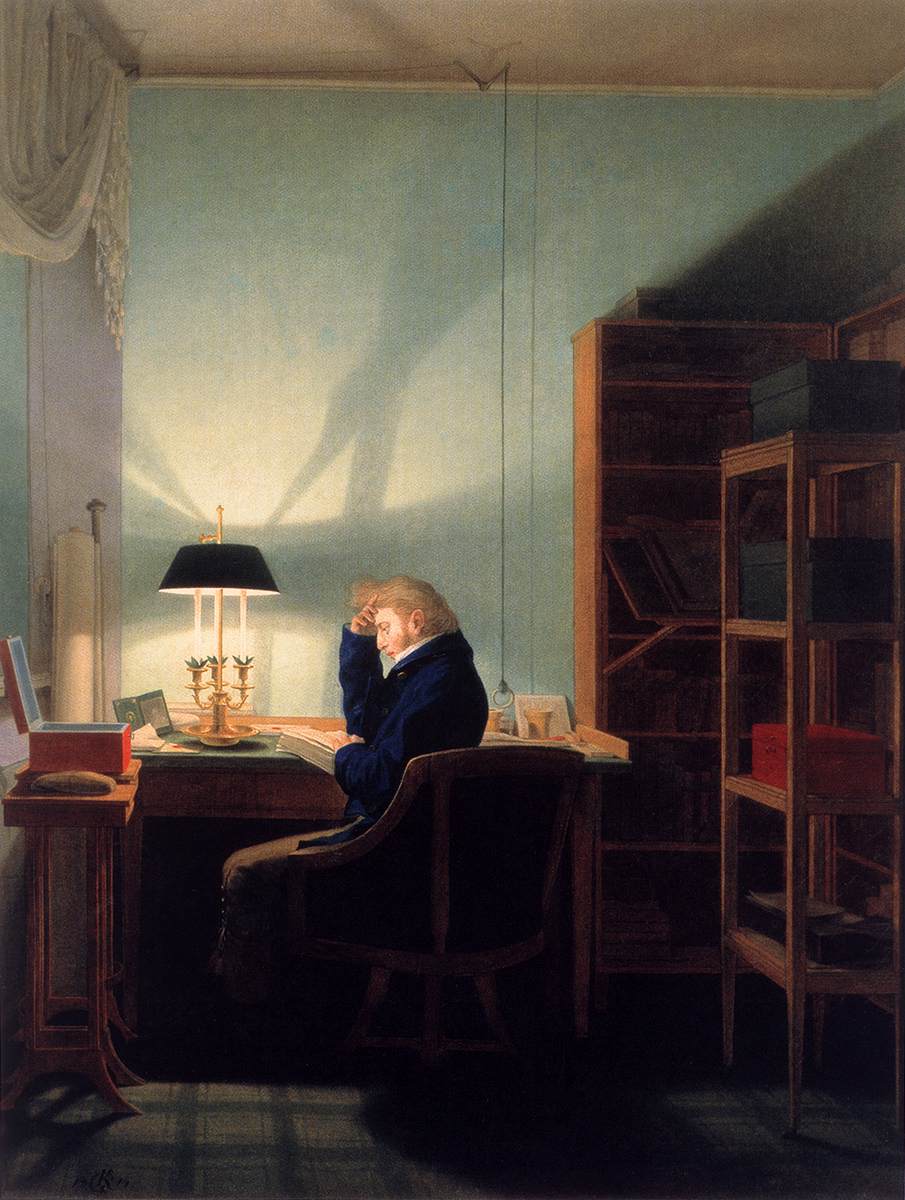
The power of reading: Enhancement

(Man Reading by Lamplight by Georg Friedrich Kersting, 1814, Oil on canvas, 48 x 37 cm, Oskar Reinhart Collection, Winterthur)

Monday, October 24, 2011

Mozart, Hölderlin y las doce variaciones de una cancioncita

Lo tomé de este post: Mozart, Hölderlin y las doce variaciones de una ca...

Se la cataloga como K (o KV) 265 o K (o KV) 265/300e. Su título original sería Zwölf Variationen in C über das französische Lied «Ah, vous dirai-je Maman» (KV 265), que es, más o menos, Doce Variaciones para piano en do mayor sobre la canción francesa «Ah vous dirai-je, Maman». La partitura consta de trece partes, la cancioncita original (ya me dirán si la conocen) y las variaciones I, II, III... hasta la XII. Sólo las variaciones XI y XII tienen indicaciones sobre el tempo (adagio la XI y allegro la XII) y el resto quedan a discreción del pianista. Se publicaron por primera vez en 1785, aunque fueron compuestas, dicen, entre 1781 y 1782.

Años después, la pieza protagonizaría un episodio más bien curioso (si bien irritante) de la vida de Hölderlin.

Johann Christian Friedrich Hölderlin, que así se llamaba, fue un grandísimo poeta, uno de los más grandes que ha parido Alemania. Es inseparable del Romanticismo y del idealismo alemán, que le inspiró y al que inspiró. Como ven, nadie es perfecto, pero aún así, insisto, escribió grandes poemas y tradujo a Píndaro al alemán, compartiendo el amor de Goethe y Schiller por Grecia. Fue compañero de pupitre de Hegel (también es mala suerte) y compañero de clase de Schelling (lo mismo). Semejante compañía acabaría afectándole (aunque digan que no), porque se le diagnosticó hipocondría en 1800, lo que hoy vendríamos a clasificar más técnicamente como chaladura. Declarado mentalmente incapacitado por los tribunales y deshauciado por el doctor Autenrieth (inventor de la máscara que lleva el personaje Hannibal Lecter en The Silence of the Lambs), éste lo hechó de su clínica de Tubinga pronosticándole apenas tres meses de vida y un estado mental irrecuperable. ¡Qué gran persona, este médico!

Un carpintero de Tubinga, Ernst Zimmer, un personaje culto que había leído algunos poemas de Hölderlin, se apiadó de él y le dejó una habitación en lo alto de un torreón desde la cual contemplar el paisaje del río Neckar los últimos días de su vida. Pero lejos de diñarla en tres meses, Hölderlin vivió ¡cuarenta años! en esa habitacioncita de quince metros cuadrados, donde escribió grandísimos poemas, puso patas arriba la literatura europea y se dedicó a tocar su espineta (una especie de piano pequeñito) todos los días, varias veces al día, para desesperación de Zimmer y los demás vecinos. Porque, he aquí la conexión entre Mozart, Hölderlin y la cancioncita francesa, Hölderlin sólo sabía tocar las variaciones de Mozart de «Ah, vous dirai-je Maman», ésas que tocaba día tras día, una y otra vez, y otra, y otra...

******************

******************

Curiosity

Hölderlin and Version Control

The German poet Johann Christian Friedrich Hölderlin (1770-1843) wrote his first drafts usually on the right half of the right page of a folio sized notebook (Heft). He left the back of this page empty, so he could use the left part of the page and the back side of the previous page for revisions and reformulations. He thus always had three times the space for later work than he used for the first draft.

Sometimes he wrote a rough sketch on the lower part of next page that was separated by a continuous line from the rest of the manuscript. As this sketch was worked out, he transferred its contents to the upper part of the page.

This approach was not unusual for the eighteenth century and various versions of it survived into the twentieth century. Thus, I was taught (late fifties, early sixties) to divide every page in a notebook in half by folding it (and then flatten it again). The first draft was to be written on one the right half of the page. The other half was to be used for revisions. What makes Hölderlin's approach remarkable is that he planned for three times the revisions (and apparently used up the space as well). Among other things, this shows that his poetry was not the result of sudden inspiration, but of gradual reworking of the first draft. The editors of the Frankfurt Edition of Hölderlin's work like to speak of "ideal growth."

Whether "ideal" or not, this kind of growth is difficult to see in an electronic text, unless, of course, the author used version control. This may not be a bad thing entirely

Dracula 1933 Español/Spanish

un clásico del cine divertido y entretenido

Friday, October 21, 2011

EL SEÑOR SCARDANELLI de Pere Gimferrer en Dietario

Para visitar al señor Scardanelli había que ir a casa del carpintero. Un carpintero cultivado, de todos modos; un buen hombre si los hay. El señor Scardanelli vive en una torre, sobre el río Neckar, tutelado por el carpintero. Al llegar a la habitación oís una voz; pero no, no hay nadie de visita: es el señor Scardanelli hablando solo. Cuando llamáis a la puerta, pidiendo permiso para entrar, esa voz os responde en tono resuelto, brusco, casi violento. Pero, en cambio, cuando véis al Bibliotecario (porque Scardanelli, recluido en la torre desde hace treinta años, continúa dándose este título), os encontráis con una silueta frágil, magra, que hace reverencias y se deshace en cumplidos. El señor Scardanelli, el bibliotecario, habla medio en alemán medio en francés, y a veces medio en griego o latín; pasa muchas horas mirando el río y la larga perspectiva de los prados en el horizonte verde y límpido, montañoso; a veces, hace leña con las ramas muertas del ciruelo del jardín; a menudo, toca el clavicémbalo, con elegancia y precisión, pero con el ruido, angustioso y sórdido, de las uñas demasiado largas —que no se deja cortar— rozando las teclas. En detalles como este notamos que el señor Scardanelli está loco.

De vez en cuando alguien le pide unos poemas. El señor Scardanelli improvisa  alguna composición muy breve, casi siempre una variación paisajística sobre la armonía entre el hombre y el mundo visible en el curso de las estaciones del año, y firma: «Vuestro humilde servidor, Scardanelli.» Al entregar sus versos al visitante, Scardanelli lo mantiene a distancia mientras lo abruma con títulos hiperbólicos y exageradas muestras de ceremonioso respeto. Lo más impresionante, sin embargo, es el contraste entre la serenidad luminosa de los versos transparentes y seguros y la falta de continuidad —como una disolución interior de la conciencia— en los pensamientos de Scardanelli.

Antes, Scardanelli no se llamaba Scardanelli; se llamaba Hölderlin, y mientras vive encerrado en la torre del carpintero, se van publicando buena parte de las obras, escritas antes, que hacen de él uno de los más grandes poetas del Romanticismo. El precio que ha pagado es, sin embargo, muy alto. A los treinta y un años, Hölderlin escribía a un amigo: «Tengo miedo de que me ocurra como a Tántalo, que recibió de los dioses más de lo que podía digerir.» Es el primer aviso: cuatro años más tarde, un médico dirá que su locura se ha hecho frenética; cinco años más tarde habrá que internarlo. Morirá, dulcemente, a los setenta y tres, sin agonía.

El destino de Hölderlin es una inmolación. Como la locura de Schumann, la de Hölderlin parece la señal suprema de la posesión del hombre por un absoluto demasiado fuerte y que lo cuartea. El individuo extravagante, sometido y exageradamente educado, para quien el mundo se había reducido a las dimensiones de una habitación y al paisaje que le era visible desde la ventana, no desmiente quizá, sino que corrobora, el poeta amplio y visionario de los años de lucidez. Quizá lo que Hölderlin llegó a conocer, al convertirse en Scardanelli, no era sino la síntesis final de lo que buscó, convulsiva y patéticamente, mientras se mantuvo cuerdo. En la paz de la locura vio la otra cara del mundo.

(14 de noviembre)

Sol y Carne [fragmento] de Arthur Rimabud

III
¡Si el tiempo retomara, el tiempo que ya fue...!
––¡El Hombre está acabado, se acabó su teatro!
Y un día, a plena luz, harto de romper ídolos,
libre renacerá, libre de tantos dioses,
buceando en los cielos, pues pertenece al cielo.
¡El Ideal, eterno pensamiento invencible,
ese dios que se agita en la camal arcilla,
subirá, subirá, y arderá en su cabeza!
Y, cuando lo sorprendas mirando el horizonte,
libre de viejos yugos que desprecia sin miedos,
vendrás a concederle la santa Redención
––Espléndida, radiante, del seno de los mares
nacerás, derramando por el vasto Universo
el Amor infinito en su infinita risa:
el Mundo vibrará como una lira inmensa
en el temblor sin límites de un beso repetido.

––El Mundo está sediento de Amor: aplácalo.

Complete English version: Soleil et Chair
III

If only the times which have come and gone might come again!
- For Man is finished! Man has played all the parts!
In the broad daylight, wearied with breaking idols
He will revive, free of all his gods,
And, since he is of heaven, he will scan the heavens!
The Ideal, that eternal, invincible thought, which is
All; The living god within his fleshly clay,
Will rise, mount, burn beneath his brow!
An when you see him plumbing the whole horizon,
Despising old yokes, and free from all fear,
You will come and give him holy Redemption!
- Resplendent, radiant, from the bosom of the huge seas
You will rise up and give to the vast Universe
Infinite Love with its eternal smile!
The World will vibrate like an immense lyre
In the trembling of an infinite kiss!

- The World thirsts for love: you will come and slake its thirst.

Complete French version: Soleil et Chair
III

Si les temps revenaient, les temps qui sont venus !
- Car l'Homme a fini ! l'Homme a joué tous les rôles !
Au grand jour, fatigué de briser des idoles
Il ressuscitera, libre de tous ses Dieux,
Et, comme il est du ciel, il scrutera les cieux !
L'idéal, la pensée invincible, éternelle,
Tout ; le dieu qui vit, sous son argile charnelle,
Montera, montera, brûlera sous son front !
Et quand tu le verras sonder tout l'horizon,
Contempteur des vieux jougs, libre de toute crainte,
Tu viendras lui donner la Rédemption sainte !
- Splendide, radieuse, au sein des grandes mers
Tu surgiras, jetant sur le vaste Univers
L'Amour infini dans un infini sourire !
Le Monde vibrera comme une immense lyre
Dans le frémissement d'un immense baiser

- Le Monde a soif d'amour : tu viendras l'apaiser.

Tuesday, October 18, 2011

Quino dice:

La vida debería ser al revés!!! Se debería empezar muriendo y así ese trauma está superado. Luego te despiertas en una residencia mejorando día a día. Después te echan de la residencia porque estás bien y lo primero que haces es cobrar tu pensión. Luego en tu primer día de trabajo te dan un reloj de oro. Trabajas 40 años hasta que seas bastante joven como para disfrutar del retiro de la vida laboral. Entonces vas de fiesta en fiesta, bebes, practicas el sexo y te preparas para empezar a estudiar. Luego empiezas el cole, jugando con tus amigos, sin ningún tipo de obligación, hasta que seas bebé. Y los últimos 9 meses te pasas flotando tranquilo. Con calefacción central, room service etc… Y al final abandonas este mundo en un orgasmo.

Sunday, October 9, 2011

José Saramago:

La historia de los hombres
es la historia de sus desencuentros con Dios,
ni Él nos entiende a nosotros
ni nosotros lo entendemos a Él.

Friday, September 30, 2011

Gore Vidal Quotes on Religion

1 by Gore Vidal

"The great unmentionable evil at the center of our culture is monotheism. From a barbaric Bronze Age text known as the Old Testament, three anti-human religions have evolved—Judaism, Christianity, Islam. These are sky-god religions. They are, literally, patriarchal—God is the Omnipotent Father—hence the loathing of women for 2,000 years in those countries afflicted by the sky-god and his earthly male delegates. The sky-god is a jealous god, of course. He requires total obedience from everyone on earth, as he is in place not for just one tribe but for all creation. Those who would reject him must be converted or killed for their own good. Ultimately, totalitarianism is the only sort of politics that can truly serve the sky-god's purpose."

—"America First? America Last? America at Last?", Lowell Lecture, Harvard University, 1992

2 by Gore Vidal

I regard monotheism as the greatest disaster ever to befall the human race. I see no good in Judaism, Christianity, or Islam — good people, yes, but any religion based on a single...frenzied and virulent god, is not as useful to the human race as, say, Confucianism, which is not a religion but an ethical and educational system that has worked pretty well for twenty-five hundred years.
- Appendix, At Home, 1988.

Tuesday, September 27, 2011

The Gates of Dawn by Herbert James Draper

Sometime I just feel unarmed... defenseless... exposed!


Herbert James Draper, 1864-1920
1900
Oil on canvas, signed
198 x 101 cm
Exhibited: London, Royal Academy of Arts, 1900
Simon Toll, who believes that this painting contains "one of Draper's most monumental figures," points out that artist "preferred to paint Greek legends, but in this case he painted Florrie Bird as Aurora, the Roman Goddess of the Dawn," and he speculates that Ovid's description of Eos (the equivalent Greek goddess) may have inspired the artist's treatment of the subject: "far in the crimsoning cast wakeful Dawn threw wide the shining doors of her rosefilled chambers" (101).
Nude study of Aurora


According to Toll, The Gates of Dawn, which at first glance appears to portray a proud, though thoughtful beauty, conveys Draper's fascination, even obsession, with destructive female sexuality:
Aurora is inviting and alluring, magnificently beautiful and proud, but she is also divinely powerful. Punished by Aphrodite for enticing Ares, Aurora was condemned to be restless and destructive in her pursuit of young men. In future years Draper considered painting a scene from the story of Aurora's love for Tithonus, a mortal granted immortality without eternal youth, metamorphosed into a grasshopper after his beauty faded. The discarded roses that litter die floor at Aurora's feet refer to her inexhaustible passion, and the parasitic bindweed flowers in her hair also allude to her strangling, obsessive desire. She is like the sirens: beautiful, erotic, insatiably voracious, and never able to live happily in the company of men. Aurora was even prepared to hypnotise and rape her lovers as they slept to satisfy her sexual hunger. Draper's femmes fatales simultaneously solicit and repel, entice and caution, desire and despise. [101]
Three observations: First, if Toll has evidence from the artist's notes or conversations he had with others, the artist could well have meant the painting to mean that, but roses can mean many things, including the obvious: roses, like the dawn, have a fragile evanescent beauty . . . but return in the cycle of time. Yes, she could be looking for her next victim, but she could also be looking towards the new day, since she is, after all, the dawn.
Second, if Draper "considered painting a scene from the story of Aurora's love for Tithonus, a mortal granted immortality without eternal youth," then he almost certainly drew upon Tennyson's powerful dramatic monologue, "Tithonus."
Third, comparing Draper's preparatory nude study of Florrie Bird with the finished painting, one can observe how much the artist departed from the model for his ideal: he changes (and covers) her awkwatd angular hip and adds a lush round abbdomen that his model did not have. — George P. Landow

References

Toll, Simon. Herbert Draper, 1863-1920: A Life Study. Woodbridge: Antique Collectors Club, 2003.
 

Monday, September 26, 2011

Secrets of the Parthenon


Parthenon is not a building is a sculpture!

Un poema de Schiller

El canto de la campana - Friedrich Schiller


"...el maravilloso Canto de la campana, el más religioso, el más humano y el más lírico de todos los cantos alemanes, y quizá la obra
maestra de la poesía lírica moderna."
M. Menéndez Pelayo


DAS LIED VON DER GLÖCKE
Johann Christoph Friedrich von Schiller


Firmemente fijado en la tierra, tapiado con obra de ladrillo,
Se alza el molde, de arcilla cocida.
Hoy nacerá la campana.
Mozos de la [fundición], ¡rápido, manos a la obra!.
El sudor ardiente
Deberá correr por la frente
Si la obra debe alabar al maestro
Pero sólo el cielo podrá bendecirla.

La tarea que vamos a acometer
Bien merece unas serias palabras.
Si le acompañan buenas palabras
El trabajo se hará con más brío.
Contemplemos ahora con diligencia
Lo que nuestras débiles fuerzas van a crear:
Hay que despreciar al mal hombre
Que nunca ha reflexionado sobre lo que hace,
Porque lo que adorna al hombre
Aquello por lo que se le dio la razón
Es el poder sentir en lo profundo de su corazón
Lo que hace y crea con sus manos.

Coged leños hechos con el tronco de una pícea,
Y procurad que sean bien secos
Para que la llama, comprimida,
Penetre en la tobera.
Cuando el cobre hierva, ya fundido,
Añadid, raudos, el estaño
A fin de que el denso caldo
Fluya como lo requiere la colada.

Lo que construyan nuestras manos
Con la ayuda del fuego, en el profundo foso de colada,
En su estancia en lo alto del campario
Dará sonora fe de nosotros.
Y todavía perdurará en días lejanos, por venir,
Llegando al oído de muchos hombres,
Afligiéndose con el afligido y
Uniéndose al coro de los oficios divinos.
Lo que aquí abajo el voluble destino
Depare al hombre
Resonará en la corona de bronce,
Quien lo propagará para edificación de todos.

Veo saltar burbujas blancas,
¡Bien! Las masas de metal ya están fundidas.
Mezclad ahora con ellas las sales de potasa,
Que así se acelerará la colada.
Y de espuma
Tiene que estar limpia la aleación,
Para que, siendo puro el metal,
La voz de la campana resuene clara y plena.


Porque es con sonido festivo y alegre
Que ella saluda al recién nacido querido
En los primeros pasos de su vida
Que realiza en brazos del sueño.
En el seno del tiempo, duermen todavía
Sus destinos, los acíagos y los resplandecientes,
Mientras los tiernos cuidados del amor de su madre
Velan su mañana dorada. –
Los años pasan volando, rápidos como flechas.
El chico se separa orgullosamente de la niña
Para precipitarse, impetuosamente, en la vida
Y varear el mundo con su bastón de caminante
Regresa, hecho un extraño, a su hogar,
Para descubrir ante sí,
Como una criatura celestial, la niña, convertida en joven doncella,
Maravillosa, en el esplendor de su juventud,
Con mejillas ruborizadas y recatadas.
Embarga entonces un anhelo desconocido
El corazón del muchacho, vaga solo,
De sus ojos brotan lágrimas y
Rehúye las filas revoltosas de sus hermanos.
Ruborizándose sigue los pasos de la chica,
Se siente feliz cuando ella le saluda.
Busca lo más hermoso que los campos pueden ofrecerle
Para adornar con ello su amor.
¡Oh! Tierno anhelo, dulce esperanza,
la época dorada del primer amor,
Cuando el ojo ve ante sí abierto el cielo
Y el corazón desborda de felicidad.
¡Oh! ¡Ojalá pudiera verdear siempre
Esa bella época del amor joven!


¡Los tubos de ventilación ya se vuelven de color tostado!
Sumergiré esta vara de hierro,
Y si sale recubierta de una capa vidriosa,
Es que habrá llegado el momento de hacer la colada.
¡Ahora!, mozos, ¡Al tanto!
Comprobadme la aleación,
Mirad si lo duro con lo dúctil
Se ha unido, en buena señal.


Pues, donde el rigor con la ternura,
Y lo fuerte con lo débil se hayan unido,
Ahí habrá un buen sonido.
Por ello, el que vaya a atarse para siempre,
¡Que pruebe, antes, si el corazón se aviene al corazón!
La pasión es corta, el arrepentimiento, largo.
La guirnalda virginal juguetea
Con gracia en los rizos de la novia,
Cuando las campanas de la iglesia,
Con claro sonido, llaman invitando al esplendor de la fiesta.
¡Ah! La más hermosa fiesta en la vida de cada uno
También es la que pone fin a la primavera de nuestras vidas.
Con el cinturón, con el velo,
También se rasga la bella ilusión.
¡La pasión huye,
El amor debe permanecer!
Cuando la flor se marchita,
Le llega al fruto el momento de crecer.
Al hombre le corresponde salir
A la vida hostil:
Debe obrar y luchar
Y plantar y producir,
Servirse de ardides y quitar por la fuerza
Debe osar y apostar
Si quiere conquistar la felicidad.
Entonces fluye una abundancia infinita,
El granero se llena con preciosos bienes,
Crecen las estancias, se ensancha la casa,
Y en ella reina
La recatada ama de casa,
La madre de los hijos,
Y gobierna sabiamente
La casa y a los que en ella moran,
Instruye a las hijas,
Y refrena a los chicos.
No dejan de moverse ni un momento
Sus manos laboriosas.
Y con su ordenada mente
Va multiplicando las ganancias.
Y llena de tesoros las arcas fragantes
Y enrolla el hilo alrededor del ronroneante huso,
Y en el ropero de pulcro acabado va atesorando
La lana reluciente, el lino inmaculadamente blanco,
Y da a lo bueno, brillo y esplendor,
Y nunca descansa.


Y el padre, con mirada satisfecha,
Desde la estancia más alta de la casa
Cuenta y recuenta su suerte floreciente,
Contempla los postes de madera de sus cercas, irguiéndose derechos,
Y los llenos recintos de sus pajares y heniles,
Y los graneros, doblándose bajo el peso de la bendición de los campos
Y las suaves olas de los trigales,
Y dice, con palabras llenas de alarde:
„¡Firme como la tierra,
Resistente a la desdicha,
Se alza la magnificencia de mi casa!“
Pero con las fuerzas del destino
No puede alcanzarse un pacto eterno
Y la desdicha se abate, rauda, sobre él.


¡Bien! La colada puede empezar:
La muestra del caldo se ve bellamente dentada;
Pero antes de hacerle fluir,
¡Recemos una pía oración!
¡Destapad, con certero golpe, la piquera!
¡Que Dios proteja el edificio!
Humeantes, caen a chorro las olas de fuego pardo
En el canal de la colada.

Benéfico es el poder del fuego
Cuando el hombre lo vigila y domeña.
Lo que hace, lo que crea
Se lo debe a esta fuerza divina.
Pero esta fuerza, regalo del cielo, se hace aterradora,
Cuando, liberándose de sus cadenas,
Avanza, la hija libre de la naturaleza,
Siguiendo sólo sus propias sendas.
¡Ay del hombre, si, ella, moviéndose a su antojo,
Y creciendo sin ninguna resistencia,
Por las callejuelas concurridas
Va propagando el monstruoso incendio!
Pues los elementos odian
Todo lo que la mano del hombre haya creado.
De las nubes
Brota la abundancia,
Cae la lluvia,
De las nubes, sin elegir a dónde irá,
¡Cae el rayo!
¿La oís gemir en lo alto del campanario?
¡He aquí la tormenta!
Rojo como la sangre
Está el cielo,
¡No es el fulgor del día!
¡Qué alboroto
En las calles!
¡Nubes de vapor se elevan!
Con llama trémula va ascendiendo la columna de fuego,
Avanza por la larga calle,
Creciendo con la fuerza del viento.
Hirviendo, como si saliera de las fauces de un horno,
El aire arde, las vigas crujen,
Caen los postes, vibran las ventanas,
Lloran los niños, las madres corren de un lado para el otro,
Y bajo los escombros,
Gimoteos de animales.
Todo corre, huye, se pone a salvo,
La noche se ilumina como el día;
Llevado por la larga cadena de las manos,
Que compiten, para ser cada cuál la más rápida,
Vuela el cubo de agua, y, formando altos arcos,
Brotan manantiales, chorros de agua.
Se acerca volando la tormenta, aullando
Busca la llama rugiente
Que, crepitante sobre el seco fruto,
Invade los graneros
Y la seca madera de las vigas.
Y la tormenta, como si, con su soplido
Quisiera llevarse consigo, en su huida poderosa,
todo el peso con el que carga la tierra,
Crece, gigantesca,
Hasta lo alto del cielo.
Sin esperanza
Cede el hombre ante la fuerza de los dioses:
Con impotencia ve, y con estupor,
Cómo perecen sus obras.

Devastado por el incendio y abandonado
Está el lugar,
Áspero lecho de salvajes tormentas,
En los desiertos huecos de las ventanas
Habita el espanto
Y las nubes del cielo, desde lo alto
Miran adentro.


Una última mirada
A la tumba
De sus bienes
Echa el hombre –
Y después, con ánimo alegre, toma su bastón de caminante.
Por más que el fuego se lo haya robado todo,
Un dulce consuelo le queda:
Cuenta las cabezas de sus seres queridos
Y, ¡mira!, nadie falta a su recuento.

En la tierra se ha acogido el metal fundido,
Felizmente, el molde se ha llenado como debía.
¿También saldrá bella a la luz,
Haciendo que hayan valido la pena arte y fatigas?
¿Y si la colada ha ido mal?
¿Y si el molde ha reventado?
¡Ay! Mientras todavía nos agarramos a la esperanza,
La desdicha, tal vez, ya nos ha golpeado.

Al oscuro seno de la tierra sagrada
Confiamos la obra de nuestras manos,
Confía el labrador su semilla
Esperando que germine
En mies bendita, según los designios del Cielo.
Una semilla aún más preciosa guardamos
Con duelo y llanto en el seno de la tierra,
Esperando que, levantándose de los ataúdes,
Florezca a un destino más hermoso.

Desde la catedral,
Con toques pausados, llenos de inquietud,
Tañe la campana
Un canto fúnebre.
Sus toques luctuosos acompañan, con gravedad,
A un peregrino en su último viaje.

¡Ay! Es la esposa, la amada,
¡Ay! Es la madre fiel,
A quien el negro príncipe de las sombras
Aparta de los brazos de su esposo,
Del tierno grupo de los hijos
Que ella le dio en la flor de sus años,
A los que vio crecer, junto a su pecho fiel,
Con satisfacción de madre –
¡Ay! Los tiernos lazos que unían la casa
Se han roto para siempre jamás,
Pues ella, la que fuera la madre de la casa,
Mora ahora en el país de las sombras,
Pues falta su fiel gobierno
Ni vela por ellos su preocupación solícita.
En este lugar huérfano reinará
La extraña, vacía de amor.

Hasta que la campana se haya enfriado
Dejad reposar el duro trabajo.
Como el pájaro en el follaje,
Así se divierta cada uno.
A la luz titileante de las estrellas
Libre ya de cualesquiera deberes,
El mozo escucha tocar a vísperas,
Pero el maestro tendrá que proseguir con el duro trabajo.

A lo lejos, en la agreste foresta, el caminante
Aprieta con viveza el paso
Camino de su querida cabaña natal.
Balando regresan
Las ovejas al establo
Y las manadas de vacas,
De ancha frente y pelo lustroso,
Llegan mugiendo,
Al sentir, cercanos ya, sus acostumbrados establos.
Cargado de grano,
Traqueteando pesadamente,
Entra el carro en el granero;
Sobre los haces de espigas,
Descansa la guirnalda
De flores multicolores,
Y los jóvenes segadores
Corren al baile.
Se van apaciguando calle y mercado,
Y los moradores de la casa
Se reúnen alrededor de la cálida llama de la luz,
Mientras las puertas de la ciudad se cierran chirriando.

La tierra se
Cubre de negro,
Pero al seguro ciudadano no le espanta
La noche
Que despierta al horrible malhechor
Porque el ojo de la ley está vigilante.

Orden sagrado, benéfico
Hijo del cielo, que une lo igual
Con alegría, ligereza y libertad,
Que inició la construcción de las ciudades
A las que luego llamó a los salvajes insociables
Que moraban en los campos incultos,
Y entrando en las cabañas de los hombres
Les avezó a costumbres apacibles
Y tejió el más precioso de los lazos:
La necesidad de tener una patria.

Mil manos laboriosas se mueven activas,
Se ayudan mutuamente en alegre unión
Y en este ajetreo fogoso
Se hacen manifiestas todas las fuerzas desplegadas.
Bregan maestro y mozo
Bajo la sagrada protección de la libertad.
Cada uno está contento con su sitio
Y se enfrenta al faccioso que tal cosa desprecia.
El trabajo adorna al ciudadano
Y la prosperidad es la recompensa de su esfuerzo,
Si al rey le honra su dignidad
A nosotros nos honra la laboriosidad de nuestra manos.


Paz preciosa,
Dulce concordia,
¡Quedaos, quedaos
Amigablemente sobre esta ciudad!
¡Que nunca llegue el día
En el que las hordas de la guerra feroz
Recorran desenfrenadas este apacible valle,
En el que el cielo
Al que pinta encantadoramente
El suave rojo del atardecer
Refleje con espanto el salvaje incendio
De pueblos y ciudades!

Rompedme ahora este envoltorio,
Ha cumplido con su propósito,
Para que ojo y corazón puedan regalarse
Con la perfección de esta obra.
Golpead, golpead con el martillo
Hasta que estalle la capa del molde:
Para que la campana resurja a la vida
Debe romperse en añicos el molde.

El maestro sabrá romper el molde
A su debido tiempo, con avezada mano,
Pero, ¡Ay si el metal fundido
Se libera a sí mismo en torrentes ardientes!
Ciego de furia, con el estruendo del trueno,
Revienta el edificio hendido,
Y como si surgiera de las fauces abiertas del infierno
Escupe destrucción e incendio.
Doquiera que reine sin sentido la fuerza bruta
No podrá formarse ninguna estructura:
El bien común no puede prosperar
Cuando los pueblos se liberan a sí mismos.

¡Ay, si en el seno de las ciudades
En silencio se ha ido acumulando la yesca,
Y el pueblo, rompiendo sus cadenas,
Recurre, con espanto, a las armas para ayudarse a sí mismo!
Es entonces cuando la revuelta, tirando de las cuerdas de la campana,
Resuena aullando,
Y, bendecida únicamente para dar de sí sones de paz,
Entona la consigna de la violencia.

¡Libertad! ¡Igualdad! se oye resonar,
El apacible ciudadano corre a las armas,
Las calles se llenan, y los edificios públicos,
Rondan sin rumbo bandas de asesinos,
Y las mujeres se convierten en hienas
Y se divierten con el horror,
Y desgarran con dientes de pantera,
Aún palpitante, el corazón del enemigo.
Ya no hay nada sagrado, se rompen
Todos los lazos impuestos por el temor reverencial,
El bueno cede su sitio al malvado,
Y todos los vicios imperan a sus anchas.

Despertar al león es peligroso,
Mortífero es el diente del tigre,
Pero el más horrible de los horrores
Es el hombre en su locura.
¡Ay de aquellos que presten al irremediablemente ciego
La antorcha celestial de la luz!
Porque ella no le va a iluminar, sólo podrá prender fuego
Y convertirá en cenizas ciudades y países.

¡Dios me ha dado la alegría!
¡Mirad! Cual astro dorado,
De su vaina de arcilla, liso y reluciente,
Se va pelando el corazón de metal.
Desde la corona hasta su boca
Brilla como los rayos del sol,
También los pulcros rótulos de los blasones
Alaban al experto artífice.


¡Entrad!, ¡Entrad!
Mozos todos, cerrad el corro,
Para bendecir, al tiempo que la bautizamos, a la campana:
Concordia sea su nombre,
Y que[, a su son,] la comunidad se reúna, llena de amor,
En la concordia y la comunión de los corazones.

¡Que éste sea, de hoy en adelante, su oficio,
Para el que la ha creado el maestro!
Que la vecina del trueno flote
En la azul bóveda celeste,
Elevándose, alta, por encima de la baja vida terrestre,
A tocar del mundo de las estrellas,
Sea ella una voz que resuene desde lo alto,
Como la hueste reluciente de los astros
Que alaban, en su carrera, a su creador
Y dirigen el año coronado.
Que su boca de metal se dedique
Sólo a lo eterno y serio.
Y que a cada hora, con sus rápidas alas,
Toque fugazmente el tiempo.
Preste su boca al destino
Y ella misma sin compasión, sin corazón,
Acompañe con su vaivén
Las variadas vicisitudes de la vida.
Y del mismo modo que el sonido se va apagando en el oído
Después de resonar poderosamente desde su boca,
Así enseñe que nada permanece,
Y que todo lo terrenal se desvanece.

Ahora, con la fuerza de la soga,
Sacádmela de su fosa,
Para que se eleve hasta el reino del sonido,
Hasta el aire del cielo.
¡Tirad! ¡Tirad! ¡Levantadla!
Ya se mueve, ya flota:
Signifique alegría para esta ciudad,
Paz sea su primer tañido.

Ludwig Richter - Das Lied von der Glöcke


Tarragona, enero 2005


Edición:

→ Schillers Werke. Nationalausgabe. Zweiter Band. Teil I: Gedichte in der Reihenfolge ihres Erscheinens (1799-1805) - der geplanten Ausgabe letzter Hand (Prachtausgabe) - aus dem Nachlaß (TEXT). Herausgegeben von Norbert Oellers. Weimar: Hermann Böhlaus Nachfolger, 1983. Pàgines 227-239.


Traductores:

Versos 1-146: → Serap Ermiş, Nora Heidemann, Frances Plówka, y Gemma Rovira Gili.

Versos 147-310: → Alexandra Álvarez Podio, Marko Bliesener y Julia Dorn.

Versos 311-426: → Katharina Busemann, Daniela Lippert y Maria Elena Pàmies i Arribas.

Corrección de la traducción: → Macià Riutort i Riutort.


Ilustraciones: Das Lied von der Glöcke, Ernst E. Oehme


External links

Monday, September 19, 2011

Thinking time by George Carlin

The only good thing ever to come out of religion was the music.

Johann Sebastian Bach 1685 - 1750


Wednesday, September 14, 2011

Cruel Insight #756

I'm so sorry my friends but...
War is not an exception as usual is mainstream rule

I'm so sorry my friends but...
Violence is not inhuman rather is just mainstream behavior

I'm so sorry my friends but...
Religion is not a rule of love but a mainstream smartness

Great Music, give it a chance!

A quote by Octavio Paz


En la revista Vuelta, Octavio Paz escribió en 1992 que, "asistimos al crepúsculo de la religión del futuro, sol del progreso. Vivimos el fin de la modernidad y el comienzo de otro tiempo". Sin embargo, olvidamos preguntarle a Don Octavio, ¿qué hay detrás del "otro". A propósito de esto, recorde un poema de Czeslaw Milosz llamado Un Poema para el Fin de la Centuria creo que valdría la pena echarle un vistazo [aquí].